Sandro Botticelli
Sandro Botticelli is known for graceful figures and flowing contours in religious and mythological painting. His work belongs to the artistic culture of Renaissance Florence.

Born: approximately 1445
Died: 1510
Birthplace: Florence, Italy
Nationality / cultural identity: Italian
Art movements / traditions: Early Renaissance
Sandro Botticelli: Life, Primavera, The Birth of Venus, and the Poetry of Line
Why Botticelli Still Looks Different
Sandro Botticelli is one of the most recognizable painters of the Italian Renaissance, yet the qualities that make him famous are not always the qualities most strongly associated with Renaissance naturalism.
Many fifteenth-century painters pursued greater solidity, convincing perspective, anatomical weight, and the illusion of bodies occupying measurable space.
Botticelli could do those things.
He often chose something else.
His figures are defined by contour.
Hair becomes rhythm.
Fabric turns into flowing pattern.
Hands communicate emotion through elegant gesture.
Bodies can appear elongated or physically improbable because the beauty of the line matters more than strict anatomical logic.
This is one reason Primavera and The Birth of Venus remain so distinctive.
They are not simply Renaissance paintings with mythological subjects.
They create a visual world in which line becomes expressive enough to carry movement, mood, beauty, desire, and psychological distance.
But Botticelli was not primarily a painter of pagan goddesses.
He spent much of his career producing Christian art.
He made altarpieces, Madonnas, devotional paintings, frescoes, portraits, narrative panels, and works for private households.
He ran a successful workshop.
He was invited to Rome to help decorate the Sistine Chapel.
He worked within the patronage culture of Medici-era Florence and lived long enough to see that culture transformed by political crisis, French invasion, the preaching of Girolamo Savonarola, and a new generation of artists.
His late religious paintings can look radically different from the lyrical mythologies of the 1480s.
That difference is essential.
Botticelli’s career does not describe one Renaissance Florence.
It records Florence changing around him.
An Approximate Birth Year
Botticelli was born in Florence around 1445.
The year is not securely documented enough to treat as exact.
Major institutions variously give about 1445 or 1444/45.
His birth name was Alessandro di Mariano Filipepi.
“Botticelli” was a nickname.
He came from a Florentine artisan family.
His father, Mariano, worked as a tanner.
Later biographies, especially Giorgio Vasari’s Lives of the Artists, supplied many colorful stories about Botticelli’s personality and early life.
Vasari remains historically important.
He was writing decades after Botticelli’s death.
A careful modern biography therefore needs to separate contemporary documentation from later anecdote.
The most secure story begins with training.
Goldsmithing, Fra Filippo Lippi, and the Importance of Line
Uffizi research states that Botticelli spent time in a goldsmith’s workshop while young before entering the studio of Fra Filippo Lippi.
This background helps explain his lifelong sensitivity to contour, ornament, surface, and decorative detail.
Goldsmithing demanded precision.
A line could define an edge, pattern, inscription, or jewel.
Lippi provided a different but complementary education.
His paintings are known for graceful figures, tender expressions, elegant drapery, luminous color, and a lyrical treatment of the Virgin and Child.
Early Botticelli works show that influence clearly.
Madonna della Loggia, dated by the Uffizi to around 1466–1467, presents Mary and the Christ Child in a close embrace.
The emotional intimacy recalls Lippi.
The refined profiles, careful contour, and gentle landscape already point toward Botticelli’s own language.
The Uffizi states that Botticelli left Lippi’s studio around 1467, when Lippi moved to Spoleto.
He also worked within the broader Florentine artistic environment associated with Andrea del Verrocchio and other painters, sculptors, goldsmiths, and designers.
By about 1470, Botticelli had established his own workshop.
That date marks an important transition.
The apprentice had become a master responsible not only for making paintings but for managing production.
The Workshop: Botticelli as Designer and Master
Renaissance workshops were collaborative businesses.
The modern idea that every work associated with a famous master must have been painted entirely by that person does not fit the way many fifteenth-century studios operated.
Botticelli’s workshop became highly productive.
Assistants repeated successful compositions.
Cartoons could transfer outlines from one panel to another.
Popular designs could be adjusted for different patrons.
Circular devotional paintings known as tondi were especially common in Florentine homes.
The National Gallery has documented numerous works from Botticelli’s workshop in which the Virgin and Child appear with Saint John the Baptist, angels, or other devotional figures.
Technical examination has even identified partial cartoons used to transfer designs.
This does not mean workshop paintings were fraudulent.
Workshop collaboration was normal.
A successful master created models, supervised assistants, designed compositions, painted important passages, corrected work, and maintained a recognizable visual language.
Quality could vary according to the assistant and the degree of Botticelli’s involvement.
For modern viewers, this distinction matters.
A painting can look strongly “Botticellian” without being entirely autograph Botticelli.
Museum labels such as “Sandro Botticelli,” “workshop of Botticelli,” and “follower of Botticelli” describe different levels of attribution.
Treating those categories carefully is part of understanding the artist rather than diminishing him.
Florence and the Medici World
Botticelli’s rise coincided with one of the most celebrated periods of Florentine cultural history.
The Medici family dominated political and cultural life while maintaining the outward structures of a republic.
Writers, philosophers, artists, architects, scholars, and patrons participated in a culture that placed new emphasis on ancient Greece and Rome.
Classical texts were read, translated, discussed, and adapted.
Poetry and philosophy provided new frameworks for thinking about beauty, love, virtue, nature, and the relationship between pagan antiquity and Christian culture.
Botticelli worked within this world.
That does not mean every major Botticelli painting can be assigned to Lorenzo the Magnificent or to one specific Medici commissioner.
The evidence is often more complicated.
Medici patronage operated through family branches, allies, private households, confraternities, and a wider network of Florentine elites.
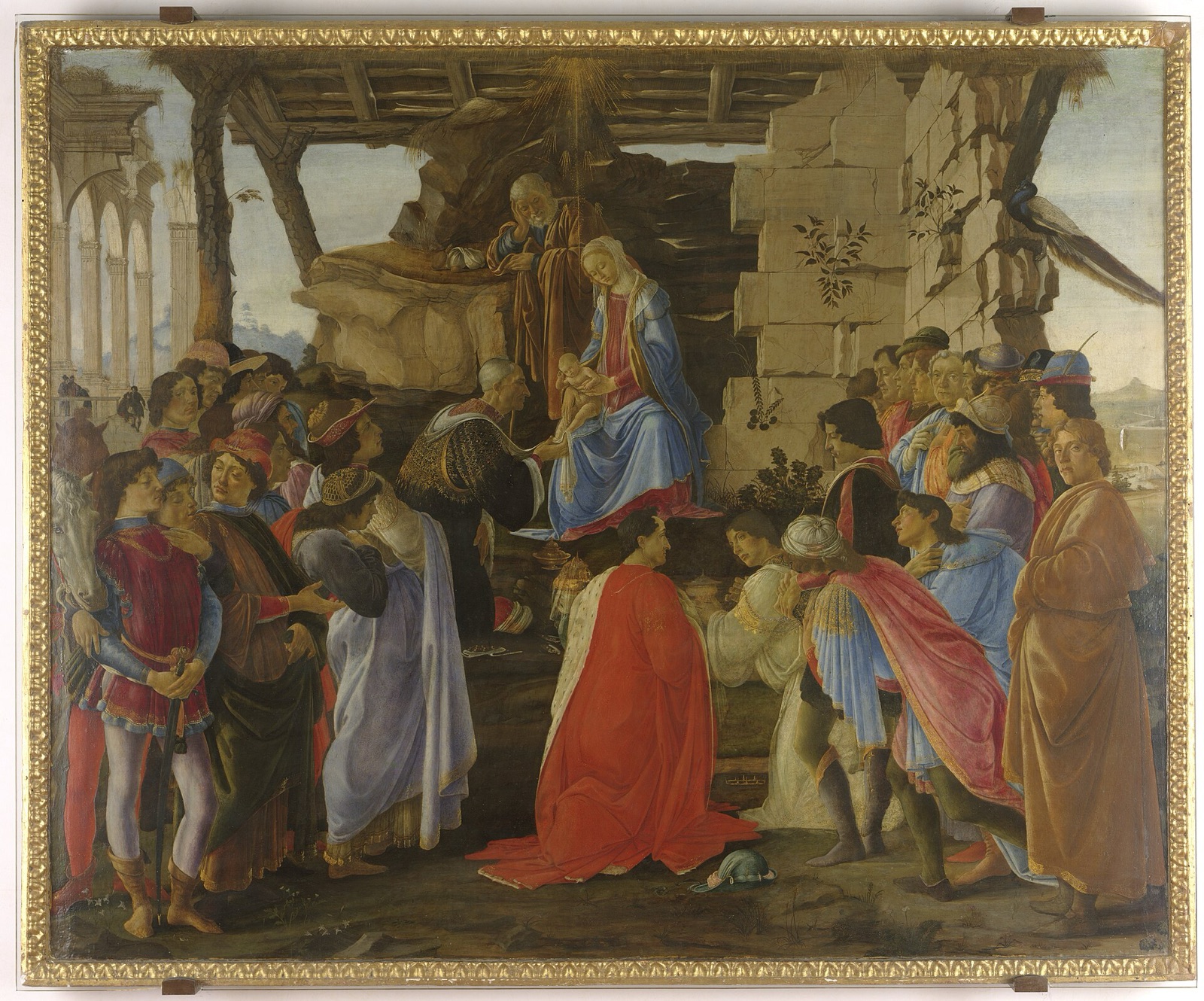
The Uffizi’s Adoration of the Magi demonstrates how closely sacred art, patronage, portraiture, and Medici identity could overlap.
Adoration of the Magi — about 1470–1475
The Uffizi dates Botticelli’s Adoration of the Magi to about 1470–1475.
The patron was Gaspare di Zanobi del Lama, a Florentine businessman who founded a chapel dedicated to the Magi in Santa Maria Novella.
Botticelli turns the biblical scene into something that also resembles a gathering of contemporary Florence.
Mary and Christ occupy the center.
The Magi approach in reverence.
Around them stands a large crowd.
According to Vasari and later interpretation, several members of the Medici family appear among the worshippers.
The Uffizi identifies Cosimo the Elder and his sons Piero and Giovanni among the traditional portrait identifications and notes possible images of Lorenzo the Magnificent and Giuliano de’ Medici.
These identifications should still be described as traditional or probable rather than treated as photographic certainty.
The patron himself appears among the figures.
Botticelli may also have inserted his own likeness as a young blond man looking outward toward the viewer.
The painting gave Botticelli major visibility.
The Uffizi emphasizes the variety of poses and the quality of the portraiture.
It also reveals something important about Florentine patronage.
The subject is Christian.
The social world surrounding the Holy Family is unmistakably Florentine.
The Medici connection does not replace the sacred theme.
The two systems coexist.
That layering of biblical history, contemporary identity, civic ritual, and family prestige is characteristic of Renaissance culture.
Rome and the Sistine Chapel
By the early 1480s, Botticelli’s reputation extended far beyond Florence.
Pope Sixtus IV brought a group of leading Florentine painters to Rome to decorate the newly built Sistine Chapel.
The Vatican Museums identify the team as including Botticelli, Pietro Perugino, Domenico Ghirlandaio, and Cosimo Rosselli together with their workshops.
The campaign began in 1481 and was completed in 1482.
Botticelli contributed major scenes from the lives of Moses and Christ as well as papal portraits.
The Temptations of Christ is among the best known.
The Roman commission demonstrates the level of Botticelli’s professional standing.
This was not a small private commission.
It was a monumental fresco program tied directly to papal authority and one of the most important sacred spaces in Rome.
The project also placed Botticelli beside other major painters of his generation.
After returning to Florence, he entered the period in which the mythological paintings now most associated with his name were produced.
Primavera — about 1480
The Uffizi dates Primavera to around 1480.
Nine mythological figures move across a flower-filled meadow in front of a dark grove of orange and laurel trees.
At the right, Zephyr seizes the nymph Chloris.
Flowers emerge from her mouth as she is transformed into Flora, goddess of spring and flowering.
At the center stands Venus.
Cupid flies above her.
At the left, the Three Graces dance while Mercury touches a cloud with his staff.
The figures can be identified with reasonable confidence.
The total meaning remains much more difficult.
The Uffizi itself describes the complex interpretation as mysterious while broadly connecting the painting with love, peace, and prosperity.
That is an important scholarly limit.
Primavera has generated interpretations involving marriage, fertility, seasonal renewal, classical poetry, humanism, Neoplatonic philosophy, Medici politics, and specific literary sources.
Some of these approaches are valuable.
No single explanation has become universally accepted.
The work’s documented setting provides useful context.
By the end of the fifteenth century, Primavera was in the Via Larga residence of the heirs of Lorenzo di Pierfrancesco de’ Medici.

It hung above a lettuccio, a kind of combination chest and daybed used in elite Renaissance homes.
The painting therefore belonged to a domestic environment.
It was not originally created as an isolated museum masterpiece.
That matters when considering scale, subject, and meaning.
The viewer should begin with what can be seen.
The figures appear unusually light.
They do not occupy the meadow with the physical weight of sculpture.
Their feet seem barely connected to the ground.
The Three Graces form a moving chain through hands, arms, and transparent fabric.
Flora’s patterned dress becomes almost continuous with the flowers around her.
Zephyr enters from the right as a colder and more forceful presence.
Venus occupies a calm opening in the grove.
Botticelli organizes the painting through rhythm.
The figures are not simply placed in space.
Their contours create the space.
This is why line matters so much.
Movement is carried through outlines before it is carried through anatomy.
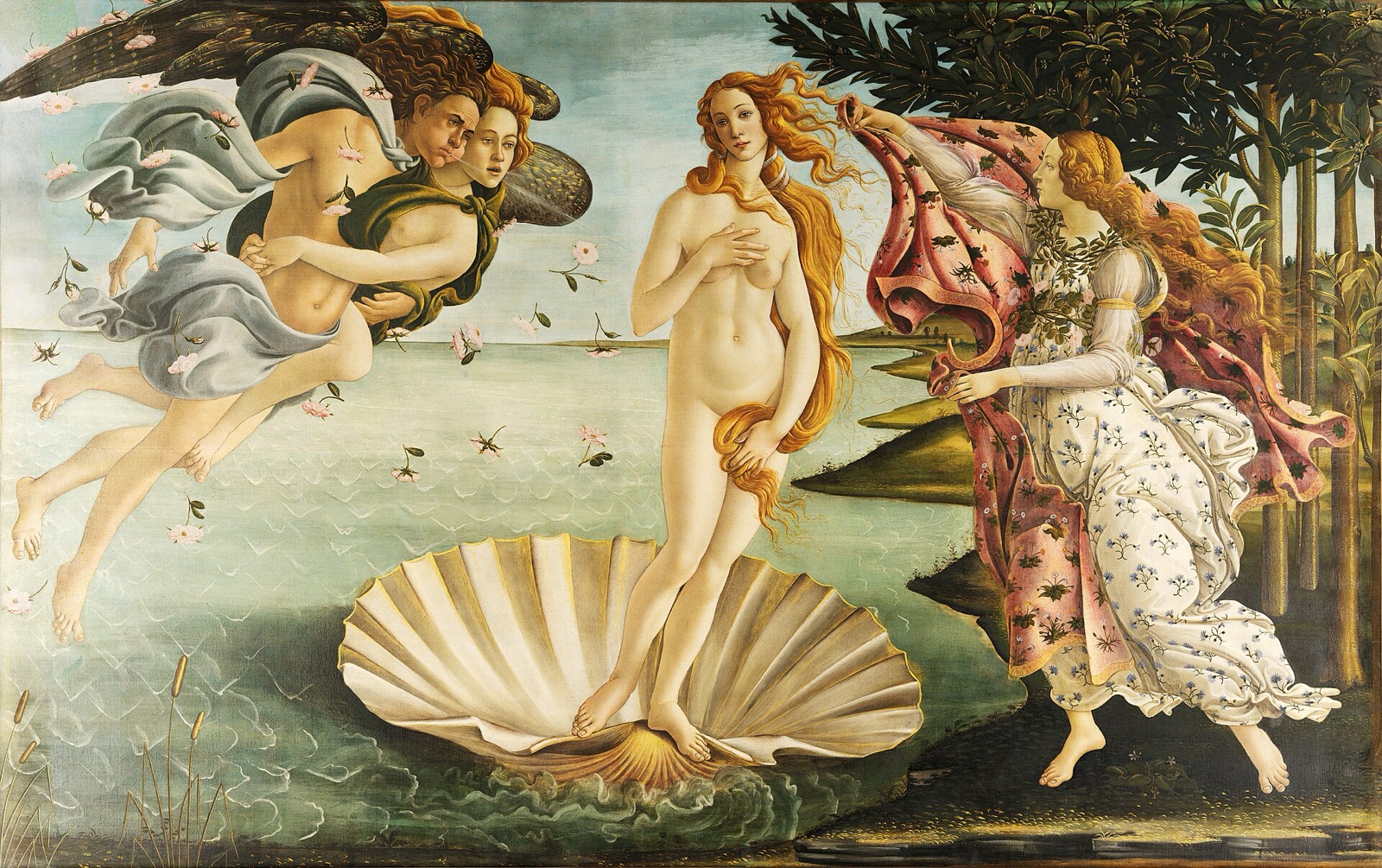
The Birth of Venus — about 1485
The Uffizi dates The Birth of Venus to around 1485.
The familiar title is slightly misleading.
Botticelli does not show the moment of Venus’s birth.
He shows the goddess arriving on the island of Cyprus after emerging from the sea.
Venus stands on a shell.
At the left, Zephyr and a companion blow her toward shore.
At the right, a female figure—often identified as a Hora of spring—steps forward with a flowered cloak.
Roses cross the air.
The subject celebrates Venus as a figure of beauty and love.
The Uffizi notes that Agnolo Poliziano’s poetry may have helped shape the theme.
Classical art also supplied important visual models.
Venus assumes a modest pose related to ancient sculpture.
The flying Winds draw on an antique motif.
Botticelli therefore creates a Renaissance image of antiquity rather than attempting an archaeological reconstruction.
The painting’s patronage remains partly uncertain.
The Uffizi considers a Medici-family commission highly probable but notes that there is no written record of the painting before Vasari described it at the Medici villa of Castello in 1550.
That distinction is important.
“Probably Medici” is not the same as “documented commission from Lorenzo the Magnificent.”
The support also deserves attention.
Unlike Primavera, which is painted on wood, The Birth of Venus is painted on canvas.
Canvas was often used for decorative works in noble domestic settings.
The painting’s physical character therefore supports its connection to elite residential decoration.
Venus’s body is one of Botticelli’s clearest demonstrations of expressive distortion.
Her neck is unusually long.
Her shoulders slope.
Her stance is difficult to reconcile with ordinary balance.
Her left side seems elongated.
These are not useful reasons to dismiss the work as anatomically weak.
The distortions contribute to elegance.
Botticelli is not building a sculptural body in the manner later associated with Michelangelo.
He is building an ideal figure from contour.
Hair becomes pattern.
The edge of the body becomes rhythm.
Wind pushes toward Venus from one side.
The attendant pulls movement toward her from the other.
Venus remains the still axis between those opposing forces.
The painting works because motion and stillness exist together.
Venus and Mars — about 1485
The National Gallery dates Venus and Mars to about 1485.
The painting probably had a domestic and marital function.
Its long horizontal format suggests that it may have been a spalliera, a decorative panel incorporated into the furnishing of an elite interior.
Venus sits awake and composed.
Mars sleeps heavily.
Four small satyrs play with his armor and weapons.
One blows a conch shell near his ear without waking him.
The joke is immediate.
The god of war is defenseless.
The goddess of love remains alert.
The National Gallery summarizes the visual theme simply: love has conquered war.
The painting also belongs to Renaissance marriage culture.
Classical mythology could provide entertainment, erotic suggestion, moral allegory, and learned reference within the same domestic object.
The National Gallery notes the period belief that looking at beautiful male bodies might influence the sex of future children.
That belief sounds strange to modern viewers.
It reminds us that Renaissance pictures lived within systems of thought very different from ours.
What to Look for in a Botticelli Painting
Start with the outline.
Follow the edge of a face.
The curve of a neck.
The movement of hair.
The path of a veil.
The shape of fingers.
The line often carries more emotional information than shading.
Then look at fabric.
Botticelli’s drapery can describe a body, but it can also behave like independent drawing.
Transparent clothing in Primavera almost turns movement itself into visible line.
Look at the feet.
Mythological figures often seem to touch the ground lightly.
This contributes to the sense that they belong partly to another world.
Watch hands and gestures.
Hands bless, pursue, defend, receive, dance, pray, and reach.
Botticelli can build relationships between figures through gesture before the viewer fully understands the narrative.
Study the faces.
Ideal figures often share long eyes, narrow mouths, elongated noses, pale skin, and an inward or melancholy expression.
Compare those faces with individualized portraits in the Adoration of the Magi.
Notice the relationship between anatomy and contour.
Botticelli may distort the body when a longer line produces greater elegance.
Anatomical naturalism is not always his highest priority.
Then compare early, mature, and late work.
The graceful mythological Botticelli is only one part of the career.
Late religious works can become more compressed, urgent, hierarchical, and emotionally tense.
The line remains.
Its emotional purpose changes.
Religious Painting Never Disappeared
Botticelli’s mythological masterpieces can create the false impression that he temporarily abandoned Christian art during his mature years.
He did not.
Religious painting remained central across his career.
He produced Madonnas, altarpieces, biblical scenes, saint narratives, and private devotional works before, during, and after the period of Primavera and Venus.
This matters when discussing his later relationship with Savonarola.
The change of the 1490s was not a clean move from pagan imagery to Christian imagery.
Botticelli had always worked in Christian subjects.
What changed was often the emotional temperature.
The later works can feel more urgent.
Spatial harmony can become less important.
Symbolic hierarchy can replace naturalistic scale.
Apocalyptic imagery becomes stronger.
These changes occurred while Florence itself was undergoing extraordinary political and religious disruption.
Florence in Crisis
The world surrounding Botticelli changed sharply during the 1490s.
Lorenzo the Magnificent died in 1492.
Piero de’ Medici was expelled in 1494.
French troops entered Italy.
The Florentine political order became unstable.
Girolamo Savonarola, a Dominican preacher, gained enormous influence.
Savonarola condemned corruption, luxury, sexual immorality, and what he saw as excessive attachment to worldly display.
His sermons frequently used prophetic and apocalyptic language.
Florence experienced the Bonfires of the Vanities, in which luxury goods, cosmetics, books, decorative objects, and some images were publicly destroyed.
Botticelli’s exact personal relationship with Savonarola is difficult to reconstruct completely.
Vasari later described him as a follower.
The National Gallery believes the spiritual and political climate of Botticelli’s later work is consistent with Savonarola’s influence.
The Metropolitan Museum similarly connects late Saint Zenobius paintings with the austere and urgent religious atmosphere of the period.
The Uffizi’s current Botticelli installation also presents late works such as Calumny of Apelles within the tumultuous world of Savonarolan Florence and Botticelli’s spiritual crisis.
What should not be presented as established fact is the dramatic story that Botticelli personally threw his own mythological paintings into Savonarola’s bonfires.
That story is widely repeated.
Secure contemporary documentation proving the act has not been established.
A responsible biography should therefore distinguish between two claims.
Botticelli appears to have been deeply affected by the religious and political climate associated with Savonarola.
Botticelli burning his own masterpieces remains unproven.
The difference matters because memorable legends can easily become false certainty.
Mystic Nativity — 1500
The National Gallery dates Mystic Nativity to 1500.
It is one of the clearest works through which to understand Botticelli’s late transformation.
The subject is the birth of Christ.
Mary kneels before the infant.
Joseph sits nearby.
The Magi and shepherds approach.
But the painting does not behave like a conventional Renaissance Nativity.
Above, a golden opening reveals heaven.
Angels circle in the sky.
In the foreground, angels embrace human figures.
Small demons flee into cracks in the earth.
An inscription refers to the “troubles of Italy.”
The National Gallery connects the text with the French invasions, civil conflict, the Book of Revelation, and Savonarola’s apocalyptic preaching.
The scale is unusual.
Mary is enormous relative to surrounding figures.
Space feels compressed.
Naturalistic perspective is less important than spiritual hierarchy.
This has sometimes been interpreted as evidence that Botticelli’s late art declined.
That conclusion misses the pictorial purpose.
Mystic Nativity deliberately looks different from a calm, mathematically ordered Renaissance space.
The image is urgent.
Heaven has opened.
Demons are fleeing.
Angels and humans embrace.
History seems close to an ending.
The distorted scale communicates a world in which spiritual significance is more important than optical consistency.
Botticelli looks backward toward older devotional systems in order to address contemporary crisis.
That archaism is expressive.
It is not simply failure.
Dante and the Power of Drawing
Botticelli’s relationship with literature extended beyond mythological painting.
He also designed images connected with Dante’s Divine Comedy.
A Florentine edition of Dante published in 1481 included engravings based on Botticelli designs.
Later, Botticelli produced an extraordinary series of drawings devoted to the poem.
These works demonstrate the strength of his imagination even when color is removed.
Hell requires complicated spatial descent.
Purgatory requires upward movement.
Paradise becomes increasingly spiritual and abstract.
Botticelli had to organize repeated episodes, landscapes, architecture, and figures across long visual sequences.
Line became the primary tool.
That makes the Dante drawings especially valuable for understanding the paintings.
Botticelli thinks graphically.
Even in Primavera, color is often secondary to contour.
The drawings reveal that underlying structure without distraction.
Later Workshop Production
Botticelli’s workshop remained active as his personal style changed.
Popular devotional compositions continued to be produced.
Assistants adapted cartoons.
Tondi remained in demand.
National Gallery research on workshop paintings confirms repeated designs and varying levels of quality.
This continuity challenges the dramatic image of Botticelli abandoning artistic production after falling under Savonarola’s influence.
The workshop economy did not simply stop.
Instead, Botticelli’s position changed within a larger artistic world.
A younger generation was redefining what ambitious painting could look like.
Leonardo explored atmosphere, anatomy, and psychological unity.
Michelangelo pushed the human body toward unprecedented monumentality.
Raphael developed a new synthesis of grace, space, and figure composition.
Against these developments, Botticelli’s elongated contours and deliberately linear elegance could increasingly look connected with an earlier Florentine moment.
That does not mean he became irrelevant overnight.
It means the standard of artistic innovation changed around him.
Decline, Death, and the Problem of Vasari
Botticelli died in Florence in 1510.
Later descriptions of his final years often depend heavily on Vasari.
Vasari presents an image of declining fortunes, melancholy, and physical difficulty.
Some aspects may preserve genuine memory.
Others are difficult to verify independently.
A modern biography should therefore resist turning Botticelli’s last years into an overly dramatic morality tale.
His reputation certainly changed.
The artistic culture of Florence had moved toward Leonardo, Michelangelo, Fra Bartolomeo, Raphael, and new forms of monumental High Renaissance painting.
Botticelli’s style could seem old-fashioned by comparison.
His workshop production and surviving commissions nevertheless show that the story is more complicated than sudden disappearance.
The larger transformation came after his death.
A Reputation Lost and Rebuilt
Botticelli’s broader fame declined substantially in the centuries after 1510.
His name did not disappear completely.
His works survived in collections, churches, and villas.
But he no longer occupied the central position he holds today.
The nineteenth century changed that.
Collectors, scholars, critics, and artists began looking again at early Florentine painting.
The linear elegance, melancholy faces, decorative rhythm, and poetic strangeness of Botticelli became newly attractive.
British artists and collectors played a particularly important role.
National Gallery workshop records document the renewed interest directly.
Nineteenth-century artists came to study and copy Botticelli workshop paintings and their tempera technique.
The Pre-Raphaelites and related artists found qualities in Botticelli that High Renaissance standards had encouraged earlier viewers to undervalue.
His difference became his strength.
That revival helped create the modern Botticelli.
Primavera and The Birth of Venus gradually became global icons.
They entered books, reproductions, advertising, cinema, fashion, graphic design, and popular culture.
Their fame now creates a new challenge.
The images are so familiar that they can become invisible.
People recognize Venus without actually examining the painting.
Botticelli’s Line Across a Changing Florence
Botticelli matters because he shows that Renaissance art never moved along one inevitable road toward greater realism.
Perspective,
anatomy,
volume,
and physical weight
were major Renaissance achievements.
Botticelli knew that world.
He did not make it his only goal.
His greatest paintings often prioritize the expressive force of line.
In Primavera, the Graces dance through contour.
In The Birth of Venus, hair becomes movement.
In Venus and Mars, sleeping and waking bodies create a long decorative rhythm.
In Mystic Nativity, unstable scale becomes a language of religious urgency.
This is why Botticelli can look both Renaissance and strangely outside the Renaissance at the same time.
His art connects several cultural worlds.
Christian devotion and classical mythology.
Workshop production and elite patronage.
Medici culture and papal Rome.
Humanist poetry and popular domestic images.
Graceful mythological fantasy and late apocalyptic religion.
The political confidence of Medici Florence and the anxiety of Savonarola’s Florence.
His career becomes most interesting when these worlds are kept together.
The Birth of Venus does not cancel the Madonnas.
Primavera does not cancel Mystic Nativity.
Savonarola does not explain every late painting.
Medici patronage does not explain every mythological image.
The workshop does not make the master irrelevant.
Botticelli’s importance lies in the way his line adapts to all of these situations.
Sometimes it creates beauty.
Sometimes it creates movement.
Sometimes it creates tenderness.
Sometimes it creates anxiety.
Across the entire career, line is not simply the edge of a form.
It is the form of thought.
Sources & further reading
- Uffizi Galleries — Botticelli works and research
- National Gallery, London — Sandro Botticelli biography
Image credits and public-domain source records appear beneath each image.