Salvador Dalí
Salvador Dalí combined recognizable objects with unsettling transformations. His paintings, films and other works made him one of the best-known figures associated with Surrealism.
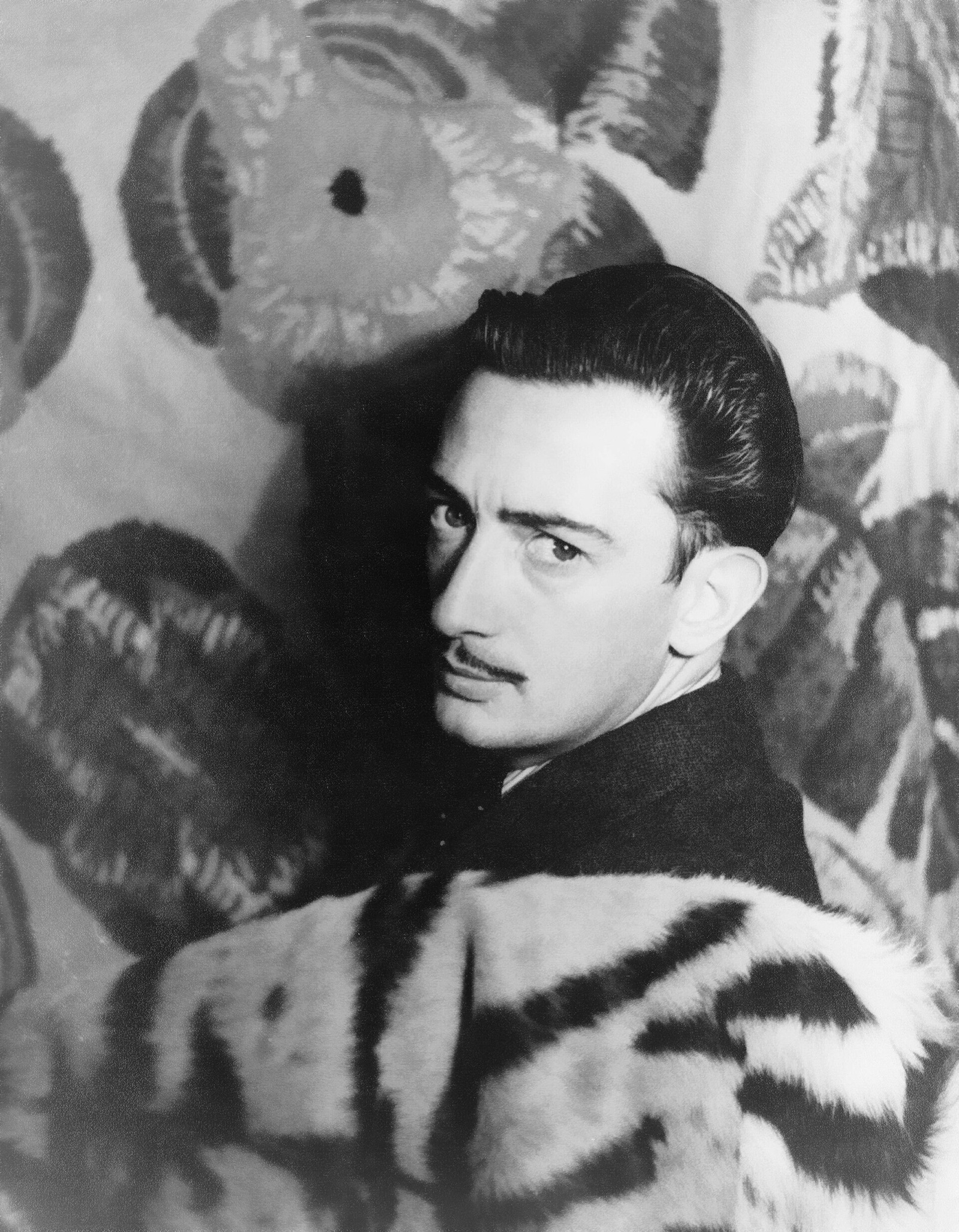

Born: 1904
Died: 1989
Birthplace: Figueres, Catalonia, Spain
Nationality / cultural identity: Spanish
Art movements / traditions: Surrealism
Salvador Dalí: Life, Surrealism, The Persistence of Memory, and the Reinvention of Reality
Why Dalí Is More Than His Persona
Salvador Dalí became one of the most recognizable artists of the twentieth century by doing something few painters had attempted so aggressively: he turned both his paintings and his public identity into works of construction.
The melting clocks, upturned mustache, theatrical interviews, staged photographs, provocative statements, and flamboyant appearances became inseparable from the name Dalí. That fame made him extraordinarily visible. It also created a problem.
The public persona can overwhelm the art.
Dalí was not simply an eccentric who happened to paint strange pictures. He was a technically ambitious artist deeply engaged with Renaissance painting, Vermeer, Velázquez, Raphael, Leonardo, modern science, psychoanalysis, film, photography, theater, fashion, sculpture, design, and the possibilities of mass media.
His strongest paintings depend on a deliberate contradiction.
The subject is impossible.
The technique is convincing.
A clock bends as if it were soft flesh, but its face, hands, shadow, and metal case remain meticulously rendered. A landscape becomes a human profile without losing its identity as landscape. A face breaks into floating spheres yet remains instantly recognizable. A crucified body is presented from a viewpoint that could not exist in ordinary experience, yet the illusionistic painting makes the vision feel physically present.
Dalí understood that fantasy becomes more disturbing when it looks real.
That idea connects the different stages of his career more strongly than any single image or movement label.
Figueres, Cadaqués, and the Catalan Landscape
Salvador Dalí i Domènech was born in Figueres, Catalonia, Spain, in 1904.
His father was a notary, and Dalí grew up in a relatively comfortable household.
From an early age he drew and painted.
The landscape of northeastern Catalonia became one of the permanent foundations of his visual imagination.
Figueres was the city of his birth.
Cadaqués and the nearby Cap de Creus coastline offered another world: hard light, dry earth, eroded rocks, coves, cliffs, and a sharp division between land and Mediterranean water.
These places never disappeared from his paintings.
Even when his imagery became completely irrational, the setting could remain recognizable.
The distant rocky cliffs in The Persistence of Memory, for example, are not generic dream scenery. They are rooted in the Catalan coast Dalí knew.
This is a useful principle for looking at his work.
The fantasy often begins from something observed.
Rock becomes body.
Landscape becomes profile.
Architecture becomes flesh.
The familiar world remains visible even after ordinary logic collapses.
Madrid, the Academy, and the Avant-Garde
Dalí moved to Madrid in 1922 to study at the Real Academia de Bellas Artes de San Fernando.
His years there were important for reasons that went far beyond academic instruction.
He lived at the Residencia de Estudiantes, an intellectual center where he became close to poet Federico García Lorca and filmmaker Luis Buñuel.
Painting entered into conversation with poetry, film, literature, theater, and modern intellectual life.
Dalí’s relationship with formal education was turbulent.
The Gala-Salvador Dalí Foundation records an expulsion in 1923 and a final expulsion in 1926.
That instability did not mean he lacked technical discipline.
The opposite is more accurate.
Dalí became increasingly fascinated by both old-master craft and the rapidly changing languages of modern art.
During the 1920s he experimented with Cubism, Futurism, Metaphysical painting, Purism, Dada, and other avant-garde tendencies while continuing to study historical art.
He met Pablo Picasso during a trip to Paris in 1926.
Joan Miró helped connect him more directly with the Surrealist circle.
By the end of the decade, Dalí had developed a visual language that no longer looked like an experiment borrowed from someone else.
It looked unmistakably like Dalí.
Film and the Destruction of Ordinary Narrative
Film was central to Dalí’s emergence as a Surrealist.
He collaborated with Luis Buñuel on Un Chien Andalou, released in 1929.
The film rejects conventional narrative logic.
Images do not develop through ordinary cause and effect.
They collide.
A razor approaches an eye.
Bodies and objects transform.
Hands, animals, sexuality, violence, desire, and absurdity appear through abrupt visual association.
The importance of the film is not simply that it shocked viewers.
Cinema allowed Dalí and Buñuel to do something painting could not do in the same way.
One image could become another through editing.
Time could be broken.
Scale could change instantly.
Objects that had no logical relationship could be forced together.
The experience of watching could be made unstable.
Dalí also worked with Buñuel on L’Âge d’or in 1930.
These projects belong directly beside his paintings of the same period.
Surrealism was not just a style of canvas.
It was a way of attacking ordinary habits of seeing and interpreting.
The Dalí Foundation describes film as one of the fields in which Dalí understood the power of mass communication unusually early.
That insight stayed with him throughout his career.
Gala and the Transformation of Dalí’s Life
Dalí met Gala in Cadaqués in 1929.
Born Elena Ivanovna Diakonova, she was then married to the poet Paul Éluard and already belonged to the international Surrealist world.
The meeting became one of the major turning points in Dalí’s life.
The Foundation timeline places the beginning of their shared life around 1930.
They married civilly in 1934.
Gala became partner, model, organizer, collaborator, recurring artistic subject, and a central presence in Dalí’s public and private career.
Calling her simply a muse is inadequate.
Her face appears repeatedly in his art.
Sometimes she is recognizably herself.
Sometimes she becomes a mythological figure.
Sometimes she becomes Madonna-like.
Sometimes her face is broken into atomic structures or transformed by optical systems.
Dalí continually returned to Gala in much the same way he returned to the Catalan landscape.
The underlying subject remained recognizable.
The conceptual system around it changed.
The Great Masturbator — 1929
The Great Masturbator is one of the crucial paintings in Dalí’s emergence as a mature Surrealist.
Museo Reina Sofía dates it to 1929.
The center of the composition is dominated by a huge distorted form derived partly from Dalí’s own profile.
This head-like shape became one of his recurring personal motifs.
Around it appear sexual imagery, a grasshopper, figures, rock-like forms, and fragments that seem to emerge from one another.
Reina Sofía connects the work with Dalí’s fears, desires, and the emotional transformation associated with meeting Gala.
That biographical context is useful.
The painting should not be treated as a literal diary.
Dalí turned autobiography into imagery rather than simply illustrating events.
The most important visual feature is the contradiction between content and technique.
The imagery is irrational.
The painted space is coherent.
Objects cast shadows.
Surfaces appear tangible.
The dry landscape recedes through conventional perspective.
Dalí paints psychic instability using the language of precision.
This becomes one of the defining strategies of his Surrealist work.
Joining the Surrealists
Dalí formally entered the Paris Surrealist group around 1929.
Surrealism had grown from the intellectual world surrounding André Breton and sought ways to move beyond conventional rational control.
Freud’s theories of dreams and the unconscious had enormous influence.
Surrealist writers and artists investigated automatic writing, dream imagery, desire, chance, irrational association, and the unstable boundaries between conscious and unconscious thought.
Dalí fit the movement while also changing it.
His pictures did not usually look spontaneous.
They looked calculated.
That distinction mattered.
Dalí used painstaking illusionistic technique to give the irrational a physical presence.
A dream did not have to appear cloudy or vague.
It could look as exact as a laboratory specimen.
The Paranoiac-Critical Method
Dalí’s most important theoretical contribution to Surrealism became known as the paranoiac-critical method.
The idea developed across the early 1930s.
The Dalí Foundation connects the method with his writings around La femme visible in 1930 and with the increasing use of multiple images.
More recent MoMA scholarship notes that the terminology itself developed over time and that the full phrase “paranoiac-critical” appears in the early 1930s rather than arriving fully formed at one exact moment.
The method should not be described as evidence that Dalí suffered from psychosis.
It was an artistic strategy.
Dalí wanted to cultivate a form of unstable perception.
One image could contain another.
A landscape could also be a face.
A cluster of figures could become a larger figure.
A rock could turn into an animal or body.
Seeing became reversible.
The viewer had to participate.
Once the second image appeared, the first image became difficult to see innocently again.
That is why double images are central to Dalí’s art.
They make vision itself unreliable.
The paranoiac-critical method also explains why technical precision mattered.
A double image only works when each reading remains convincing.
The irrational depends on control.
The Persistence of Memory — 1931
The Persistence of Memory is Dalí’s most famous painting and one of the defining images of twentieth-century Surrealism.
MoMA dates it to 1931.
The painting is physically small—about twenty-four by thirty-three centimeters.
Its psychological space feels enormous.
Several watches have become soft.
One hangs from a barren branch.
Another collapses over a rectangular ledge.
A third drapes across a strange fleshy form that resembles a distorted version of Dalí’s own profile.
A closed watch is covered with ants.
In the distance, the Catalan cliffs remain sharply defined.
The painting is built around contradictions.
Hard objects become soft.
Mechanical devices become organic.
Metal appears vulnerable to decay.
A landscape associated with permanence surrounds instruments designed to measure time, yet the instruments themselves lose their stable form.
The technical control intensifies the strangeness.
The watches remain recognizable as watches.

Their numbers, hands, edges, and shadows are carefully rendered.
They simply obey impossible physical laws.
Dalí later told the famous story that melting Camembert cheese inspired the soft watches.
MoMA’s recent research treats that account cautiously.
The story comes from The Secret Life of Salvador Dalí, written about a decade after the painting and explicitly characterized by the museum as a self-mythologizing autobiography.
Technical examination also suggests a more deliberate painting process than Dalí’s later tale of sudden inspiration implied.
This distinction is important.
Dalí’s explanation is historically interesting because it shows how he wanted the painting remembered.
It is not the same thing as neutral documentation.
The painting is more powerful when it is allowed to remain larger than one anecdote.
The Artist as Self-Invention
Dalí understood very early that an artist could create a public image as carefully as a painting.
This became one of the most controversial aspects of his career.
His appearance changed.
His mustache became iconic.
He cultivated theatrical public behavior.
He produced memorable statements.
He staged photographs.
He wrote autobiographies, manifestos, essays, fiction, and promotional material.
He became both an artist and the character “Dalí.”
The Foundation’s material on his written work shows how extensive this self-construction was.
His 1942 autobiography, The Secret Life of Salvador Dalí, is one example among many.
This does not mean everything Dalí wrote about himself should be dismissed.
It means autobiographical claims need to be read as part of an artistic performance.
Dalí was not merely remembering his life.
He was shaping the story of his life.
For a modern reader, one of the most useful distinctions is therefore between documentary biography, the public persona, and the autobiographical mythology Dalí created around himself.
They overlap.
They are not identical.
What to Look for in a Dalí Surrealist Painting
Begin with the landscape.
Dalí frequently places impossible events inside dry, open environments rooted in Catalonia.
Look for low horizons, rocky forms, empty ground, distant cliffs, hard sunlight, and long cast shadows.
The realistic setting makes the impossible event more convincing.
Then look for repeated motifs.
Ants, grasshoppers, eggs, crutches, drawers, bread, soft objects, hard stones, elongated limbs, distorted faces, and fragmented bodies recur throughout the work.
Do not assume each symbol has one permanent meaning.
Dalí reused images in different contexts.
Look for double images.
Stand back.
Move closer.
Ask whether one form can become another.
The unstable reading is often the point.
Watch the relationship between hard and soft.
Dalí repeatedly transforms solid material.
Clocks melt.
Bodies stretch.
Architecture becomes flesh.
Stone becomes organic.
Later, matter breaks into particles.
Notice how traditional the painting can look technically.
Precise edges, careful perspective, believable shadows, smooth modeling, and atmospheric distance support completely impossible events.
That tension is deliberate.
Finally, recognize autobiography without turning the painting into a literal confession.
Dalí used his own profile, fears, desires, Gala, childhood landscapes, and recurring personal imagery.
He also invented stories about himself.
The art should be treated as evidence of artistic construction rather than transparent testimony.
Soft Construction with Boiled Beans — 1936
Soft Construction with Boiled Beans (Premonition of Civil War) is one of Dalí’s most violent paintings.
The Gala-Salvador Dalí Foundation dates it to 1936.
A gigantic distorted body tears itself apart.
Hands and feet swell to unnatural scale.
Limbs twist into a structure that is simultaneously human, architectural, and monstrous.
A tiny figure appears beneath the enormous body.
The scale difference turns bodily violence into something almost geological.
The familiar subtitle connects the work to the Spanish Civil War.
The self-destroying body becomes an image of collective conflict.
The figure is both aggressor and victim.
Its own anatomy is the mechanism of destruction.
Even the title has a complicated history.
The Foundation catalogue raisonné notes evidence that an early title referred to boiled apricots rather than boiled beans and suggests that the familiar wording may reflect a later translation confusion.
The standard title is firmly established today.
The title history is still worth knowing.
It reminds viewers that artwork titles are not always timeless facts.
The painting itself remains visually direct.
Political catastrophe is translated into bodily disintegration.
Conflict with the Surrealists
Dalí became one of Surrealism’s most visible artists.
That success did not guarantee harmony with the group.
His relationship with André Breton and other Surrealists deteriorated during the 1930s.
The reasons were complex.
Political disagreements played a major role.
So did Dalí’s provocative public positions.
His willingness to enter commercial culture and his increasingly independent public identity intensified the conflict.
The Dalí Foundation documents an early attempt to expel him in 1934 and the final rupture by 1939.
This history should not be reduced to the popular story that Dalí was expelled simply because he became commercial.
Surrealism was also a political and intellectual movement with expectations about collective alignment.
Dalí increasingly refused those boundaries.
The break created another paradox.
Dalí could be expelled from the organized Surrealist group while becoming, in the broader public imagination, one of the most famous Surrealists in the world.
Institutional membership ended.
The visual identity remained.
America and the Expansion of Dalí’s Practice
Dalí first traveled to New York in 1934.
The United States became increasingly important to his career.
During World War II, Dalí and Gala lived in the United States from 1940 until their return to Portlligat in 1948.
The American period expanded the scale of his public activity.
Painting remained central.
So did writing, theater, fashion, commercial imagery, photography, jewelry, and film.
The Dalí Foundation describes him as a “total artist” whose practice moved across painting, graphic work, sculpture, drawing, writing, film, and fashion.
This was not a late accident.
Dalí understood mass media unusually early.
Film was especially important.
In 1945 he worked with Alfred Hitchcock on the dream sequence for Spellbound.
In 1946 he collaborated with Walt Disney on Destino.
The Foundation describes cinema as a medium Dalí recognized for both artistic and mass-cultural possibilities.
This willingness to move between museum art and popular media contributed heavily to accusations of commercialism.
Dalí did not accept the idea that serious art had to avoid publicity.
He treated publicity as another space in which images could operate.
That decision made him one of the most famous artists of his century.
It also made his reputation permanently contentious.
A Gradual Turn Toward Classicism
Dalí’s postwar transformation is often described as though Surrealism ended one day and classical painting began the next.
The Dalí Foundation’s own account is more nuanced.
It says that no single moment can be identified as an explicit renunciation of Surrealism.
The change happened gradually.
During the 1940s, Dalí increasingly emphasized Renaissance and Baroque masters.
Vermeer, Velázquez, Raphael, Leonardo, and others became explicit reference points.
His 1948 book 50 Secrets of Magic Craftsmanship celebrated traditional technique and named several of those artists among his principal models.
The visual world also changed.
Classical architecture appeared.
Religious subjects returned.
Bodies became more idealized.
Geometric order became increasingly important.
Yet Surrealist habits did not disappear completely.
Dalí continued to transform bodies, destabilize matter, construct impossible spaces, and use double imagery.
The framework changed.
The underlying fascination with unstable reality remained.
Nuclear Mysticism
The atomic age gave Dalí a new conceptual language.
The use of atomic bombs in 1945 transformed public understanding of matter.
Solid objects were no longer conceptually solid.
Matter could be divided into particles and energy.
Dalí found this idea extraordinarily powerful.
The Foundation describes the resulting phase as nuclear mysticism: a synthesis of nuclear physics, Catholic religion, classical painting, geometry, and Dalí’s own visual language.
His 1951 Mystical Manifesto articulated the new direction.
The combination can seem contradictory.
Science and religion are often treated as opposing systems.
Dalí wanted them inside the same picture.
Atomic disintegration and spiritual transcendence could become visually related.
Bodies could separate into particles without disappearing.
Geometry could organize sacred imagery.
Old-master technique could represent modern physics.
This was not orthodox Surrealism.
It was not a return to conventional religious painting either.
It was another Dalinian hybrid.
Christ of Saint John of the Cross — 1951
Christ of Saint John of the Cross is one of the defining paintings of Dalí’s postwar religious period.
The Foundation places the 1951 work at the beginning of his nuclear-mystical phase.
The composition is immediately unusual.
Christ is viewed from above.
The viewer seems suspended over the crucified body, looking past the cross toward the landscape far below.
The perspective is not the traditional frontal view of the Crucifixion.
Dalí reorganizes Christian imagery through geometry and an impossible vantage point.
The body is idealized.
The cross seems suspended in darkness.
Below it lies a landscape associated with Portlligat.
This combination is characteristic of mature Dalí.
A sacred subject from European tradition is joined to personal geography.
Historical technique is joined to modern pictorial invention.
Religious imagery is made strange again.
Dalí’s surface remains highly controlled.
At a time when Abstract Expressionism was becoming internationally dominant, he moved in a deliberately different direction.
He defended drawing, illusionistic oil painting, geometry, and historical craft.
Galatea of the Spheres — 1952
Galatea of the Spheres belongs directly to Dalí’s nuclear-mystical period.
The Foundation catalogue dates it to 1952.
Gala’s face appears to be assembled from floating spheres.
The image is immediately recognizable.
It is also fragmented.
The face remains present even as matter separates.
This painting gives viewers one of the clearest comparisons between Dalí’s early and late methods.
In The Persistence of Memory, a mechanical object becomes soft.
In Galatea of the Spheres, a human face becomes particulate.
Both paintings destabilize ordinary physical reality.
The conceptual explanation changes.
The 1931 painting belongs to the language of Surrealism, memory, dreams, and unconscious transformation.
The 1952 painting belongs to atomic structure, geometry, religion, classical technique, and Gala.
Dalí’s precision remains.
That continuity matters more than the change in subject.
He continues asking what happens when a familiar object no longer obeys the physical rules we expect.
Gala as an Artistic Constant
Gala remained one of Dalí’s most important subjects throughout his mature career.
Her role extends far beyond romantic biography.
She helped organize his life and career.
She appeared in paintings.
She became part of his public mythology.
Most importantly for the art itself, her recognizable face provided Dalí with a stable form he could repeatedly transform.
Gala could become Leda.
She could become a Madonna-like figure.
She could become an atomic image.
She could appear as portrait, symbol, sacred figure, or fragmented structure.
In that sense, Gala functions like Dalí’s Catalan landscape.
The subject remains identifiable while the artistic system surrounding it changes.
Following Gala through Dalí’s work is one of the most effective ways to see his development over several decades.
The Dalí Theatre-Museum: A Late Total Artwork
Dalí’s late career culminated in a work too large to be contained by a frame.
The Dalí Theatre-Museum in Figueres developed inside the ruins of the town’s former municipal theater.
Dalí conceived and designed the museum as an immersive environment.
It officially opened in 1974.
The Foundation calls it his most monumental and personal work and describes the building as his largest Surrealist object.
That language is useful because the museum is not simply a container for paintings.
The building itself participates in the art.
Architecture, painting, sculpture, installation, optical effects, objects, decorative systems, theater, and self-curation become one environment.
Dalí controlled relationships among rooms and works.
He treated the visitor’s movement through the building as part of the experience.
The project brings together interests that had existed across his career.
Film had taught him to think about sequences of images.
Theater had taught him to think about sets.
Surrealism had taught him to disrupt ordinary relationships among objects.
Publicity had taught him to think about spectators.
The Theatre-Museum combines all of these.
Its location is equally important.
It stands in Figueres.
Dalí returned late in life to the city where he was born and built an environment designed to control how his art and identity would be encountered.
The artist became his own curator.
Late Years and Final Works
The 1970s brought major retrospectives and institutional recognition.
Dalí continued experimenting with optical systems, stereoscopy, holography, double images, and scientific concepts.
His interest in visual instability did not disappear with age.
Gala died in 1982.
Dalí then spent time at Púbol Castle, which he had previously given her.
The Foundation states that he stopped painting in 1983.
His final works returned again to artists he had admired for decades, including Michelangelo and Velázquez, while also incorporating contemporary mathematical ideas such as catastrophe theory.
After a fire at Púbol in 1984, Dalí moved to the Galatea Tower adjoining the Theatre-Museum.
His health continued to decline.
He died in Figueres in 1989.
His tomb is within the Theatre-Museum.
That final location feels almost inevitable.
The artist who spent his life merging painting, performance, autobiography, spectacle, architecture, and persona was ultimately buried inside the environment he had designed to contain them all.
What to Look for Across Dalí’s Career
Do not look only for weirdness.
Look for continuity.
The Catalan landscape survives from the early paintings into Surrealism and the religious works.
Gala survives as a recognizable presence across multiple styles.
Old-master precision remains important even when the subjects change completely.
Look at matter.
What does Dalí make unstable?
Clocks soften.
Bodies stretch.
Rock becomes flesh.
Faces become landscapes.
Matter separates into particles.
A cross floats in impossible space.
That repeated destabilization is one of the strongest links between different phases.
Look at shadows.
Dalí often uses convincing shadows to persuade you that an impossible object really occupies physical space.
Look at scale.
Tiny figures appear beneath enormous forms.
Small paintings contain psychologically vast landscapes.
Bodies become architectural.
Look for images inside images.
Especially in the 1930s and later optical work, one interpretation often hides inside another.
And compare technique with subject.
Dalí frequently paints the irrational with the discipline of a traditional illusionist.
That contradiction is the heart of his visual language.
Legacy: Surrealism, Spectacle, and the Artist as Media Image
Dalí’s fame is both his legacy and the obstacle to understanding his legacy.
The melting clocks became cultural shorthand.
His mustache became a logo.
The name Dalí became associated with anything bizarre or dreamlike.
That level of recognition is extraordinary.
It can flatten the artist into a caricature.
Dalí’s historical importance is broader.
He was one of Surrealism’s major visual innovators.
His paranoiac-critical method developed new ways of making multiple images and unstable perception central to painting.
His technically precise dream imagery changed the popular appearance of Surrealism.
His collaborations with Buñuel helped define Surrealist cinema.
He treated photography, fashion, theater, objects, jewelry, commercial imagery, and film as legitimate spaces for artistic activity.
His later paintings attempted an unusual synthesis of classical art, Catholic imagery, geometry, and twentieth-century science.
He also understood the power of the artist as media figure with unusual clarity.
Today, artists routinely cultivate public personas across interviews, photography, film, fashion, advertising, social platforms, and branded environments.
Dalí explored many of those possibilities decades earlier.
That does not make every act of self-promotion profound.
It does make the relationship between his art and his celebrity historically important.
Precision in the Service of Doubt
Dalí’s best paintings make the visible world unreliable.
A clock remains recognizable even when it melts.
A face remains recognizable when it breaks into spheres.
A body remains recognizable when it becomes landscape.
A sacred image remains recognizable when its viewpoint becomes physically impossible.
Dalí understood that uncertainty becomes more powerful when recognition is preserved.
If everything were completely abstract, the viewer would have nothing stable to lose.
Dalí gives us stability first.
Then he removes it.
During the Surrealist period, that destabilization came through dreams, desire, memory, fear, double images, and the unconscious.
During the nuclear-mystical period, it came through atomic physics, religion, geometry, and the discontinuity of matter.
The intellectual systems changed.
The artistic question remained remarkably consistent.
How certain are we that reality is what it appears to be?
Dalí spent his career constructing images that make that certainty difficult to maintain.
The great paradox is that he used extraordinary technical control to create visual doubt.
The imagination is unstable.
The paint is precise.
And the viewer is caught between them.
Sources & further reading
- Fundació Gala-Salvador Dalí — Dual Timeline and Dalí: The Total Artist
- Museum of Modern Art — The Persistence of Memory
Image credits and public-domain source records appear beneath each image.