Pierre-Auguste Renoir
Pierre-Auguste Renoir explored light and movement through landscapes and figure painting. His work is closely associated with the color and sociability of French Impressionism.
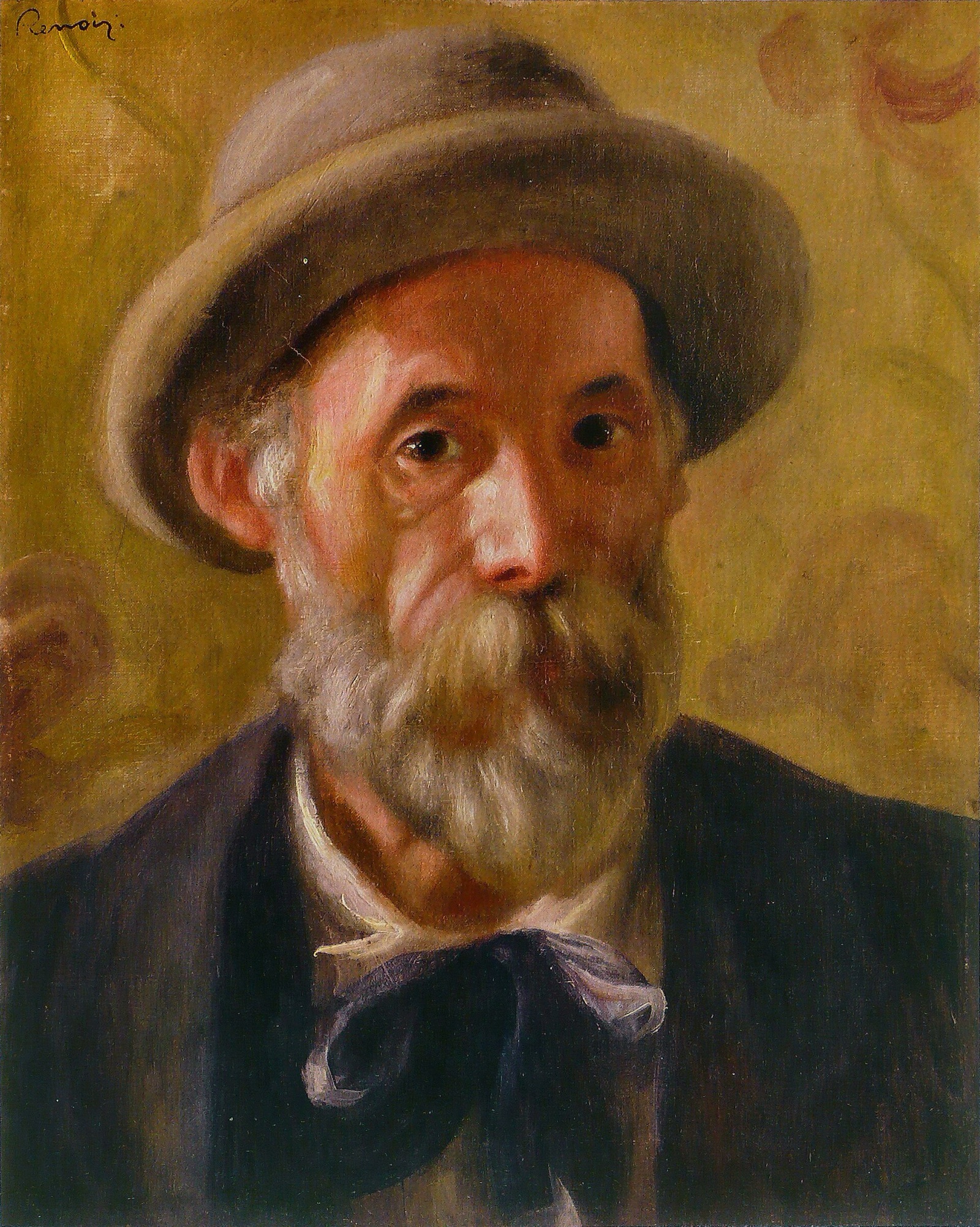

Born: 1841
Died: 1919
Birthplace: Limoges, France
Nationality / cultural identity: French
Art movements / traditions: Impressionism
Pierre-Auguste Renoir: Life, Impressionism, and the Search for Lasting Form
More Than a Painter of Pleasure
Pierre-Auguste Renoir helped create Impressionism, but his career is most interesting when it is not reduced to Impressionism alone.
He is famous for paintings of dancers, cafés, boating parties, gardens, theaters, children, portraits, and luminous figures in outdoor light. Works such as Dance at the Moulin de la Galette and Luncheon of the Boating Party helped define the visual image of modern Parisian leisure in the late nineteenth century.
Yet Renoir eventually became dissatisfied with some of the very methods he had helped make famous.
During the 1880s, he returned to drawing with new intensity, studied the Old Masters, traveled to Italy, strengthened the contours of his figures, and searched for a more permanent kind of structure. The shimmering crowds and broken brushwork of his 1870s paintings gave way to monumental bathers, more sculptural bodies, carefully prepared compositions, and an increasingly classical sense of the figure.
This was not a simple rejection of Impressionism.
Renoir kept its discoveries.
Color remained central.
Light remained active.
Brushwork remained visible.
But he increasingly wanted those qualities to coexist with stronger drawing, firmer form, and the sense that a painting could survive beyond the instant it described.
His career therefore tells a larger story about modern art.
Renoir did not simply invent a new style and repeat it.
He helped create a revolution in painting and then spent decades asking what that revolution had left unresolved.
Early Life: Porcelain, Drawing, and the Louvre
Renoir was born in Limoges, France, in 1841.
His family moved to Paris while he was still a child.
Unlike artists whose professional training began immediately inside an elite academy, Renoir first learned to use a brush through commercial decorative work.
As a teenager, he worked painting designs on porcelain.
The job demanded careful handling of color and paint on a relatively small scale. It was not yet the career of a fine artist, but it gave him practical experience before he entered formal artistic study.
Renoir also received drawing instruction during these years.
By 1860 he had received permission to copy paintings in the Louvre.
Copying the Old Masters was a traditional part of artistic education. It allowed a young painter to study composition, color, figure construction, gesture, drapery, and brushwork directly from established art.
Renoir later entered the École des Beaux-Arts and studied in the private studio of Charles Gleyre.
That studio became one of the decisive environments of his early career because there he met Claude Monet, Alfred Sisley, and Frédéric Bazille.
The friendships formed among these young painters helped create the conditions from which Impressionism emerged.
Painting Outdoors with Monet, Sisley, and Bazille
Renoir and his friends began working outside the formal studio.
They painted in the forest of Fontainebleau and other locations where they could study changing light, landscape, and weather directly.
Renoir, however, remained particularly committed to people.
Figures would stay central to his art even when outdoor light and landscape became increasingly important.
His early paintings still show the influence of established painters.
The Metropolitan Museum of Art has emphasized the effect of Gustave Courbet on Renoir’s early female nudes, including their substantial figures and darker, earthier colors.
Gradually, Renoir’s palette brightened.
His brushwork became more direct.
The decisive moment came in 1869, when Renoir and Monet painted together at La Grenouillère, a popular bathing and boating establishment on the Seine.
La Grenouillère — 1869
Renoir’s La Grenouillère is one of the key early paintings in the development of Impressionism.
Nationalmuseum in Stockholm identifies the 1869 painting campaign shared by Renoir and Monet as a major breakthrough.
The setting itself mattered.
La Grenouillère was not a timeless pastoral landscape.
It was a commercial leisure site used by modern Parisians.
People swam, boated, talked, ate, and gathered beside the water.
The subject belonged to contemporary life.
Renoir and Monet painted the site from related viewpoints, allowing them to test ways of representing the same changing environment.
The technique became part of the experiment.
Water breaks into short strokes of blue, green, white, brown, and reflected color.
Figures are simplified.
Leaves, boats, ripples, sky, and clothing are painted with quick marks rather than smooth academic transitions.
The result appears sketch-like because the sketch-like handling is the point.
Renoir was trying to capture visual conditions that did not remain stable for long.
A reflection changes when the water moves.
A shadow shifts when a cloud passes.
A figure turns.
The sun moves.
Painting had to become faster and more flexible if it was going to preserve those effects.
La Grenouillère therefore shows Renoir learning one of the central lessons of Impressionism:
light does not simply fall on objects.
It changes how objects appear.
Impressionism and Modern Life
During the 1870s, Renoir became one of the central painters associated with the independent group later called the Impressionists.
The group challenged dependence on the official Salon and questioned academic expectations about subject matter, finish, and technique.
Renoir participated voluntarily in the independent exhibitions of 1874, 1876, and 1877.
His relationship with the movement remained more complicated than the word “member” suggests.
Renoir still needed the Salon.
He still wanted portrait commissions.
He still needed patrons.
He did not believe that artistic independence required permanent separation from established exhibition systems.
The Frick Collection has emphasized that Renoir continued to submit work frequently to the official Salon even while taking part in Impressionist exhibitions.
In 1882, twenty-five Renoir paintings appeared in the seventh Impressionist exhibition, but dealer Paul Durand-Ruel had sent them without Renoir’s authorization.
That detail matters because it shows that Renoir’s relationship with Impressionism changed even before his later classical turn became fully visible.
The modern-life paintings of the 1870s remain among his greatest achievements.
Renoir painted people in cafés, theaters, gardens, streets, restaurants, suburban leisure sites, and dance halls.
These are pleasant subjects.
They are also historically specific.
Railways made suburban recreation easier.
New entertainment districts changed Parisian social life.
Fashion became an important visual marker.
Public leisure created new situations in which strangers could observe one another.
Renoir became one of the painters who gave this new social world a visual language.
Dance at the Moulin de la Galette — 1876
Dance at the Moulin de la Galette is the defining large-scale work of Renoir’s Impressionist period.
Painted in 1876, it shows a popular dance garden in Montmartre.
Young people sit, talk, drink, flirt, and dance beneath trees.
The subject feels casual.
The composition is not.
Renoir organized the crowd into overlapping groups.
Heads repeat across the canvas.
Figures form diagonal rhythms.
Seated bodies create stable zones while dancers introduce movement.
Tables, chairs, hats, clothing, tree trunks, and areas of color help control the apparent confusion.
The most striking element is light.
Sun filters through leaves.
Patches of brightness cross faces, hats, clothing, ground, and tables.
Some forms appear to dissolve under this moving illumination.
Blue and violet shadows replace the dull neutral shadows expected in more conventional painting.
Brushstrokes remain visible.
The edges of figures can merge with neighboring color.
Musée d’Orsay notes that contemporary critics objected to this apparent dissolution of form.
That objection identifies the experiment.
Renoir was asking whether movement and light could be painted without outlining every person as a stable, separate object.
The painting feels spontaneous because the planning is concealed.
That became one of Renoir’s great skills.
Portraiture and the Need for Patrons
Modern leisure helped define Renoir’s artistic identity.
Portraiture helped sustain his career.
Renoir had a particular ability to make sitters look physically present and socially attractive without turning every portrait into a stiff ceremonial image.
This brought him important patrons.
One of the most influential was the publisher Georges Charpentier.
His wife, Marguerite Charpentier, hosted a major Parisian salon attended by writers and artists.
The relationship brought Renoir into contact with a wider circle of wealthy and culturally influential clients.
Madame Georges Charpentier and Her Children — 1878
Madame Georges Charpentier and Her Children was painted in 1878 and exhibited at the official Salon the following year.
The Metropolitan Museum of Art describes the work as a major turning point in Renoir’s professional success.
The portrait shows Madame Charpentier in an elegant interior with her children and the family dog.
The room itself matters.
Furniture, textiles, Japanese decorative objects, clothing, and the polished domestic setting communicate wealth and modern taste.
Yet the scene does not feel rigid.
The children are physically close.
The dog contributes an informal domestic element.
Madame Charpentier appears socially composed without becoming remote.
Renoir balances intimacy and status.
This is exactly what made him valuable as a portrait painter.
The work also complicates the idea that Renoir had to choose between Impressionism and official success.
He could paint with a bright modern palette and remain interested in contemporary life while producing a portrait designed for the Salon and elite patronage.
His career was not a clean sequence in which he first rejected the establishment and later returned to it.
He moved between systems when they served different purposes.
Luncheon of the Boating Party — 1880–1881
Luncheon of the Boating Party is one of Renoir’s most famous paintings and one of the best examples of the difference between visual spontaneity and actual working process.
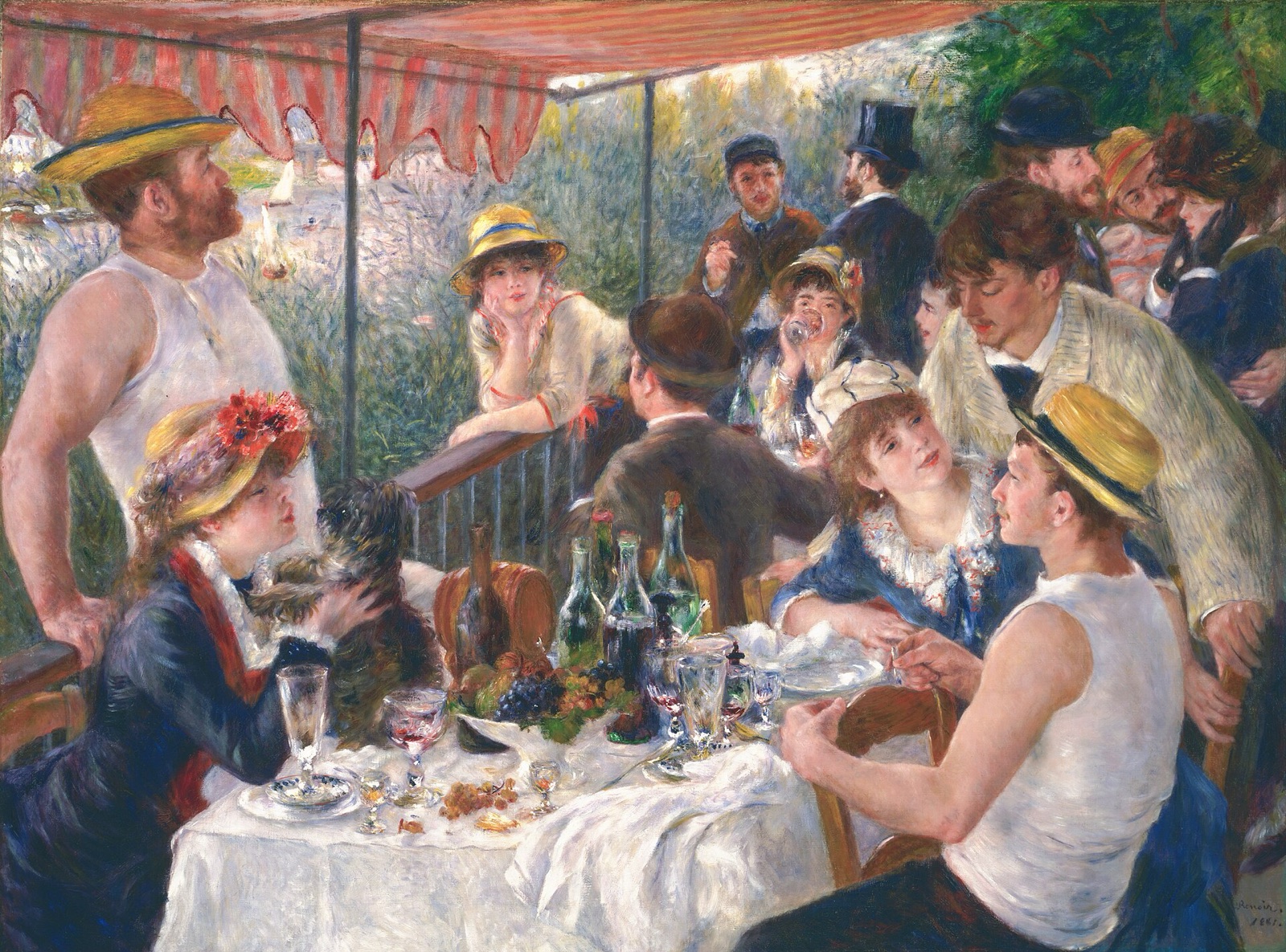

The Phillips Collection dates the painting to 1880–1881.
It shows Renoir’s friends gathered on the balcony of the Maison Fournaise restaurant at Chatou beside the Seine.
The setting combines several themes central to his work:
modern friendship,
boating culture,
fashion,
food and drink,
portraiture,
water,
landscape,
and changing light.
Aline Charigot, who later became Renoir’s wife, appears near the foreground holding a small dog.
The painting feels like one afternoon.
Technical evidence shows that it was not.
Phillips Collection examination has revealed numerous changes.
Figures moved.
The awning changed the structure of the upper composition.
Objects on the table were added, removed, or replaced.
The relationships among sitters shifted.
Some people appear to have posed separately or in small groups.
Renoir continued revising while the picture developed.
This technical history is crucial because it challenges one of the simplest myths about Impressionism.
A painting can create the experience of a fleeting moment without being painted in one fleeting moment.
Renoir worked hard to make construction disappear.
The final image feels immediate because the revisions have been absorbed into a convincing social whole.
A Crisis of Structure
By the early 1880s, Renoir had begun questioning the direction of his painting.
The problem was not that he suddenly disliked color, light, or modern life.
The problem was structure.
The Metropolitan Museum of Art notes that Renoir became skeptical about the permanence of Impressionist aesthetics.
He began turning toward older art for qualities he believed Impressionism did not fully provide:
drawing,
craft,
solidity,
and durability.
Musée d’Orsay’s 2026 research on Renoir’s drawings adds an especially important dimension.
During much of his main Impressionist period, Renoir made relatively few preparatory drawings and often developed compositions directly on the canvas.
From the early 1880s onward, drawing became much more important.
The change reflects a change in artistic priorities.
Renoir wanted stronger form.
He wanted bodies to hold together more firmly.
He wanted composition to feel less dependent on the accidental look of changing light.
This search coincided with travel.
He visited Algeria and traveled to Italy in 1881–1882.
In Italy, Raphael, Renaissance art, Pompeian painting, and classical traditions gave him new models.
He returned to France with a stronger interest in contour and monumentality.
Figures became more crisply drawn.
The relationship between body and background changed.
His work of this period is sometimes called “Ingresque,” “dry,” or classical.
No single label fully captures what he was doing.
He was trying to solve a problem.
How could he keep the color and living surface of modern painting while giving the figure greater permanence?
The Great Bathers — 1884–1887
The Great Bathers at the Philadelphia Museum of Art is the major monument of Renoir’s 1880s search.
He worked on the painting from 1884 to 1887.
The museum records that he labored over it for three years.
He made numerous preparatory drawings for individual figures.
He produced at least two large multifigure studies.
This level of preparation is dramatically different from the popular stereotype of the Impressionist painter responding quickly to an outdoor effect.
The subject is also different.
There is no recognizable Parisian social setting.
No dance garden.
No suburban restaurant.
No modern fashion.
The bathers occupy a deliberately timeless world.
Their bodies are sharply defined.
The paint is drier.
The figures have a sculptural quality that contrasts with the shimmering landscape.
The Philadelphia Museum describes the work as Renoir’s attempt to reconcile traditional French painting with modern art.
That is one of the best ways to understand it.
Renoir does not abandon everything he learned from Impressionism.
The background still vibrates.
Color still moves.
Light still matters.
But the figures are no longer allowed to dissolve completely into atmosphere.
The painting asks the body to survive the light.
Contemporary criticism of the new style was discouraging.
Renoir never again devoted quite the same degree of preparatory labor to a single work.
But the experiment permanently changed his direction.
What to Look for in a Renoir Painting
Start with skin.
Renoir rarely builds flesh from one stable skin tone.
Pink, peach, red, yellow, violet, blue, cream, and reflected colors may all contribute to the figure.
This is one reason the skin can appear luminous.
Then look at edges.
In the 1870s, contours may soften into surrounding light.
A sleeve merges with foliage.
A face is crossed by sun.
A shadow breaks into color.
In the 1880s, many figures become more sharply contained.
Comparing the two periods is one of the clearest ways to see Renoir change.
Watch the brushwork.
There is no single Renoir touch.
Art Institute of Chicago technical studies document wet-in-wet painting, small adjacent strokes of relatively unmixed color, thin washes, dragged paint, heavier impasto, dry-brush effects, exposed ground, and compositional revision.
Renoir changes the brush according to the surface he wants.
Hair does not have to be painted like skin.
A hat does not have to be painted like water.
A dress does not have to be painted like a tree.
Look at color relationships rather than isolated objects.
A white dress may contain blue, pink, cream, violet, and green reflected from its surroundings.
A shadow may be colored rather than gray.
A face can become warmer because of a cool color beside it.
In group scenes, follow the social geometry.
Who looks at whom?
Which figures form a conversational cluster?
Which body connects one group to another?
Where are the strongest diagonals?
Renoir often makes a gathering look accidental while using carefully repeated shapes and color zones to hold it together.
Notice the difference between foreground and background.
Principal figures may receive more definition.
Distant landscape may break into looser marks.
That change in handling can create both depth and atmosphere.
Finally, ask whether the painting only looks spontaneous.
Luncheon of the Boating Party teaches the lesson clearly.
The visual experience can be immediate even when the construction was slow.
Technique: More Varied Than “Soft Brushwork”
Renoir is often described as a soft or loose painter.
Technical study shows a much richer process.
The Art Institute of Chicago has documented that Renoir could begin with thin washes and later build thicker passages.
He worked wet into wet.
He placed relatively unmixed colors beside one another.
He dragged nearly dry brushes across textured surfaces.
He used impasto.
He scraped or revised.
He sometimes allowed the prepared ground to remain visible.
Within one painting, he might use a soft brush for flesh and a stiffer brush for hair or fabric.
This variety matters because Renoir’s surfaces are not accidental.
The touch changes to create different materials and effects.
Technical imaging also shows that he revised compositions.
A figure can move.
A hem can change.
A posture can be corrected.
A background can be reworked.
The visible surface is therefore often the final solution to a sequence of decisions.
Renoir’s famous ease was frequently earned through adjustment.
Drawing Returns
One of the most important recent developments in Renoir scholarship is the renewed attention given to his drawings.
Musée d’Orsay’s 2026 exhibition devoted to Renoir’s works on paper emphasizes that drawing remained part of his practice across his career but became especially significant from the 1880s onward.
That timing is important.
The return to drawing coincides with the moment Renoir became increasingly dissatisfied with some Impressionist methods.
He used graphite, charcoal, chalk, pastel, watercolor, pen, tracing, and printmaking.
Drawings could serve as quick visual notes.
They could also become serious preparatory studies.
The Great Bathers required extensive planning.
The large dancing figures of the early 1880s also reveal an increasingly deliberate relationship between drawing and painting.
This does not mean color became unimportant.
Renoir was too deeply committed to color for that.
Instead, drawing and color were brought into a new negotiation.
During the 1870s, color and immediate visual sensation often seemed to lead.
During the 1880s, drawing increasingly reasserted control.
That struggle shaped the rest of Renoir’s career.
Aline Charigot, Family, and New Places
Around 1880, Renoir met Aline Charigot.
She was from Essoyes in Champagne and became one of his models, his companion, and eventually his wife.
Aline appears in important paintings associated with Renoir’s transitional years.
She is present in Luncheon of the Boating Party.
She also modeled for Dance in the Country.
Their marriage took place in 1890.
The couple had three sons: Pierre, Jean, and Claude.
Family life changed Renoir’s working geography.
Essoyes became important because of Aline’s family roots there.
Later, Renoir increasingly sought the climate of southern France.
In 1907 he purchased Les Collettes at Cagnes-sur-Mer.
The property, with its olive trees and Mediterranean light, became central to his last years.
That landscape would enter his late paintings.
Modern Paris gradually receded.
A more timeless Mediterranean world took its place.
Late Renoir and the Classical Nude
Renoir never lost interest in the human figure.
In his late work, the nude became increasingly important.
These paintings are very different from the dappled figure studies of the 1870s.
Bodies become fuller.
Contours are broader.
Color is warmer and more unified.
The setting often avoids modern social detail.
Musée d’Orsay’s research on Renoir’s late nudes emphasizes the importance of Titian, Rubens, and Ingres.
Large Nude of 1907 is particularly useful for seeing the transition.
The reclining figure has greater weight than many earlier Renoir models.
The palette is more controlled.
The body becomes a continuous, monumental form.
The painting sits historically between his early experiments with outdoor figure painting and the enormous late bathers.
This late classicizing direction became influential in the twentieth century.
Musée d’Orsay notes the importance of Renoir’s late nudes for artists such as Henri Matisse and Pablo Picasso.
That influence is significant.
It complicates the idea that Renoir simply retreated from modern art after Impressionism.
His renewed engagement with older traditions became useful to later modernists who were themselves trying to rethink the figure.
The Bathers — 1918–1919
The late Bathers in the Musée d’Orsay functions almost like a pictorial testament.
Painted in 1918–1919, it removes nearly every trace of contemporary urban life.
The women occupy a Mediterranean landscape associated with Les Collettes.
Their bodies are full and rhythmic.
The color is warm.
The setting is idealized.
Musée d’Orsay describes the work as a celebration of timeless nature from which references to the contemporary world have been deliberately excluded.
Titian and Rubens stand behind the figures.
The landscape evokes the classical Mediterranean.
This is far from the Renoir of La Grenouillère.
That distance is what makes the comparison valuable.
The young Renoir was trying to capture a modern recreation site under changing light.
The old Renoir was trying to place the contemporary model inside an imagined continuity with historical painting.
Both were forms of modern experimentation.
They simply defined “modern” differently.
Illness and Continued Work
Renoir’s later years were physically difficult.
He suffered from severe arthritis.
By the 1910s his mobility was greatly limited.
The Metropolitan Museum of Art records that when the actress Tilla Durieux sat for Renoir in 1914, he had to work from a wheelchair and paint with his brush secured to his hand.
That evidence should be treated precisely.
It does not justify every popular legend about Renoir’s brushes being permanently tied to his fingers.
What it does show is that his physical condition created significant practical challenges.
He continued working despite them.
He also became involved with sculpture.
Renoir collaborated with the younger sculptor Richard Guino on modeled figures in his later years.
This allowed his interest in solid form to extend beyond painting.
The late sculptures fit logically into the same career that produced The Great Bathers.
Renoir had become increasingly interested in bodies as volume.
Sculpture made that concern literal.
He died at Cagnes-sur-Mer in 1919.
Renoir’s Place in Modern Painting
Renoir occupies a complicated but essential place in modern art.
He was one of the painters who helped create Impressionism.
La Grenouillère contributed to the new language of broken brushwork, brighter color, and immediate visual effect.
Dance at the Moulin de la Galette transformed a modern leisure scene into a major painting.
His portraits connected Impressionist color with elite patronage.
Luncheon of the Boating Party demonstrated how carefully constructed social painting could still feel spontaneous.
Then Renoir changed direction.
He returned to drawing.
He traveled to Italy.
He looked again at Raphael, Ingres, Titian, Rubens, French eighteenth-century painting, and classical art.
He sought bodies that could withstand the dissolution of Impressionist light.
That shift once made his later career seem conservative beside the more linear modernist story usually told about nineteenth-century art.
The history now looks more complicated.
Artists do not always move from tradition toward innovation in one direction.
Sometimes they return to tradition in order to find a new problem.
Renoir’s late figure paintings became important to Matisse and Picasso precisely because those artists were also reconsidering what the human figure could mean after the breakthroughs of nineteenth-century painting.
His career therefore links several different ideas of modernity.
One modernity belongs to quick perception, outdoor light, leisure, railways, cafés, and changing urban life.
Another belongs to an artist reexamining the museum and the history of painting after the first shock of innovation has passed.
Renoir participated in both.
What Renoir Changed—and Kept
Renoir is easiest to underestimate when he is reduced to pleasure.
Many of his paintings are pleasurable.
That is true.
People dance.
Friends eat together.
Children sit beside their mothers.
Young women walk, read, bathe, play music, or pose.
The color can be warm and seductive.
The atmosphere can appear effortless.
But beneath that ease are persistent artistic problems.
How do you paint sunlight moving across a crowd?
How do you keep a figure legible when the contour dissolves into atmosphere?
How do you make an arranged group look casual?
How do you revise a painting repeatedly without losing the sensation of immediacy?
How do you keep Impressionist color while restoring stronger drawing?
How do you make the classical nude relevant after modern life has changed painting?
Renoir spent his career giving different answers.
La Grenouillère answers through reflection and rapid brushwork.
Moulin de la Galette answers through a crowd fragmented by moving light.
Madame Charpentier answers through modern portraiture and social ambition.
Luncheon of the Boating Party turns extensive revision into the illusion of one relaxed afternoon.
The Great Bathers answers by restoring drawing, contour, and monumentality.
The late Bathers transforms the contemporary model into a timeless classical figure while retaining a modern surface of visible paint and intense color.
Those answers do not all point in the same direction.
That is precisely why Renoir’s career is so useful.
He helped invent Impressionism.
Then he refused to let Impressionism become a limit.
Sources & further reading
Image credits and public-domain source records appear beneath each image.