John Collier
John Collier painted portraits and narrative scenes with a strong emphasis on observation. He was also a writer on the practice of art.

Born: 1850
Died: 1934-04-11
Birthplace: London, England
Nationality / cultural identity: British
Art movements / traditions: Victorian figurative painting; academic painting
John Collier: Life, Portraits, Lady Godiva, and Victorian Storytelling
Why John Collier Is Hard to Put in One Box
John Maler Collier was one of the most versatile British painters to build a successful career across the late Victorian and Edwardian periods. He painted scientists, politicians, aristocrats, clergy, military figures, legendary heroines, Greek myth, Shakespearean subjects, and modern scenes designed to provoke public debate.
That range is one reason Collier is difficult to classify.
He is sometimes described casually as a Pre-Raphaelite painter. The connection is understandable. Some of his pictures share the sharp detail, literary subject matter, saturated color, long-haired women, and polished surfaces associated with later Pre-Raphaelite art. But Collier was not a member of the original Pre-Raphaelite Brotherhood, which was founded before his career began. His documented training and professional life belong more securely to the broad world of Victorian figurative and academic painting.
Portraiture was the foundation of his career.
The National Portrait Gallery describes him as a prolific and proficient portraitist who exhibited at the Royal Academy from 1874. He painted leading intellectual and public figures, including Thomas Henry Huxley, Charles Darwin, scientists, politicians, judges, clergy, and members of fashionable society.
At the same time, Collier repeatedly stepped outside portraiture.
Clytemnestra stages the aftermath of murder in ancient Mycenae. Priestess of Delphi presents a sacred figure associated with prophecy. Lady Godiva turns a medieval legend into an image about vulnerability and spectatorship. Later paintings such as The Prodigal Daughter and Sentence of Death move into a recognizably modern world of social conflict, medical authority, and uncertain moral meaning.
Across these different subjects, Collier keeps returning to one basic problem:
How much can a viewer understand from a face, a pose, a gesture, an object, and a carefully staged moment?
That question connects his portraits, myths, historical scenes, and problem pictures more strongly than any single movement label.
Early Life and Training
Collier was born in London in 1850.
The National Portrait Gallery gives his exact birth date as January 27, but year-only precision is more appropriate for a compact artist record.
His father was Robert Porrett Collier, a lawyer who later became the first Lord Monkswell. Collier therefore grew up in a prosperous family connected to public life, law, politics, education, and the intellectual culture of Victorian Britain.
His artistic education was broad.
He studied at the Slade School of Fine Art and continued his training in Munich and Paris.
The Slade was an important center for rigorous figure drawing and life study. Munich exposed British artists to a Continental academic tradition often associated with stronger tonal contrast and direct handling. Paris was one of the major centers of nineteenth-century figure and history painting.
Collier did not simply reproduce one school’s style.
He developed a highly legible form of figurative painting based on clear drawing, convincing anatomy, controlled modeling, recognizable materials, and psychologically readable faces.
He began exhibiting at the Royal Academy in the 1870s and maintained a presence in British public exhibition culture for decades.
That longevity matters.
Collier’s career began in a world dominated by Victorian academic painting, Aestheticism, Pre-Raphaelite influence, and large public exhibitions. It continued into an era increasingly shaped by photography, mass journalism, new forms of popular illustration, Impressionism, Post-Impressionism, and early modernism.
Collier remained committed to recognizable figures and traditional oil painting throughout those changes.
Portraiture and the Public Face of Victorian Britain
Portrait painting made Collier professionally successful.
Victorian Britain placed enormous importance on the painted image of public achievement.
Scientists, judges, reformers, politicians, industrialists, military officers, bishops, aristocrats, and scholars were frequently commemorated through formal portraiture. Such paintings served families, institutions, universities, professional organizations, and the broader culture of public memory.
Collier became highly effective within this system.
The National Portrait Gallery holds or documents portraits by him of figures including Anthony Ashley-Cooper, seventh Earl of Shaftesbury; Thomas Henry Huxley; Charles Darwin; Sir William Huggins; Sir Michael Foster; and many others.
These portraits are generally not built around spectacular brushwork.
Collier wants the sitter to remain legible.
Faces, hands, posture, clothing, and expression carry the picture.
That restraint fits the artistic philosophy associated with his writings. The National Portrait Gallery summarizes Collier’s preference as a commitment to “truth to nature” rather than virtuoso painterly display.
That phrase should not be confused with mechanical copying.
Portraiture always involves selection.
The painter chooses the pose.
The painter controls the light.
The painter decides whether the sitter faces the viewer directly or turns away.
The painter determines how much information to include in costume, furniture, books, background, hands, and surrounding space.
Collier’s skill lies in making those decisions appear natural.
Thomas Henry Huxley — 1883
Collier’s 1883 portrait of Thomas Henry Huxley is an important example of the portrait side of his career.
Huxley was one of Victorian Britain’s most prominent scientists and public intellectuals, a major defender of evolutionary science and an influential educator.
He was also Collier’s father-in-law.
Collier had married Huxley’s daughter Marian in 1879.
In the portrait, Huxley is not surrounded by elaborate scientific symbolism.
The emphasis falls on the man himself.
Dark clothing and a restrained setting direct the eye toward the face, hands, and posture.
This relative simplicity is deliberate.
Collier’s portraits often communicate authority through control rather than display.
The sitter occupies the space convincingly.
The viewer is invited to study expression and physical presence.
That is one of the useful ways to look at Collier’s portraiture.
Ask not only whether the likeness is accurate.
Ask how character is being built.
Is the sitter relaxed or rigid?
Does the gaze meet the viewer?
How are the hands positioned?
What has Collier chosen to suppress?
What has he chosen to emphasize?
In Huxley’s case, the portrait depends on concentration and intellectual presence rather than theatrical biography.
Marian Collier: An Artist in Her Own Right
Marian Huxley Collier is important to John Collier’s story because she was not simply the wife of a painter.
She was an artist herself.
The National Portrait Gallery identifies Marian as a prize-winning student at the Slade School, where she studied under Alphonse Legros. She exhibited at the Royal Academy and the Grosvenor Gallery and painted portraits of significant figures, including members of her own intellectual family.
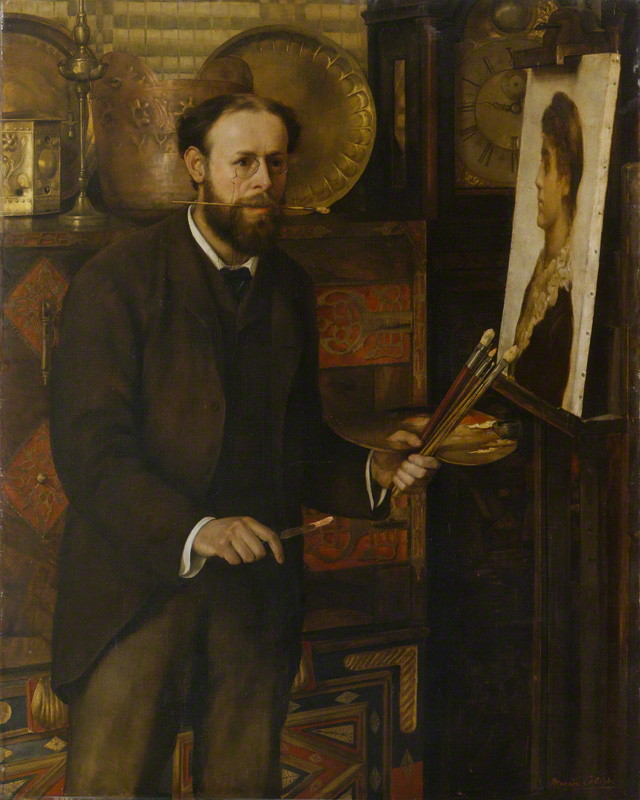
Her portrait of John Collier from around 1882–1883 is especially revealing.
She depicts her husband standing at an easel.
On his canvas appears a small image of Marian herself.
The painting therefore becomes both a portrait of John Collier and a record of two artists looking at one another through painting.
John Collier also painted Marian.
His portrait of her presents a fashionable young woman rather than emphasizing her profession.
The contrast is telling.
Marian shows John at work.
John presents Marian primarily as a sitter.
That difference reflects not only personal choices but the gender expectations of Victorian portraiture.
Marian died in 1887.
Collier later married her younger sister Ethel Huxley. Because British law at that time prohibited marriage to a deceased wife’s sister, the marriage had to take place outside Britain.
The Huxley connection kept Collier tied to a world of science, rationalism, public debate, and reform as well as art.
History Painting and the Drama of a Single Moment
Portraiture gave Collier professional stability.
Historical, literary, and mythological painting gave him a different kind of freedom.
These pictures frequently depend on choosing one decisive instant.
Rather than illustrating an entire story, Collier selects the moment after an irreversible action or just before one.
This makes his paintings theatrical.
A curtain seems almost ready to rise or fall.
The viewer encounters a figure in a state of psychological pressure.
Clytemnestra has already killed.
Lady Godiva is already exposed.
The Delphic priestess is caught in sacred concentration.
The doomed patient in Sentence of Death has already heard the diagnosis.
Collier’s historical paintings also reveal his interest in material accuracy.
In A Manual of Oil Painting, first published in 1886, he argued that historical pictures should be consistent with the best available knowledge.
This concern placed him within a broader Victorian culture of archaeological and historical reconstruction.
Artists such as Lawrence Alma-Tadema used museum collections, archaeological discoveries, architecture, costume, furniture, and material culture to make antiquity appear physically convincing.
Collier admired that seriousness.
But historical detail in his paintings is not there only to demonstrate research.
It creates a stage on which psychology can become believable.
Clytemnestra — 1882
Clytemnestra is one of Collier’s most powerful historical paintings.
The subject comes from the cycle of Greek tragedy surrounding the house of Agamemnon.
Agamemnon returns from the Trojan War.
Clytemnestra kills him.
Her reasons belong to a much larger story of betrayal and violence: Agamemnon had sacrificed their daughter Iphigenia before sailing to Troy and returned with Cassandra as a captive.
Collier does not paint the murder itself.
He paints the aftermath.
Clytemnestra stands in a doorway holding a bloodied weapon.
The decision to show what comes after the act is crucial.
The viewer cannot prevent anything.
The moral event has already happened.
What remains is interpretation.
Collier gives Clytemnestra enormous physical presence.
Her posture is upright and confrontational.
Blood marks the image.
Architectural elements create a heavy, enclosed setting.
The face is not presented as a melodramatic mask of remorse.
Instead, she appears defiant.
Guildhall interpretation has emphasized the painting’s theatrical force and psychological intensity.
Collier also attempted to construct an archaeologically plausible Mycenaean environment.
That attempt is historically interesting because Victorian archaeological reconstruction was itself imperfect.
One famous architectural detail in the painting reflects the way a Mycenaean object had been displayed rather than its original historical orientation.

That mistake does not make the picture unserious.
It demonstrates something more interesting:
“Historical accuracy” depends on the historical knowledge available at the time.
Clytemnestra therefore records both ancient myth and Victorian archaeology.
Priestess of Delphi — 1891
Priestess of Delphi offers a different kind of classical subject.
The painting shows the Pythia, the priestess associated with the oracle of Apollo at Delphi.
Collier does not stage a crowded mythological narrative.
Instead, he isolates the figure.
The vertical format intensifies her presence.
Costume, expression, pose, and atmosphere carry the meaning.
The Delphic priestess occupied a space between ordinary human experience and divine communication.
Collier’s painting depends on that psychological threshold.
She is present before us but also seems mentally elsewhere.
The picture therefore has much in common with Collier’s later problem paintings.
The subject is different, but the viewer’s task is similar.
We examine a face and body for evidence of an internal state that cannot be directly seen.
That continuity is one of the reasons Collier’s varied career makes more sense when viewed as a whole.
The Pre-Raphaelite Question
Collier is frequently described as Pre-Raphaelite in popular writing.
That description needs qualification.
The original Pre-Raphaelite Brotherhood was founded in 1848.
Collier was born in 1850.
He was never a member.
Still, the comparison is understandable.
Some of Collier’s paintings share visual features associated with later Pre-Raphaelite art:
bright color,
literary or legendary subjects,
carefully described costume,
polished surfaces,
medieval themes,
idealized or striking female figures,
and strong narrative clarity.
But those similarities do not define his full career.
Collier’s Slade and Continental training, his professional society portraiture, his interest in academic figure painting, his classical subjects, his admiration for archaeological reconstruction, and his later problem pictures place him inside a broader Victorian figurative tradition.
For that reason, “Victorian figurative painting” and “academic painting” are more useful movement labels than “Pre-Raphaelite.”
The distinction matters because movement labels shape what viewers expect to see.
If Collier is introduced only as a Pre-Raphaelite, his portraits and problem pictures appear like exceptions.
If he is understood as a Victorian figurative painter with several overlapping influences, the career becomes more coherent.
Lady Godiva — 1897–1898
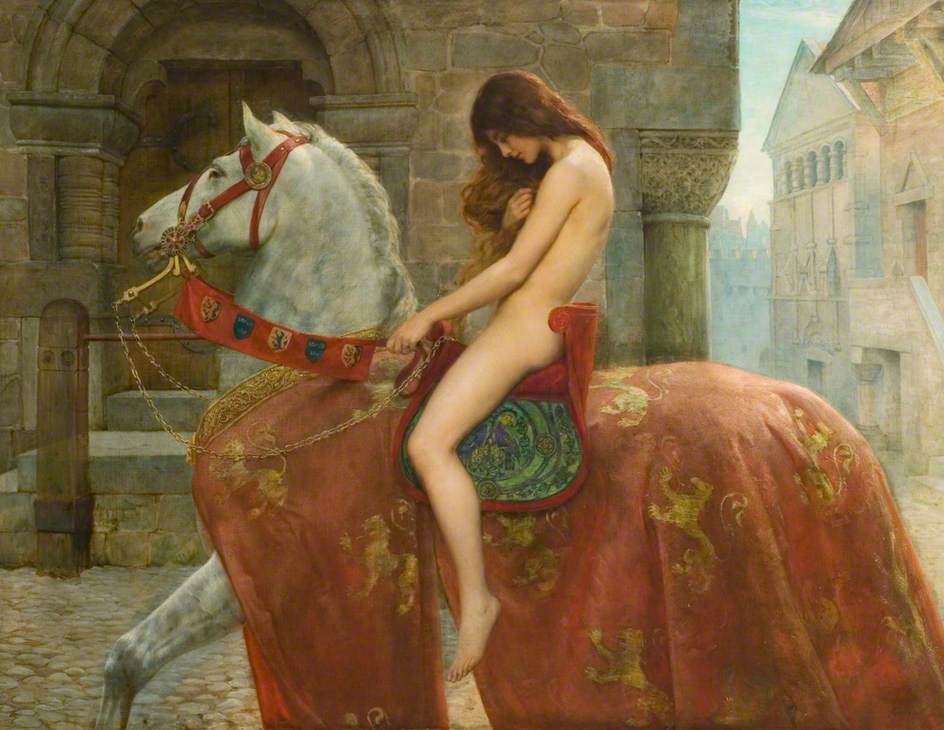
Lady Godiva is probably Collier’s most widely recognized painting.
The work belongs to the Herbert Art Gallery & Museum in Coventry.
Dating varies slightly between institutions.
The National Portrait Gallery refers to the work as around 1897.
The Herbert states that Collier completed it in 1898.
A date range of 1897–1898 is therefore the most responsible way to present it.
The painting shows the legendary Godiva seated nude on a white horse covered with elaborate red trappings.
Her long hair falls over her body.
Her head is lowered.
Architecture appears in the background.
The historical Lady Godiva was a real eleventh-century noblewoman.
The famous story that she rode naked through Coventry to persuade her husband to reduce oppressive taxation is a later legend.
The Herbert itself separates the historical person from the traditional story and notes that nobody knows with certainty whether the ride happened.
That distinction matters.
Collier was not reconstructing a securely documented historical event.
He was painting a powerful Victorian legend.
The painting’s emotional force comes from visibility.
Godiva’s story depends on the idea that the people of Coventry agreed not to look.
Yet a painting exists to be looked at.
The viewer is therefore placed in an uncomfortable position.
We become spectators to a figure whose vulnerability depends on the imagined absence of spectators.
Collier controls this tension carefully.
Godiva does not appear triumphant.
Her bowed head and posture make the image inward and exposed.
The red cloth beneath her creates a strong field of color against the white horse and pale body.
Her hair both reveals and conceals.
The composition turns a public legend into a private psychological moment.
This is why Lady Godiva remains more interesting than a simple illustration of the story.
It is a painting about looking.
Writing About Painting
Collier was unusual among successful Victorian portrait painters in leaving substantial practical writing about his art.
A Manual of Oil Painting was published in 1886.
The Art of Portrait Painting followed in 1905.
These books matter because they show that Collier thought of painting as a craft involving decisions that could be explained and taught.
Materials mattered.
Preparation mattered.
Color mattered.
The pose of a sitter mattered.
The relationship between observation and interpretation mattered.
Historical subjects required research.
The painter had to understand how oil paint behaved and how a picture could be constructed from life.
This practical mindset helps explain Collier’s surfaces.
He rarely asks the viewer to admire brushwork before subject.
The technique generally serves legibility.
Skin should read as skin.
Clothing should read as clothing.
Metal should feel metallic.
Architecture should support the setting.
The sitter or narrative figure should remain central.
This does not mean Collier lacked style.
His style lies partly in refusing to let style overpower the image.
The Problem Picture and the Rise of Public Interpretation
Around the turn of the twentieth century, Collier became strongly associated with a genre that suited his narrative instincts perfectly: the problem picture.
Problem pictures showed scenes from modern life in which the meaning was deliberately incomplete.
The audience had to decide what had happened.
Why had someone returned home?
What had been said?
Was a marriage breaking down?
Had a secret been discovered?
What would happen next?
These paintings became enormously popular at the Royal Academy and in the press.
Newspapers reproduced them.
Critics debated them.
Readers sent in interpretations.
The public exhibition became a space of collective storytelling.
Pamela Fletcher’s scholarship on the Royal Academy identifies Collier’s The Prodigal Daughter of 1903 as one of the earliest and most popular examples.
A young woman returns to a modest home.
Her clothing and appearance sharply contrast with the older parents inside.
The title evokes the biblical parable of the prodigal son.
But Collier does not tell viewers what happened while the daughter was away.
He does not tell us whether the parents will forgive her.
The painting is structured around missing information.
That is the “problem.”
Collier himself did not entirely embrace the label.
He preferred to describe such works as attempts to tell dramatic and human stories.
That distinction is worth preserving.
The ambiguity was not a trick for its own sake.
It forced viewers to interpret emotion, class, gender, morality, and social behavior from visual evidence.
Sentence of Death — 1908
Sentence of Death is one of Collier’s most disturbing modern narratives.
The painting was exhibited at the Royal Academy in 1908.
A contemporary color photogravure preserved by the Wellcome Collection shows the scene clearly.
A young man sits in a doctor’s office.
He has apparently just learned that he is going to die.
The doctor remains nearby.
A microscope and books help establish the medical setting.
Almost nothing physically dramatic occurs.
That is precisely why the painting works.
The decisive event has already taken place.
It was spoken.
Information has changed the patient’s life.
The man looks outward.
The viewer occupies the space of that gaze.
We do not know exactly what the doctor has diagnosed.
Contemporary reviewers speculated.
Wellcome material notes that syphilis was among the possibilities suggested.
But Collier does not solve the medical puzzle.
The uncertainty forces attention onto the psychological condition.
The patient knows something he did not know moments before.
The world looks the same.
His future does not.
This is a remarkably modern subject.
Fate no longer arrives through gods or prophecy.
It arrives through medicine.
The doctor replaces the oracle.
The diagnosis replaces the curse.
Collier’s traditional technique makes the modernity of the situation even sharper.
The painting looks controlled and conventional.
The experience it represents is destabilizing.
What to Look for in a John Collier Painting
Start with the face.
Collier frequently builds the emotional structure of a painting around expression.
Clytemnestra’s defiance,
Godiva’s lowered gaze,
the Pythia’s inward concentration,
Huxley’s intellectual presence,
and the patient’s distant stare in Sentence of Death all organize the viewer’s response.
Then look at posture.
Collier uses the body as evidence.
A straight spine, lowered head, turned shoulder, extended arm, rigid hand, or slumped seated pose can carry more narrative information than an elaborate symbol.
Look at the hands.
This is especially useful when comparing portraiture and narrative painting.
Hands can reveal occupation, confidence, restraint, violence, uncertainty, or status.
A hand holding a weapon means something different from a hand resting on a book or gripping a chair.
Notice the objects.
Collier’s paintings are generally designed to be readable.
Weapons, clothing, furniture, books, medical instruments, horse tack, architecture, jewelry, and textiles are not abstract shapes.
They help identify the world of the picture.
But do not assume every historical detail is infallible.
Collier valued research.
Victorian knowledge was still incomplete.
Museum displays, archaeological reconstructions, and historical scholarship could contain errors that painters then reproduced.
Compare portraits and narratives.
In a portrait, Collier gives you a known identity and asks you to read character.
In a mythological or legendary painting, you usually know the story and interpret the chosen moment.
In a problem picture, Collier removes the known story.
The viewer must build one.
That progression is one of the most useful ways to understand his career.
A Traditional Painter in a Modern Media World
Collier’s career extended across enormous changes in visual culture.
By the early twentieth century, photography had transformed portraiture.
Illustrated magazines and newspapers could reproduce images on a scale unimaginable earlier in the century.
Cinema was emerging.
Modernist painters were abandoning many of the conventions Collier still valued.
Collier did not respond by becoming formally avant-garde.
He kept painting recognizable people and clear spaces.
Yet the problem picture shows that he understood a new kind of audience.
These paintings were made not only for silent contemplation.
They were built for circulation and debate.
A Royal Academy picture could become the subject of newspaper commentary, serialized discussion, public guessing, and reproduced images.
The ambiguity of the story encouraged participation.
In that sense, Collier’s apparently conservative technique was paired with a surprisingly modern understanding of spectatorship.
He knew that viewers wanted to complete the narrative.
A Long Career Across Changing Taste
Collier exhibited for roughly six decades.
That longevity means his career cannot be understood only through the artistic priorities of the 1880s.
He outlived the high Victorian world in which he first became successful.
He saw the culture of the Royal Academy challenged by new exhibition societies.
He saw the rise of photographic portraiture.
He saw Impressionism and Post-Impressionism change the language of painting.
He saw modernism increasingly reject academic narrative art.
Collier did not follow those movements.
His commitment to recognizable figures, observed likeness, historical research, and narrative clarity remained consistent.
That consistency later worked against his reputation.
Twentieth-century art history often privileged formal innovation and avant-garde rupture.
A painter who remained successful within Victorian and Edwardian institutions could therefore appear conservative by definition.
That judgment is too narrow.
Collier’s work is historically valuable precisely because it shows what traditional figurative painting continued to do well.
It could preserve likeness.
It could reconstruct historical worlds.
It could turn myths into psychological encounters.
It could transform contemporary social problems into public debate.
It could use a familiar visual language to create uncertainty rather than certainty.
Collier After the Victorian Era
John Collier died in London in 1934.
His reputation never disappeared completely, but it changed.
Portraits remained in institutional and family collections.
Lady Godiva became one of the most recognizable visual versions of the Coventry legend.
Clytemnestra continued to attract attention as an example of Victorian classical drama.
Problem pictures became important to scholars studying mass audiences, gender, narrative, journalism, and Royal Academy culture.
His practical writings also preserve a valuable record of how a successful academic portrait painter thought about oil painting and likeness.
Collier matters because he occupied several worlds at once.
He could paint a scientist with restrained authority.
He could turn Greek tragedy into a confrontational single figure.
He could create a medieval legend that asks the viewer to think about spectatorship.
He could stage a modern medical consultation with the gravity once reserved for historical painting.
He could write about technique while painting narratives whose meaning remained unresolved.
The common thread is attention to evidence.
A face is evidence.
A hand is evidence.
A weapon is evidence.
A microscope is evidence.
A costume is evidence.
A lowered gaze is evidence.
But evidence does not always produce certainty.
That is the key to Collier’s strongest work.
Clarity, Ambiguity, and Collier’s Legacy
The clarity of Collier’s paintings can be deceptive.
Everything seems understandable.
The figures are recognizable.
The space is coherent.
The objects are legible.
The story appears close at hand.
Then uncertainty enters.
What exactly is Clytemnestra feeling after the murder?
What does Lady Godiva know about being watched?
What state of mind does the Pythia occupy?
How will the parents respond to The Prodigal Daughter?
What has the doctor told the patient in Sentence of Death?
Collier’s best paintings turn visual clarity into psychological ambiguity.
That tension is why he deserves more than the label of a polished Victorian academic.
He was a portraitist, historical painter, writer on technique, interpreter of legend, and storyteller of modern uncertainty.
His paintings ask viewers to look closely at people and decide what the visible evidence can—and cannot—tell us.
Sources & further reading
- National Portrait Gallery — John Collier, Later Victorian Portraits Catalogue
- Paul Mellon Centre — The Royal Academy Summer Exhibition: 1903 and the Problem Picture
Image credits and public-domain source records appear beneath each image.