Johannes Vermeer
Johannes Vermeer is celebrated for carefully composed scenes and an exceptional sensitivity to light. His small surviving body of work is closely connected with Delft.

Born: 1632
Died: 1675
Birthplace: Delft, Netherlands
Nationality / cultural identity: Dutch
Art movements / traditions: Dutch Golden Age
Johannes Vermeer: Life, Light, Delft, and the Art of Looking
Why Vermeer Feels So Quiet—and Why His Paintings Are Not Simple
Johannes Vermeer created one of the smallest and most concentrated bodies of work in seventeenth-century Dutch painting. Only about three dozen paintings are generally associated with him today, and even that total can shift as attribution research changes. Yet those few works have become some of the most closely studied images in European art.
Vermeer is famous for rooms filled with quiet light: a woman reading a letter, a maid pouring milk, a figure holding a balance, a musician seated at an instrument, a young woman turning toward the viewer. His paintings often seem almost effortless. Walls are calm. Gestures are restrained. Objects appear to sit exactly where they belong. Light moves through the room without drama.
That apparent simplicity is one of Vermeer’s greatest achievements.
Modern technical research has shown that the calm final surfaces were carefully constructed. Beneath them are bold underlayers, compositional revisions, altered objects, practical experiments with pigments, and deliberate perspective systems. Vermeer simplified rooms, shifted architecture, changed the position of figures and objects, and adjusted the distribution of light.
The result is not a neutral copy of reality.
It is an edited reality.
That distinction is essential to understanding Vermeer. He observed the visible world closely, but he did not merely reproduce it. He transformed ordinary spaces into highly controlled environments where the smallest action—a stream of milk, a letter, a scale, a glance—can feel momentous.
A Birth Year, Not a Known Birthday
Vermeer was born in Delft in 1632.
The surviving archival record does not tell us his exact birthday. What it records is his baptism at the Nieuwe Kerk in Delft on October 31, 1632.
That difference matters.
A baptismal entry is not a birth certificate, so October 31 should not be presented as Vermeer’s documented date of birth. The most accurate public wording is that he was born in Delft in 1632 and baptized on October 31.
His parents were Reynier Jansz and Digna Baltens. His father moved through several occupations. He worked in the textile trade, kept inns, and also dealt in art. In 1631, Reynier registered with the Delft Guild of Saint Luke as an art dealer.
The family eventually ran an inn called Mechelen on Delft’s market square.
That environment would have placed the young Vermeer close to the commercial and social life of the city. Inns were not simply places to sleep. They were spaces where merchants, travelers, craftsmen, artists, and customers met. His father’s art dealing also meant that paintings and prints were part of the family economy.
Vermeer later became both a painter and an art dealer himself.
An Artist with No Documented Teacher
One of the largest gaps in Vermeer’s biography concerns his training.
No surviving document identifies the artist who taught him.
Scholars have proposed several possibilities. Leonaert Bramer, an established Delft painter, had connections to Vermeer’s family and later acted as a witness in matters relating to Vermeer’s marriage. Carel Fabritius, a pupil of Rembrandt who worked in Delft, has also been suggested because of perceived artistic relationships.
Neither can be securely described as Vermeer’s teacher.
That uncertainty is worth preserving because it reminds us how incomplete the documentary record is.
What can be said with confidence is that Vermeer had completed the professional training required to become a master painter by the end of 1653, when he entered Delft’s Guild of Saint Luke.
His earliest surviving paintings also show an artist who had not yet settled into the domestic interiors that would define his mature work.
Christ in the House of Martha and Mary is a large religious scene. Diana and Her Nymphs belongs to mythological history painting. The Procuress, signed and dated 1656, presents large figures in a contemporary genre scene.
These early works suggest experimentation rather than a fully formed “Vermeer style.”
The quiet room came later.
Marriage, Catholic Delft, and a Large Household
In April 1653 Vermeer married Catharina Bolnes.
Catharina came from a Catholic family. Vermeer had been baptized in the Reformed Church, and National Gallery of Art scholarship suggests that he probably converted to Catholicism around the time of the marriage, although no formal conversion record survives.
Catharina’s mother, Maria Thins, was financially more secure than Vermeer’s family and owned property. Vermeer and Catharina eventually lived in her house on the Oude Langendijk in Delft, close to a Jesuit mission.
The religious setting is important, but it should not be used as a shortcut for interpreting every painting.
Some works have clear or probable Catholic associations, especially Allegory of the Catholic Faith. Others, such as Woman Holding a Balance, have generated religious interpretations partly because a Last Judgment hangs behind the figure. But a Catholic household does not automatically turn every pearl, map, balance, or glass of wine into a fixed theological symbol.
Vermeer and Catharina had a very large family.
Sources differ slightly on whether fourteen or fifteen children were born to them, but museum research agrees that eleven survived infancy. That is the more durable fact.
The crowded reality of this household is striking when compared with the apparent stillness of Vermeer’s paintings.
His interiors are not necessarily literal portraits of family life.
They are constructed pictorial worlds.
The Guild of Saint Luke and Vermeer’s Professional Standing
Vermeer became a master in the Delft Guild of Saint Luke on December 29, 1653.
The guild regulated professional painters and connected them to a wider community that included artists, art dealers, and craftsmen.
Vermeer later served as a headman of the guild in 1662, 1663, 1670, and 1671.
Those repeated appointments matter.
They challenge the romantic idea that Vermeer was an unknown recluse ignored by his own city. He was respected enough by fellow professionals to hold an important guild office several times.
His later obscurity had other causes.
He produced relatively few paintings. Many appear to have remained with a small circle of Delft collectors. He lived his entire documented career in Delft rather than establishing himself in Amsterdam or another larger international art center.
His local reputation could therefore be substantial while his broader fame remained limited.
A Small Oeuvre and a Concentrated Circle of Collectors
Vermeer’s surviving oeuvre is exceptionally small.
Museums often speak of around thirty-five or thirty-six accepted paintings, but the exact total changes as attribution research develops.
That uncertainty is not a problem.
It is part of Vermeer scholarship.
One reason his production may have remained manageable despite a large family is that his paintings were connected to a relatively small group of prosperous Delft collectors.
Pieter Claesz van Ruijven and his wife, Maria de Knuijt, are central figures.
Older scholarship often emphasized Van Ruijven alone as Vermeer’s great patron. More recent research has given greater attention to Maria de Knuijt and the couple’s wider role in collecting his work.
By the time the family collection reached the famous Dissius auction of 1696, twenty-one paintings attributed to Vermeer were offered for sale.
That is an extraordinary concentration.
It suggests that a large portion of Vermeer’s production did not circulate widely during his lifetime.
The relationship should still be described carefully. We do not possess a contract proving that the Van Ruijven–De Knuijt family commissioned every painting directly from Vermeer. “Collector,” “patron,” and “client” can overlap, but they are not automatically identical categories.
From History Painting to the Domestic Interior
The most important transformation in Vermeer’s career occurred during the later 1650s.
His early works are relatively large and narrative. By the time of The Milkmaid and Girl Reading a Letter at an Open Window, his attention had shifted toward more intimate interiors.
The scale became smaller.
The action became quieter.
The composition became more controlled.
Yet the ambition did not disappear.
Vermeer transferred the drama of history painting into the organization of ordinary space.
A wall becomes an active compositional field. A window controls light. A chair blocks entry. A curtain reveals and conceals. A map expands the meaning of a room. A table can separate viewer and figure.
The subject might be a woman reading, pouring, writing, weighing, or making music.
The painting asks the viewer to look closely enough that these small activities become significant.
That is one of Vermeer’s great inventions.
He turned attention itself into a subject.
The Milkmaid — 1658–1659
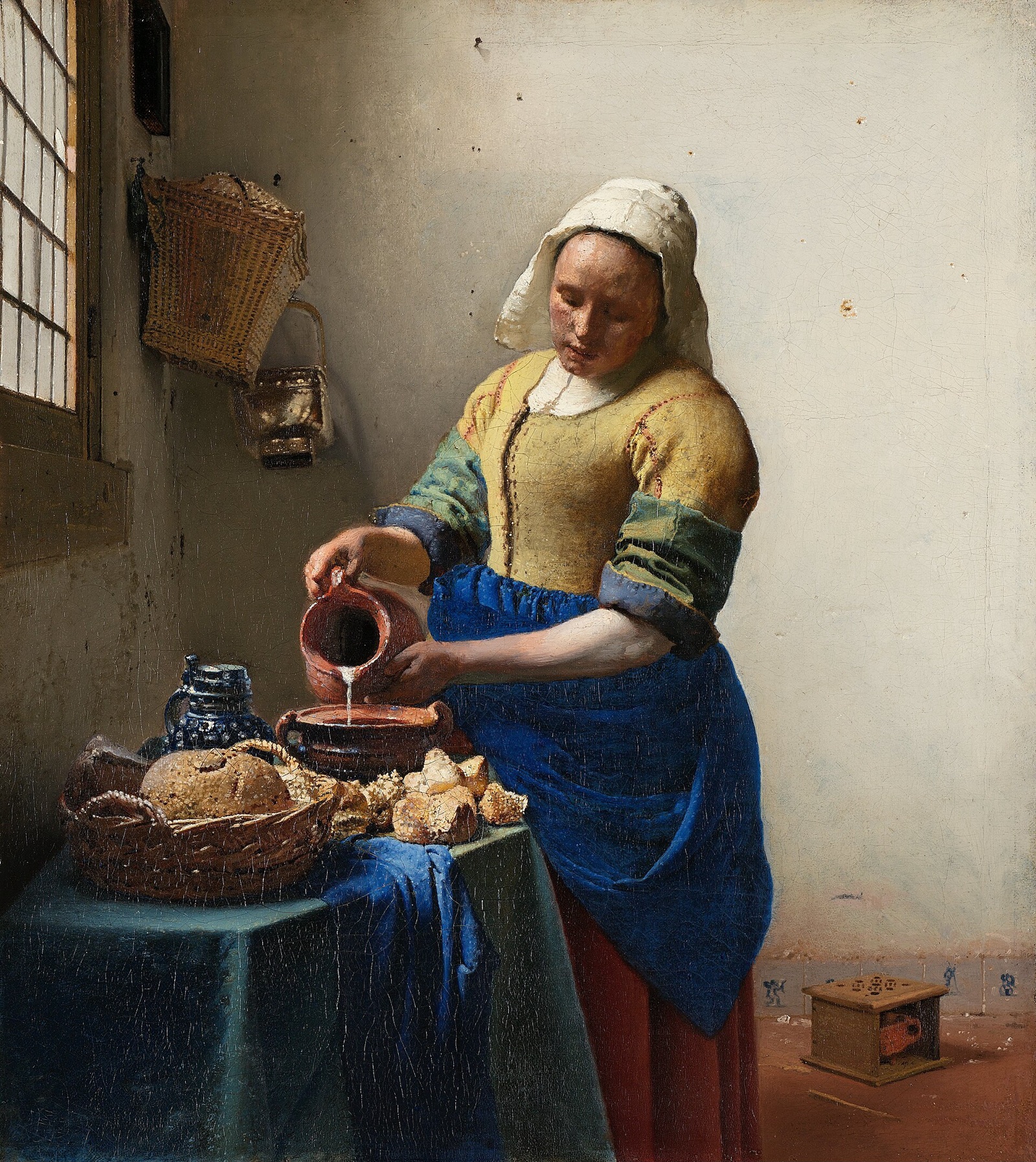
The Milkmaid, now in the Rijksmuseum, is one of the clearest examples of Vermeer’s mature transformation of everyday life.
A kitchen maid stands beside a table and pours milk from an earthenware jug into a vessel.
The action is simple.
The painting is not.
The room is constructed from carefully controlled relationships among wall, table, window, figure, basket, bread, ceramic vessels, tiles, and light.
The maid has an unusual sense of physical weight. She stands solidly, almost monumentally.
Vermeer reinforces that solidity through the low viewpoint and the pyramidal shape of the figure. Her yellow bodice and blue apron form large blocks of color. The table and bread anchor the lower foreground.
Light enters from the left.
It catches the woman’s forehead, shoulder, sleeve, bread, pottery, and rough plaster wall.
Look closely at the bread and Vermeer’s technique becomes visible. Rather than describing every crumb, he uses small dots and touches of light to suggest a sparkling surface.
Those points have often been compared with optical effects seen through a camera obscura.
But the composition is far from mechanical.
Technical study has revealed that Vermeer changed the room as he worked. Earlier objects were removed or altered, leaving the figure more isolated and the spatial arrangement more powerful.
The calm final image is the result of editing.
The thin stream of milk is the only continuous action.
That tiny movement becomes the center of the picture.
View of Delft — about 1660–1661
View of Delft proves that Vermeer’s control of atmosphere and structure was not limited to interiors.
The painting looks across water toward the city from the south.
Large horizontal zones organize the composition: water, foreground shore, city, and sky.
Clouds cover much of the upper field, while sunlight breaks through to illuminate selected buildings.
At first glance, the scene seems almost photographic.
It is not.
Mauritshuis research notes that Vermeer altered Delft.
He shifted architectural elements, including the Nieuwe Kerk tower, and simplified the city’s crowded appearance to produce a clearer composition.
Again, observation is followed by editing.
The sky is enormous and active, but the city feels stable.
Reflections connect architecture to water.
Small figures and boats animate the lower band without distracting from the larger structure.
The painting is extraordinary because it creates the sensation of a specific place while reorganizing that place according to pictorial logic.
Vermeer did not ask, “How can I copy Delft exactly?”
He asked, “How can Delft become a painting?”
Woman Holding a Balance — about 1664
Woman Holding a Balance is one of Vermeer’s most precisely organized interiors.
A woman stands beside a table and holds a small balance in front of her.
Jewelry and valuables lie nearby.
On the wall behind her hangs a painting of the Last Judgment.
For generations, viewers tried to solve the scene by assigning a single symbolic meaning.

Earlier titles even assumed she was weighing pearls.
The balance pans appear empty.
National Gallery of Art scholarship has instead emphasized larger themes such as judgment, moderation, self-examination, and equilibrium while acknowledging a history of different interpretations.
The visual idea of balance is especially strong.
The woman, the scale, the framed Last Judgment, the window, the table, the jewelry boxes, and the light all seem arranged around a fragile state of equilibrium.
Technical research shows that Vermeer refined this effect during painting.
Infrared imaging revealed that the balance was originally positioned differently. Vermeer changed it until the pans hung parallel to the picture plane.
Researchers also identified evidence of perspective construction, including a pinhole associated with establishing orthogonals.
The result feels inevitable.
It was not.
Vermeer constructed serenity through revision.
Girl with a Pearl Earring — about 1665
Girl with a Pearl Earring is Vermeer’s most famous painting, but its fame can obscure what kind of object it actually is.
The Mauritshuis identifies it as a tronie.
A tronie was not a conventional commissioned portrait. It was a study of a face, expression, costume, or type.
That means the painting does not give us a documented individual whose biography can be reconstructed.
We do not know who the girl was.
She may have posed from life, but the image was not created primarily to preserve her social identity.
Instead, Vermeer reduces almost everything to an encounter between face, light, color, and viewer.
The young woman turns toward us against a dark background.
Her blue and yellow head covering is visually unusual. Her lips are slightly parted. A white collar creates a bright wedge below her face.
The so-called pearl hangs beside her neck.
Technical research shows how economical this “pearl” is.
It is made with a small number of translucent and opaque strokes of white paint. There is no visible hook connecting it to the ear.
The object is therefore almost pure illusion.
Its enormous size has also led researchers to question whether it represents a natural pearl at all. It may be an imitation jewel or an imagined effect.
The same scientific research revealed more about the face than the naked eye can see.
Tiny painted eyelashes survive around the eyes, even though they are difficult to perceive normally.
The painting therefore balances specificity and generalization.
The figure feels present.
Her identity remains unknown.
The Art of Painting — about 1666–1668
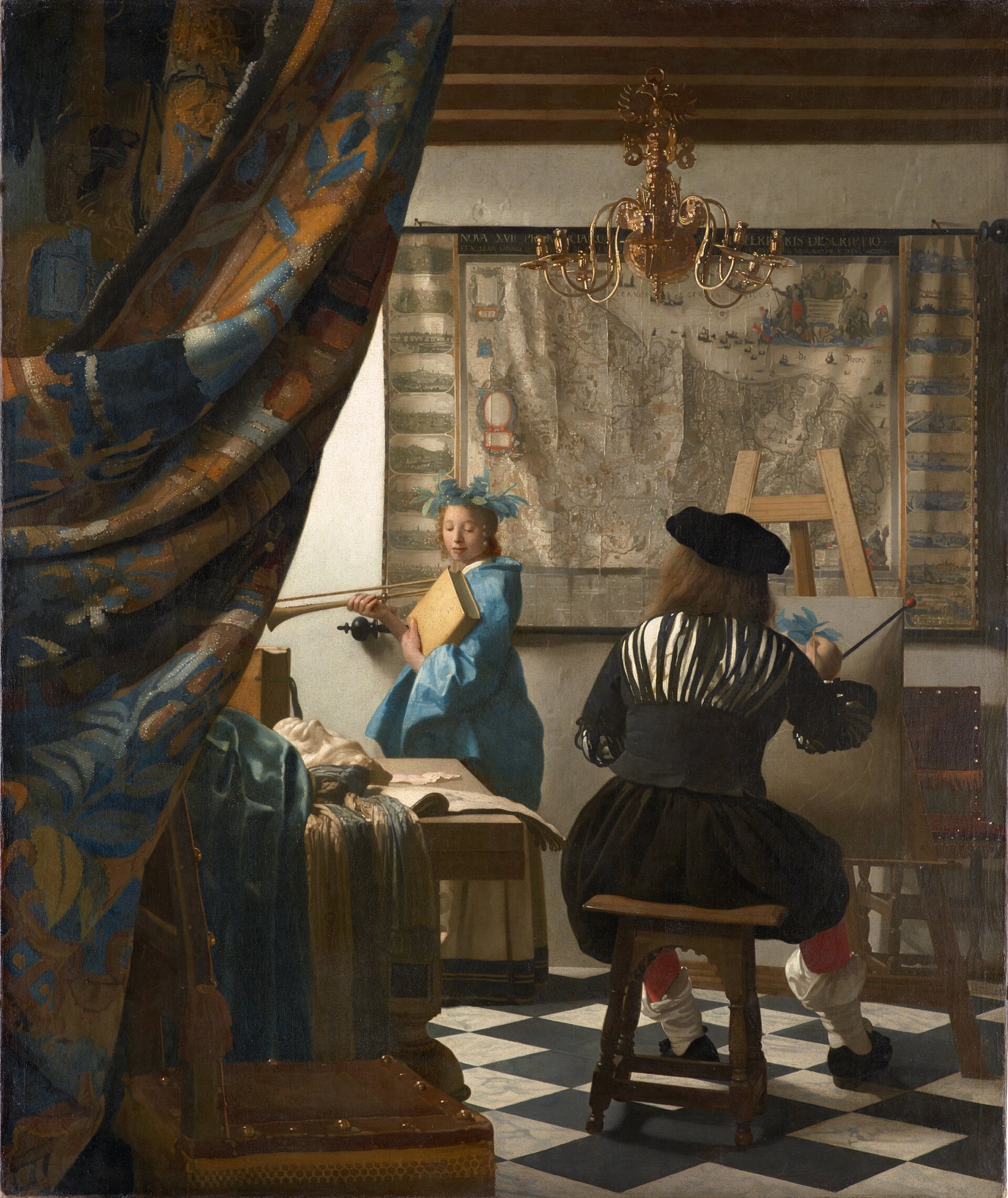
The Art of Painting is one of Vermeer’s largest and most ambitious works.
A painter sits with his back to the viewer at an easel.
A young woman stands as the model.
She wears attributes associated with Clio, the muse of history.
A large map hangs on the wall behind them.
The painting is not simply a studio scene.
Kunsthistorisches Museum scholarship treats it as an allegory of the art of painting.
Clio connects painting to history and fame. The map places the studio within the cultural and political geography of the Netherlands. The painter’s clothing, studio objects, curtain, chandelier, tiled floor, and model all contribute to a carefully staged meditation on art.
The spatial organization is remarkable.
A heavy curtain opens at the left as if revealing a theater.
A chair and table form barriers in the foreground.
The tiled floor leads inward.
The painter blocks part of the model from view.
The map flattens the rear wall even as the room extends toward it.
The viewer is allowed to see the act of painting but remains outside it.
Vermeer appears to have kept The Art of Painting throughout his life.
That fact has encouraged scholars to see it as unusually important to his sense of professional identity.
The Camera Obscura: Possibility, Not Proof
No subject in Vermeer studies has captured public imagination more than the camera obscura.
A camera obscura is an optical device in which light passes through a small opening or lens and projects an image onto a surface.
Certain qualities in Vermeer’s work resemble optical effects associated with such devices.
Bright highlights can appear as small disks or points. Foreground objects sometimes soften. Differences in apparent scale can feel lens-based. Rijksmuseum exhibition research notes that Vermeer may have studied visual effects with optical instruments.
That possibility deserves serious attention.
It is not proven.
No known document records Vermeer owning or using a camera obscura.
Mauritshuis scholarship continues to present the issue as a question rather than a settled fact.
More importantly, the paintings themselves show why a camera cannot be the complete explanation.
Vermeer changed compositions.
He moved architectural features.
He repainted objects.
He altered the balance in Woman Holding a Balance.
He simplified View of Delft.
He established perspective systems using practical geometric methods.
He built paintings through layered underpainting and final paint.
If he used a camera obscura, it would have been one source of visual information among many.
The real achievement is not finding a machine that “explains” Vermeer.
It is understanding how he combined optical curiosity, perspective, pigment, observation, editing, and imagination.
Perspective Without Mystery
Vermeer’s rooms often feel remarkably convincing.
Part of that effect comes from perspective.
Researchers have found small pinholes at the vanishing points of several interiors. A thread could be attached at the pinhole, stretched across the surface, coated with chalk, and snapped to establish the orthogonal lines of floors, windows, tables, and other receding forms.
This is a practical workshop method.
It does not diminish Vermeer’s achievement.
Perspective gives him a framework.
He then decides what to do within it.
A chair can be placed where it disrupts entry.
A table can push the viewer back.
A figure can sit slightly away from the geometric center.
The room therefore feels both mathematically coherent and psychologically controlled.
Geometry and human attention work together.
Pigments: How Vermeer Built Light with Material
Vermeer’s light is made from physical paint.
Technical research has identified a sophisticated palette that includes lead white, natural ultramarine, lead-tin yellow, earth pigments, blacks, red lakes, and other materials.
Ultramarine is especially famous in discussions of Vermeer.
Natural ultramarine was made from lapis lazuli and was expensive.
Vermeer used it prominently in obvious blue passages such as the head covering in Girl with a Pearl Earring, but his use of blue could also extend into shadows and mixtures where the pigment is less immediately visible.
This helps explain the unusual luminosity of some interiors.
Color in Vermeer is rarely isolated.
A “white” wall may contain warm and cool changes.
A yellow jacket may involve several pigments and reflected colors.
A shadow may contain blue rather than simply black or brown.
Light therefore does not sit on top of objects.
It changes their color.
Modern non-invasive imaging has allowed researchers to map these materials in extraordinary detail.
The Rijksmuseum’s technical studies have used macro X-ray fluorescence scanning, reflectance imaging spectroscopy, macro X-ray powder diffraction, and high-resolution photography to reveal pigments, first sketch phases, underlayers, and compositional changes.
These studies make Vermeer’s paintings more material, not less mysterious.
The luminous room is built from minerals, oils, opaque particles, transparent layers, and deliberate brushwork.
Bold Beginnings Beneath Calm Final Surfaces
Perhaps the most surprising recent insight into Vermeer concerns how energetically some of his paintings began.
National Gallery of Art imaging has revealed broad, forceful brushwork beneath the smooth final layers.
In Woman Holding a Balance, Vermeer first established forms, tonal patterns, colors, and illumination in a relatively bold underpainting.
These buried strokes look very different from the restrained final surface.
Researchers also detected a copper-containing material in black underpaint that would have helped the slow-drying black paint cure more quickly.
That is a practical studio decision.
It shows Vermeer thinking about workflow as well as beauty.
The discovery changes an old stereotype.
Vermeer was not necessarily painting every stage with microscopic slowness.
He could begin broadly.
Then he refined.
The stillness we see is the endpoint of a process that could be active, experimental, and efficient.
What to Look for in a Vermeer Painting
Start with the light.
In many interiors, it enters from the left.
Do not stop at locating the window.
Follow where the light is brightest, where it softens, and how it changes different materials.
Look at edges.
Some contours are crisp. Others dissolve.
A face may merge gently into shadow while a white collar or highlight is sharply accented.
These differences help create atmosphere and depth.
Notice barriers between you and the subject.
Vermeer frequently places a chair, table, curtain, tiled floor, or musical instrument in the foreground.
These objects keep the viewer from entering too easily.
They turn looking into a controlled act.
Follow the geometry.
Windows, maps, frames, floor tiles, tabletops, chair backs, and hanging fabrics create rectangles, diagonals, and measured divisions.
Then notice how the human figure interrupts that system.
Look for simplification.
A wall may be quieter than a real wall.
Architecture may be shifted.
A city may be cleaned up.
Objects may have disappeared during painting.
Vermeer removes information when it interferes with the image.
Watch small highlights.
Bread, pearls, ceramic glaze, wet lips, metal, and fabric can be suggested through tiny touches of light.
Those touches often produce more convincing material effects than exhaustive detail would.
Compare different paint handling.
A face can be softly modeled.
A collar can be built with thick white paint.
A blue passage can be transparent.
A wall can be thinly painted.
The picture is unified, but not mechanically uniform.
Finally, ask where the action is.
Often it is extremely small.
Milk pours.
A letter is read.
A scale waits.
A hand touches an instrument.
A woman turns.
Vermeer makes these tiny actions feel important by eliminating competing noise.
Delft: More Than a Background
Vermeer’s entire documented career is tied to Delft.
He was born there.
He joined its guild.
He married and raised his family there.
He dealt in art there.
He served as a guild officer there.
He died there.
View of Delft and The Little Street make the city visually explicit.
But Delft also exists indirectly inside the interiors.
Maps point outward toward trade, territory, travel, and politics.
Pearls, pigments, ceramics, textiles, paintings, furniture, and musical instruments reflect a prosperous urban culture connected to local and international exchange.
Natural ultramarine depended on lapis lazuli that had traveled vast distances.
Paintings inside Vermeer’s paintings connect his domestic rooms to the art market.
Letters introduce invisible relationships beyond the frame.
The room may look private.
Its materials connect it to a global world.
Financial Crisis and the Year of Disaster
Vermeer’s respected position in Delft did not protect his family from financial collapse.
In 1672, the Dutch Republic entered the Rampjaar, or “Year of Disaster,” as war and invasion caused severe political and economic disruption.
The art market suffered.
That mattered especially to Vermeer because he depended not only on painting but also on art dealing.
Catharina’s later bankruptcy petition described how the collapse left him unable to sell his own work effectively and forced him to dispose of art acquired for trade at heavy losses.
The financial pressure appears to have become extreme.
Vermeer died in Delft in December 1675 at only forty-three.
The exact cause of death is unknown.
Catharina described him as falling into illness and dying within a very short period after becoming overwhelmed by the family’s burdens.
He left eleven surviving children and substantial debt.
The bankruptcy proceedings that followed are tragic, but they are also historically valuable.
Inventories and petitions preserve details about the household, works of art, furniture, rooms, debts, and possessions that otherwise would have disappeared.
Rediscovery, Misattribution, and Forgery
Vermeer did not become completely unknown after his death.
Collectors continued to own and value his paintings.
The 1696 Dissius auction included twenty-one works attributed to him.
But his name gradually became confused with other artists, and paintings now recognized as Vermeer were sometimes attributed elsewhere.
His modern reputation was rebuilt largely during the nineteenth century.
French critic Théophile Thoré-Bürger became one of the most important figures in that rediscovery. Fascinated by View of Delft, he spent years tracing paintings connected with the artist he famously called the “Sphinx of Delft.”
Growing fame created a new problem.
Once Vermeer became rare and valuable, misattributions became commercially attractive.
The twentieth century produced one of art history’s most notorious forgery episodes when Han van Meegeren successfully created fake “Vermeers” that deceived experts and collectors.
That history makes attribution especially important today.
Museums do not rely only on whether a painting “looks like Vermeer.”
They examine canvas, ground, pigments, brushwork, underlayers, provenance, changes during painting, perspective methods, and comparison with firmly accepted works.
Scientific evidence has changed the accepted catalogue before.
It may do so again.
That is why it is better to say “about three dozen paintings are generally accepted” than to present one permanent exact number.
Attention as Vermeer’s Lasting Subject
Vermeer matters because he made attention visible.
He rarely depends on dramatic action.
Instead, he slows the viewer down.
A hand holding a balance becomes meaningful because the surrounding room is so carefully ordered.
A stream of milk becomes compelling because almost nothing else moves.
A young woman turning toward us becomes unforgettable because the background has been stripped away.
Light is not decoration.
It organizes the painting.
Geometry is not merely technical.
It controls distance.
Objects are not clutter.
They establish rhythm, meaning, and resistance.
Technical research has made this achievement more impressive rather than less mysterious.
Beneath the quiet surfaces are revisions, broad underpainting, optical experiments, perspective systems, costly pigments, practical drying strategies, and compositional changes.
The apparent perfection was constructed.
That is the crucial point.
Vermeer was not a mysterious genius who somehow painted perfect rooms outside ordinary artistic practice.
He was a professional painter, art dealer, guild officer, husband, father, and citizen of Delft who worked with materials, tools, conventions, patrons, and economic pressures.
The documents remain incomplete.
We do not know his exact birthday.
We do not know his teacher.
We do not know whether he used a camera obscura.
We do not know the identity of the Girl with a Pearl Earring.
Those gaps should remain gaps.
The paintings do not need invented answers.
What Vermeer left us is already extraordinary: a small body of works in which light, space, pigment, geometry, material, and human attention are organized with such precision that ordinary moments seem suspended outside time.
Sources & further reading
- Rijksmuseum — Vermeer exhibition texts and technical studies
- National Gallery of Art — Johannes Vermeer artist biography and technical research
Image credits and public-domain source records appear beneath each image.