J. M. W. Turner
J. M. W. Turner explored the power of light, weather and color in landscape and marine painting. His work ranges from precise early views to freely handled atmospheric scenes.
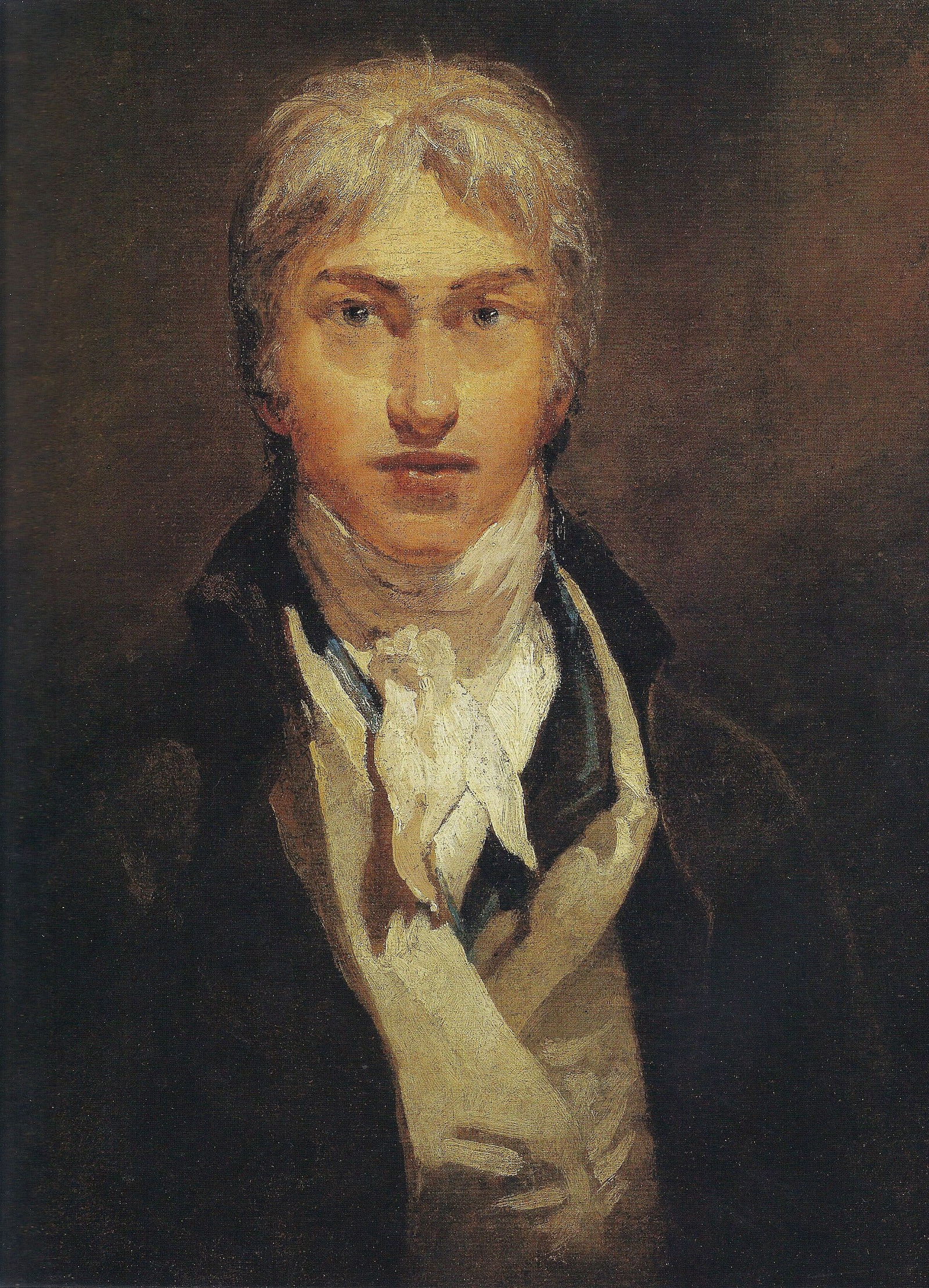

Born: approximately 1775-04-23
Died: 1851
Birthplace: Covent Garden, London, England
Nationality / cultural identity: British
Art movements / traditions: Romanticism
J. M. W. Turner: Life, Light, Landscape, and the Modern World
Why Turner Still Looks Radical
Joseph Mallord William Turner transformed landscape painting by making light, weather, movement, memory, history, and modern technology as important as the places he represented. Born in London in 1775, Turner began as a precise topographical watercolorist and architectural draftsman. By the end of his career, he was producing paintings in which ships, buildings, mountains, and even solid ground could seem to dissolve into rain, mist, fire, sunlight, or sea spray.
That progression is sometimes described as a march toward abstraction, but that can be misleading. Turner never simply stopped looking at the world. He traveled constantly, filled hundreds of sketchbooks, studied buildings and coastlines, observed storms, worked from firsthand experience, and returned to places repeatedly. His mature freedom grew out of decades of disciplined observation.
Turner’s achievement was to discover that a landscape did not have to be a neutral record of scenery. It could carry historical ambition, political urgency, technological change, terror, beauty, memory, and moral meaning. Ancient armies, slave ships, steam locomotives, Venetian palaces, burning government buildings, and ordinary stretches of coast could all become subjects for serious painting.
The phrase “painter of light” is therefore useful only if light is understood as more than a visual effect. In Turner, light can reveal or conceal, promise safety or intensify catastrophe, turn a sunset into an image of historical transition, or make a modern train seem to materialize out of the weather itself.
Early Life and Training
Turner was born near Covent Garden in London in 1775, the son of a barber. His talent developed early. At fourteen he entered the Royal Academy Schools, where he began in the Plaster Academy and later advanced to the Life Class.
His education also extended beyond the Academy. He worked for architectural draftsman Thomas Malton, gaining a strong command of perspective and built space. He colored prints and participated in the informal drawing circle organized by Dr. Thomas Monro, where young artists including Turner and Thomas Girtin studied and copied watercolors, prints, and topographical drawings.
These beginnings are essential to understanding the later work. Turner first built his reputation through careful drawing, perspective, and topography. His earliest exhibited pictures described recognizable monuments, rivers, towns, and landscapes with considerable precision.
He exhibited a watercolor at the Royal Academy in 1790 while still a teenager. His first exhibited oil painting followed in 1796. He became an Associate of the Royal Academy in 1799 and a full Academician in 1802. In 1807 he was elected Professor of Perspective.
Turner would later challenge many conventions of academic finish, but he did so from inside the system. He knew the rules of drawing, perspective, composition, and historical painting before deciding how far they could be stretched.
Travel and the Discipline of Observation
Travel was one of Turner’s most important working methods.
He moved extensively through England, Wales, and Scotland and, when political conditions permitted, across continental Europe. France, Switzerland, the Rhineland, the Netherlands, Italy, and especially Venice supplied him with recurring subjects.
Turner carried sketchbooks almost everywhere. More than three hundred survive. Many were small enough to fit in a pocket and contain rapid pencil notations, watercolor studies, architectural observations, coastline profiles, fragments of figures, weather effects, and written notes.
These sketchbooks show that Turner’s mature paintings were not produced by abandoning observation. Instead, observation became raw material.
A location might first be recorded in pencil. A later watercolor could isolate its light or weather. A finished oil might combine multiple viewpoints, alter the position of the sun, compress space, enlarge a storm, or move buildings to strengthen the composition.
That willingness to reconstruct a scene is one of Turner’s defining characteristics. He was less interested in literal transcription than in recreating the experience of seeing: glare, distance, speed, instability, heat, rain, atmospheric haze, and the emotional force of a place.
Watercolor as a Laboratory
Watercolor was central to Turner’s development, not a secondary medium.
During the 1810s and 1820s he pushed watercolor toward new levels of luminosity and flexibility. He could build broad zones of light and dark, lay transparent washes over one another, then scrape, blot, wipe, scratch, or redraw into the surface.
Instead of defining every object with a firm outline, he often allowed forms to emerge from color.
That approach shaped his oils as well. Turner increasingly used thin veils of paint, scumbling, dragged brushwork, translucent layers, and areas of exposed or lightly covered ground. Solid forms could appear only where they were needed and then dissolve elsewhere.
His involvement with printmaking also mattered. Watercolors prepared for engraved publications spread his imagery to a much wider audience and provided significant income. Projects devoted to rivers, ports, landscape tours, poetry, and travel helped establish Turner as both a painter and a visual interpreter of Britain and Europe.
The Liber Studiorum, produced from 1807 to 1819, was especially ambitious. Its title deliberately recalled Claude Lorrain’s Liber Veritatis. Turner used it to demonstrate the range of landscape through categories including marine, mountainous, historical, architectural, pastoral, and epic pastoral subjects.
The project amounted to a declaration: landscape could possess the variety and seriousness traditionally associated with history painting.
Claude Lorrain and the Old Masters
Turner’s originality did not depend on rejecting the past. He studied older painters intensely and measured himself against them.
Claude Lorrain was particularly important. Claude’s idealized landscapes, classical architecture, luminous distances, and carefully organized spaces gave Turner both a model and a rival.
Dido building Carthage, painted in 1815, makes the relationship explicit. The painting turns an episode from ancient history into a radiant architectural landscape. Figures appear in the foreground, but the city, water, and brilliant light dominate the experience.
Turner valued the painting enough to make it part of his plans for posterity. In his will, he required Dido building Carthage and Sun Rising through Vapour to be displayed in relation to major paintings by Claude at the National Gallery.
The instruction was more than admiration. Turner wanted future viewers to judge his achievement beside one of the canonical landscape painters of European art.
The Sublime and the Power of Weather
Turner’s Romanticism is often most visible in scenes where human beings confront forces much larger than themselves.
Snow Storm: Hannibal and his Army Crossing the Alps, exhibited in 1812, is a striking example. The ancient army occupies the landscape, but the storm is the real protagonist. A sweeping arc of cloud and darkness dominates the composition while soldiers appear small and vulnerable below.
The painting transforms history into an experience of the sublime: terror, awe, instability, and immense scale.
Turner returned repeatedly to similar tensions. Storms, shipwrecks, mountains, avalanches, fires, and violent seas allow nature to overwhelm ordinary human proportion. But he does not always present nature as simply hostile. Light can break through danger, and atmospheric beauty can coexist with catastrophe.
That contradiction became central to his mature art. A picture can be visually beautiful and morally disturbing at the same time.
The Modern World Enters Landscape Painting
Turner lived through enormous technological and social change. Steam replaced sail, railways transformed travel, industrial production reshaped landscapes, political reform altered public life, and debates about slavery, war, and labor intensified.
He did not ignore those changes.

Steamboats, railways, industrial smoke, coal workers, naval technology, modern ports, and contemporary disasters entered his art. The Museum of Fine Arts, Boston, has emphasized that Turner’s engagement with modern life extended to industrialization, abolition, war, political reform, and the social consequences of change.
This matters because Turner is often imagined as a painter retreating into timeless sunsets. In reality, some of his most important works depend on the collision between old and new.
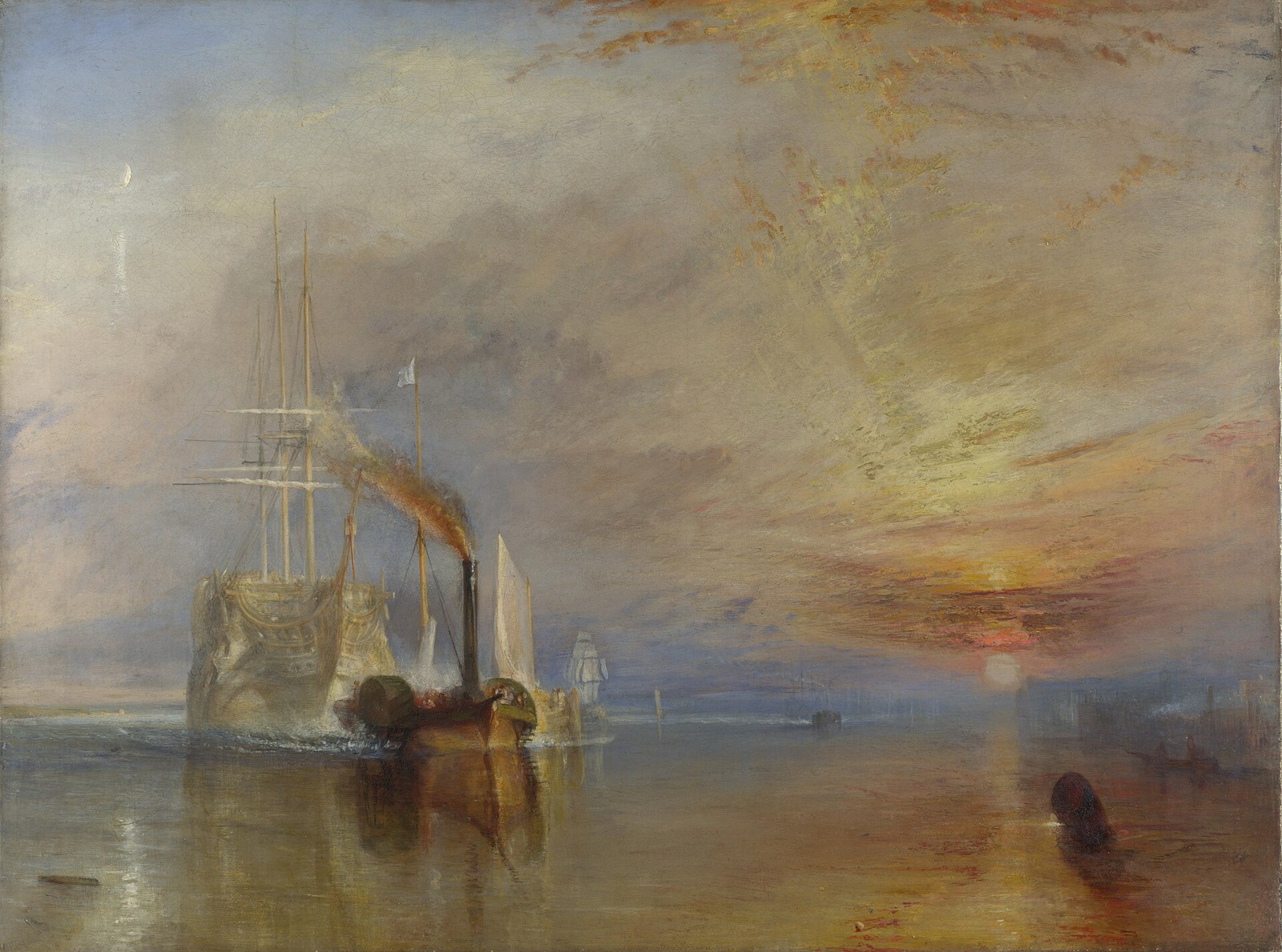
The Fighting Temeraire and Rain, Steam, and Speed are not only atmospheric landscapes. They are paintings about historical transition.
Five Paintings That Show Turner’s Development
Snow Storm: Hannibal and his Army Crossing the Alps — 1812
Turner uses ancient history here to stage a confrontation between human ambition and overwhelming nature.
Hannibal’s army is present, but there is no heroic commander dominating the scene. Instead, a vast rotating storm overwhelms the composition. The curve of cloud and darkness sweeps across the sky while soldiers struggle below.
The instability of the viewpoint is important. Turner does not allow the viewer to stand safely outside the event and inspect it. Weather obscures distance and scale. The picture is designed to make the eye feel uncertain.
This is an early example of Turner allowing atmosphere to become structure rather than merely surrounding the subject.
Dido building Carthage, or The Rise of the Carthaginian Empire — 1815
Dido building Carthage represents Turner at his most consciously classical.
The composition uses architecture, water, light, and small foreground figures to create an expansive vision of the ancient city. The eye moves through carefully arranged spatial layers toward a luminous distance.
Claude Lorrain’s influence is unmistakable, but Turner is not simply imitating Claude. He is testing how a British landscape painter of his own century might equal or surpass the ambition of an Old Master.
The painting’s later role in Turner’s will confirms how important that comparison was to him.
The Fighting Temeraire — 1839
The Fighting Temeraire shows the celebrated warship being towed toward its final dismantling after a long naval career.
The scene feels documentary, but it is carefully reconstructed. Turner probably did not witness the actual tow, and the National Gallery notes that he altered geography and the sunset for poetic effect.
That decision is central to the painting.
The pale, almost ghostlike Temeraire belongs to the age of sail and naval warfare. A compact dark steam tug pulls it forward. Behind them, the setting sun intensifies the sense of ending.
It would be too simple, however, to say that Turner merely mourns the past and rejects steam power. He was fascinated by modern transport and painted it repeatedly. The tug may look harsh beside the luminous old ship, but it is also the force moving history forward.
The picture works because Turner refuses to make technological change emotionally simple.
Slave Ship (Slavers Throwing Overboard the Dead and Dying, Typhoon Coming On) — 1840
Slave Ship is one of Turner’s most powerful and disturbing paintings.
The work is connected to the 1781 atrocity aboard the Zong, where enslaved people were thrown overboard so that their deaths could be treated as an insurance loss. Turner exhibited the painting in 1840, during a period of active international debate over slavery and abolition.
At first glance, the canvas can overwhelm through color. Reds, oranges, violet, dark water, and storm-filled light spread across the surface. Only after looking more closely do bodies, chains, and violence emerge in the foreground.
That sequence matters.
Turner makes visual beauty ethically uncomfortable. The sunset attracts the viewer, then the subject makes that attraction difficult to sustain innocently.
The Museum of Fine Arts describes the painting as a forceful indictment of the transatlantic slave trade. The approaching typhoon amplifies the human violence without excusing it: the catastrophe is both moral and elemental.
Rain, Steam, and Speed — The Great Western Railway — 1844
Rain, Steam, and Speed places a modern locomotive at the heart of landscape painting.
A train rushes toward the viewer across the Maidenhead Railway Bridge while rain, steam, smoke, and reflected light blur the boundaries between machine and atmosphere.
The bridge recedes steeply into the distance, intensifying the sense of motion. The locomotive is visible, but not crisply isolated. It seems to emerge from weather.
That fusion is the painting’s great invention. Turner does not simply place a train inside a traditional landscape. He makes the sensations of modern travel—speed, vibration, reduced visibility, compression of distance—part of the painting’s structure.
The work should not be reduced to a warning against industrialization. Turner traveled by modern forms of transportation and repeatedly made technology a subject. His response was complex: fascination, awe, disruption, and energy coexist.
What to Look for in a Turner Painting
Start with the source of light.
Find the sun, moon, fire, bright horizon, or opening in cloud that organizes the image. Then trace how the light moves across water, architecture, smoke, or weather.
Next, look for what is disappearing.
Turner often gives you enough information to identify a ship, bridge, building, mountain, or figure, then lets its edges dissolve. That loss of definition can suggest rain, mist, spray, glare, smoke, distance, or speed.
Follow the largest directional movement. A storm may spiral. A bridge may rush toward a vanishing point. Waves may push diagonally across the foreground. A band of sunlight may pull the eye toward the horizon.
Turner’s surfaces can look spontaneous, but the underlying composition is usually deliberate.
Notice scale. Small people, ships, or buildings often exist to make a mountain, storm, sea, or technological structure feel more powerful.
Watch warm and cool color. Turner frequently builds emotional force through the relationship between fiery yellow, orange, and red and cooler blue, gray, green, or brown. Color can carry structure even when outlines begin to disappear.
If the work is on paper, look at the paper itself. Areas of brightness may come from leaving the sheet relatively untouched, scraping back color, or manipulating transparent washes. In oils, thin and thick passages can similarly create shifts between luminosity and opacity.
Finally, ask what kind of truth Turner is pursuing. Is he recording a place accurately, combining several viewpoints, remembering an experience, altering geography, or constructing an impossible but emotionally convincing scene?
That question often reveals more than asking whether every detail is literally correct.
Venice: Architecture Dissolving into Light
Venice became one of Turner’s most important mature subjects because it brought together water, architecture, reflection, history, travel, and atmospheric instability.
In Venice: The Dogana and San Giorgio Maggiore of 1834, recognizable landmarks remain present, but they seem suspended inside light. Water reflects and breaks architecture into shifting color. Haze softens distance, and the sky occupies as much emotional space as the buildings.
Later Venetian works move even further in this direction. Palaces, towers, boats, and figures can become only partial anchors inside expanses of blue, yellow, pink, and white.
It is easy to look at these paintings and think ahead to Impressionism or abstraction. Those later comparisons help explain Turner’s influence, but they can also obscure his own concerns.
Turner remained deeply engaged with old-master landscape, poetry, travel, topography, history, and the visual culture of his own century. His innovation came from stretching those traditions until light and atmosphere could rival solid objects in importance.
Criticism, Ruskin, and the Late Style
Turner’s later work divided contemporary audiences.
Some viewers admired his daring handling of color and atmosphere. Others mocked paintings in which forms seemed unfinished, obscured, or overwhelmed by paint.
John Ruskin became Turner's most influential nineteenth-century defender. Ruskin argued that Turner’s apparently unconventional surfaces reflected a deeper attention to natural truth rather than technical incompetence. His defense eventually expanded into the multi-volume Modern Painters.
Ruskin played an enormous role in shaping Turner’s reputation, but his writings are interpretations, not direct transcripts of Turner’s intentions.
That distinction matters because Turner himself could be elusive. He was intensely ambitious but not always interested in explaining his pictures in straightforward terms. He sometimes attached poetic quotations or his own verse to paintings, yet the images often resist simple verbal translation.
The Turner Bequest
Turner thought carefully about what would happen to his work after his death.
He retained large numbers of paintings, drawings, watercolors, and sketchbooks rather than dispersing everything through the market. His will became legally complicated after his death in 1851, but the eventual 1856 settlement transferred an extraordinary body of art to the nation.
National Gallery archival records describe 100 finished pictures, 182 unfinished pictures, and 19,049 drawings and sketches entering the collection through that settlement. Broader modern descriptions of the entire Turner Bequest count nearly 300 oil paintings and around 30,000 sketches and watercolors, including roughly 300 sketchbooks.
The differing totals reflect different ways of cataloguing the huge body of material rather than a simple factual conflict.
Most of the Bequest is now associated with Tate Britain, while important paintings remain at the National Gallery.
Its importance is difficult to overstate. Because Turner preserved not just finished exhibition works but studies, sketchbooks, incomplete paintings, and experiments, viewers and scholars can follow his process unusually closely. The Bequest makes it possible to see the disciplined observation behind paintings that once seemed almost incomprehensibly free.
Turner’s Reach Beyond the Nineteenth Century
Turner changed what landscape painting could do.
He began in the topographical traditions of the eighteenth century, mastered academic perspective and historical composition, studied old masters, and then pushed those foundations toward something far more expansive.
Landscape in Turner could become political argument, historical meditation, sensory experience, technological spectacle, tragedy, or poetry.
His later surfaces influenced the way subsequent generations understood painting. Impressionists admired his concern with light and atmosphere. Modern viewers have often found parallels with abstraction. Yet Turner’s importance does not depend on calling him a painter born “ahead of his time.”
He was intensely of his own time.
He painted the transformation of Britain by steam, the moral horror of slavery, the legacy of war, the destruction of old institutions, the romance of travel, and the tension between human ambition and forces larger than ourselves.
His radicalism came from discovering that the visible world could be made more powerful by refusing to treat visibility as stable.
Rain obscures. Fire consumes. Light blinds. Speed compresses distance. Memory rearranges geography. Weather turns solid forms uncertain.
Turner made those conditions the substance of painting.
What Turner Changed
The best Turner paintings do not merely show a place or event. They make the viewer experience instability.
In The Fighting Temeraire, history seems to move forward even as the old ship moves toward destruction. In Slave Ship, beauty and horror occupy the same sunset. In Rain, Steam, and Speed, weather and technology become inseparable. In Hannibal crossing the Alps, human ambition is swallowed by the scale of a storm.
Across these very different subjects, Turner repeatedly asks what happens when the world cannot be seen clearly or held still.
That is why his art remains so immediate.
He understood that vision is affected by rain, glare, smoke, speed, distance, memory, emotion, and history. Instead of correcting those disturbances, he painted them.
Turner’s great innovation was not simply that he loosened his brushwork or used brilliant color. It was that he made uncertainty itself visible—and showed that landscape painting could describe not only what the world looks like, but what it feels like to encounter it.
Sources & further reading
- National Gallery, London — Joseph Mallord William Turner catalogue biography
- The Metropolitan Museum of Art — Joseph Mallord William Turner (1775–1851)
Image credits and public-domain source records appear beneath each image.