Ivan Aivazovsky
Ivan Aivazovsky specialized in seascapes, from storms and shipwrecks to maritime scenes. His reputation was built on the drama and atmosphere of the sea.
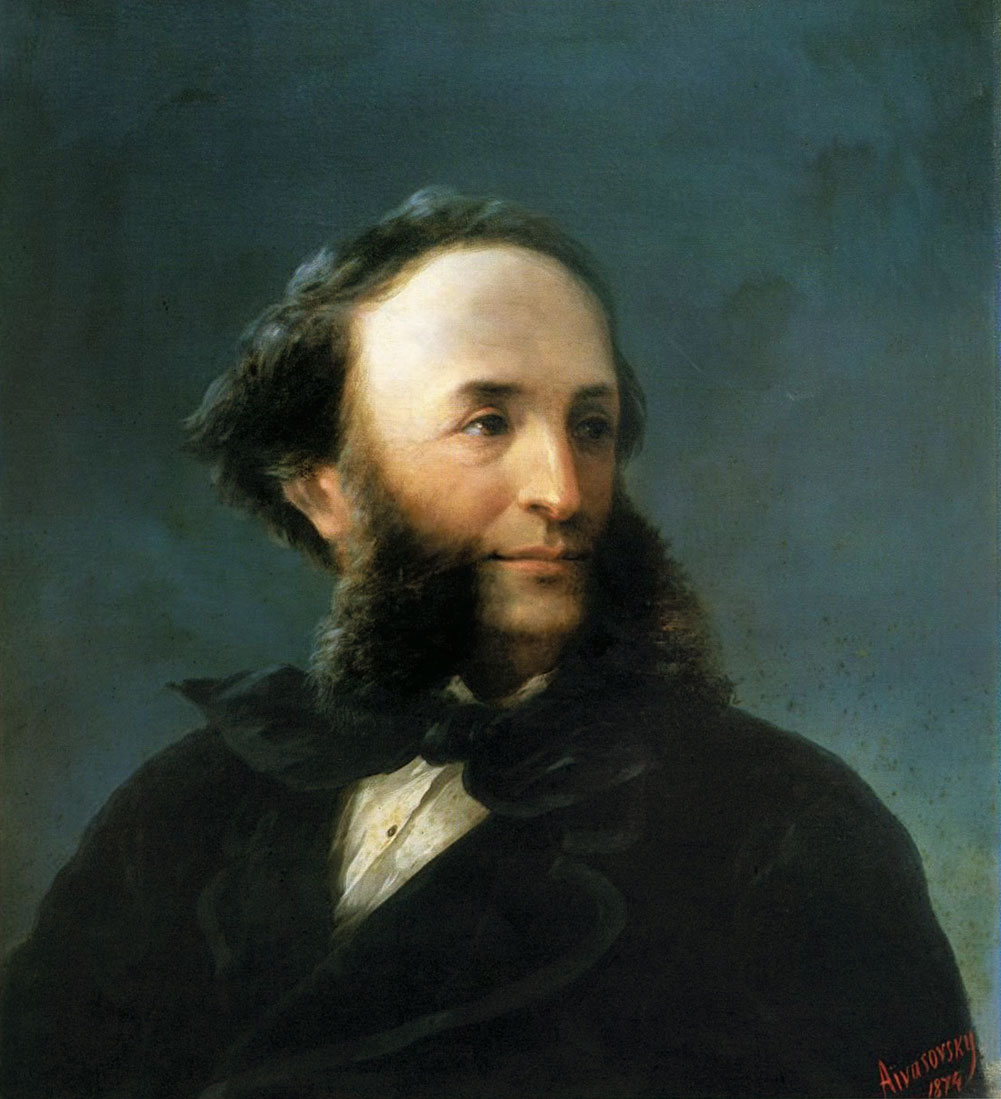

Born: 1817
Died: 1900
Birthplace: Feodosia, Crimea
Nationality / cultural identity: Armenian; worked in the Russian Empire
Art movements / traditions: Romanticism
Ivan Aivazovsky: Life, Seascapes, and The Ninth Wave
A Painter Who Made the Sea His World
Ivan Aivazovsky was one of the nineteenth century’s great painters of the sea. Born Hovhannes Aivazian in Feodosia, Crimea, in 1817, he came from an Armenian family living within the Russian Empire and developed a career that crossed artistic, cultural, and geographic boundaries. He trained at the Imperial Academy of Arts in Saint Petersburg, worked closely with the Russian naval establishment, exhibited across Europe and beyond, remained deeply connected to Armenian cultural life, and spent much of his long career returning to his Black Sea hometown.
Aivazovsky’s reputation rests on an extraordinary range of marine images: calm harbors, moonlit coasts, naval encounters, distant ports, shipwrecks, storms, sunrises, and enormous waves. His best-known painting, The Ninth Wave of 1850, has become almost synonymous with his name. Yet his achievement is broader than any single image. He spent decades exploring how water, sky, weather, light, and human scale could turn a seascape into an emotional experience.
The key to his art is not simply technical skill at painting waves. Aivazovsky understood the sea as something constantly changing and impossible to hold still. Rather than trying to copy a single wave exactly as it appeared, he observed the behavior of water and atmosphere, remembered those impressions, and reconstructed them in the studio. His paintings therefore combine close observation with invention. The sea feels believable, but it is organized for drama, mood, and meaning.
Feodosia, Armenian Heritage, and Early Talent
Aivazovsky was born in 1817 in Feodosia, a Black Sea port with a longstanding Armenian community. Armenian church records preserve the name Hovhannes, son of Gevorg Aivazian. In Russian contexts he became known as Ivan Konstantinovich Aivazovsky, while the Armenian form Aivazian remained part of his cultural identity.
Feodosia shaped his imagination from the beginning. The sea was not an occasional subject encountered on travel; it was part of the landscape of his childhood and later became the center of his professional life. Even after international success gave him the opportunity to live in larger artistic capitals, he repeatedly returned to Feodosia and eventually made the city the base of his mature career.
His talent was recognized early. After schooling in Simferopol, he entered the Imperial Academy of Arts in Saint Petersburg in 1833. There he studied landscape painting and gained specialized experience with marine subjects. The Academy gave him the disciplined drawing, composition, and painting skills expected of a professional artist, but his strongest subject soon became unmistakable.
The combination of academic training and direct experience of the Black Sea proved decisive. Aivazovsky learned the conventions of landscape and history painting, but he also studied ships, coastlines, clouds, surf, and changing weather. Those observations later supplied the visual memory from which he constructed many of his studio paintings.
The Imperial Academy and the Naval World
Aivazovsky advanced rapidly at the Academy and received opportunities that brought him into close contact with the Russian Navy. He traveled with naval expeditions, observed ships under different conditions, and became associated with the Main Naval Staff as a painter.
This relationship gave him access to subjects few landscape painters could study so closely. Sailing vessels, naval maneuvers, ports, and maritime history appear throughout his career. His knowledge of ships helped make even highly dramatic compositions convincing.
Yet Aivazovsky was never merely an illustrator of naval hardware. In his paintings, ships almost always exist within a larger atmospheric drama. Smoke from cannon fire can merge with cloud. Sails catch the same light that moves across the water. A vessel may be historically specific, but its emotional effect comes from the scale of the surrounding sea.
That balance between recognizable maritime detail and Romantic atmosphere became one of the defining characteristics of his art.
Italy, Travel, and International Recognition
In the early 1840s, Aivazovsky traveled and worked in Italy, where his reputation expanded rapidly. Mediterranean light and coastal scenery broadened his visual vocabulary, while exhibitions in major European cities introduced him to an international audience.
Italy was especially important because it confirmed that marine painting could support an ambitious career beyond the Russian Empire. Aivazovsky painted coastlines, harbors, moonlit water, and views connected with places such as Naples and Venice. He also came into contact with European collectors, academies, and exhibition networks.
Over the following decades he exhibited widely and received honors from artistic institutions in several countries. The State Russian Museum records participation in exhibitions from Saint Petersburg to Paris, London, Munich, Berlin, Philadelphia, and Chicago. He received France’s Legion of Honor in 1857.
His productivity became legendary. Aivazovsky himself claimed to have produced roughly six thousand paintings. That enormous number should be treated as an indication of scale rather than a statement that every work was equally ambitious. His long career included repetition, variations, smaller works, exhibition pieces, commissions, and major canvases. The finest examples, however, show why his technique and atmosphere became internationally admired.
Painting the Sea from Memory
One of the most important things to understand about Aivazovsky is that the apparent immediacy of his seascapes does not mean they were painted as direct copies of a single moment outdoors.
The State Russian Museum and Tretyakov scholarship both emphasize his reliance on visual memory. Aivazovsky observed the sea intensely, but he often painted later in the studio, reconstructing what he had seen and combining it with imagination. In some cases he worked without extensive preparatory drawing.
That method was well suited to the subject. A wave changes before an artist can fully describe it. Clouds shift, spray disappears, reflections move, and the relationship between sky and water is continuously altered by light. Instead of trying to freeze one instant mechanically, Aivazovsky learned recurring patterns.
He understood how a crest becomes translucent as light passes through thinner water; how distant forms soften in haze; how moonlight creates a vertical or diagonal path across a dark surface; and how a small vessel can make the surrounding sea feel immeasurably large.
This is why his paintings can appear naturalistic without being literal records. They are constructed memories of nature.
Light and Transparency
If the sea is Aivazovsky’s great subject, light is the force that gives it life.
The Latvian National Museum of Art has emphasized the importance of glazing and specialized brushwork in his paintings. Thin, transparent layers allow color and luminosity to build gradually. Rather than treating water as an opaque blue surface, Aivazovsky often suggests depth by allowing darker tones to remain visible beneath lighter or more transparent passages.
Look closely at one of his illuminated waves and the color can become surprisingly complex. Green, brown, gray, blue, and warm reflected tones may all appear within the same mass of water. Near the crest, the wave can brighten as if light is passing through it. Foam then sits across the surface as a lighter, more opaque layer.
Aivazovsky used similar control in skies. Dawn may emerge behind storm clouds, moonlight may dissolve architecture into haze, or a sunset may organize the entire picture around bands of warm color.
Light therefore does more than describe time of day. It creates emotional meaning.
Romanticism and the Power of Nature
Aivazovsky’s strongest paintings belong naturally within Romanticism because they emphasize awe, danger, beauty, memory, emotion, and the overwhelming scale of nature.
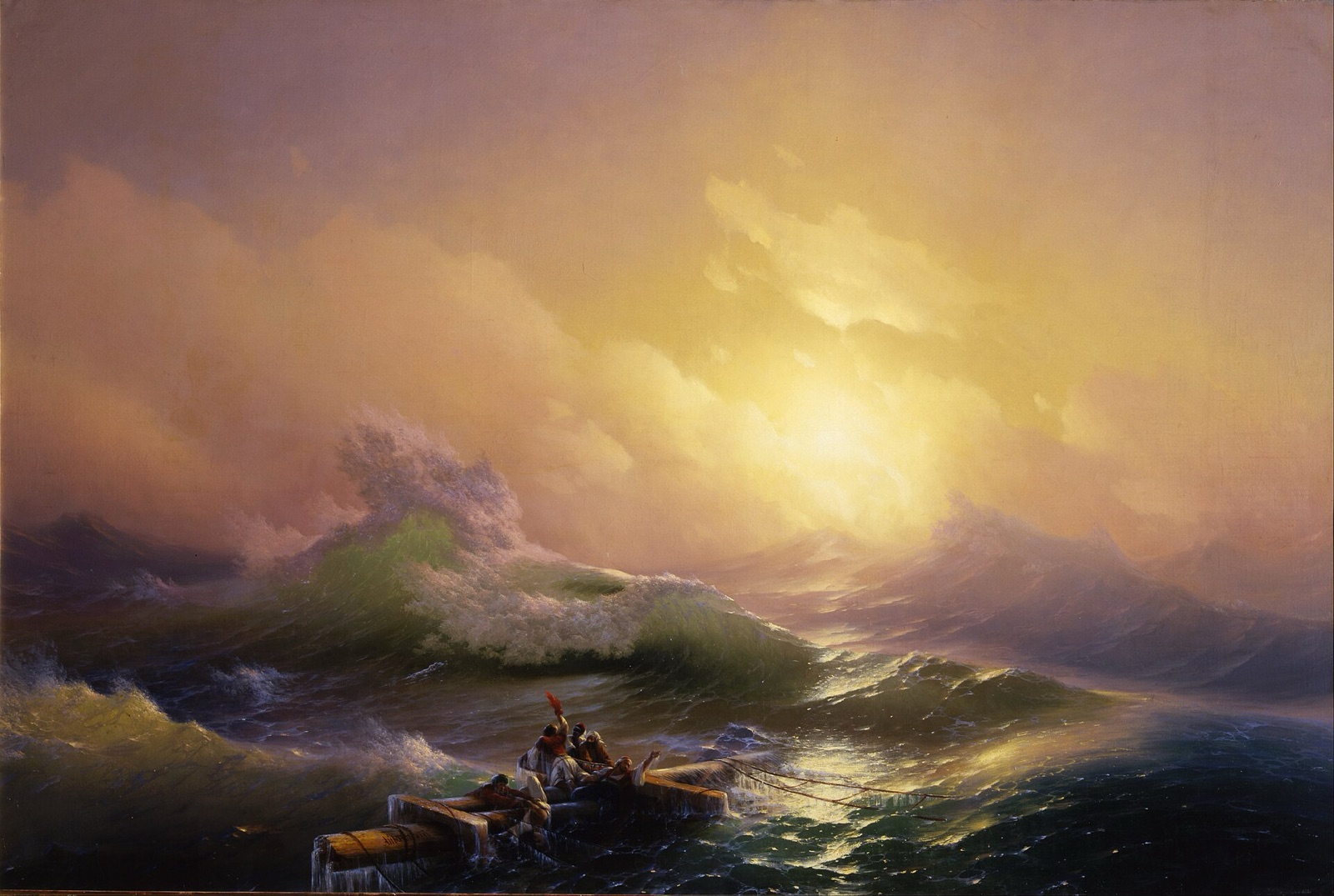

People and ships are frequently small. That scale matters. A person clinging to wreckage can be physically tiny yet emotionally central because the surrounding sea makes human vulnerability impossible to ignore.
At the same time, Aivazovsky rarely presents nature as only destructive. Light often survives inside danger. The sea can be terrifying, but a horizon opens beyond it. A ship can be damaged but still moving. A storm can be illuminated by dawn.
This tension between danger and hope reaches its most famous expression in The Ninth Wave.
Five Works That Show Aivazovsky’s Range
The Shore of the Sea. Calm — 1843
The Shore of the Sea. Calm shows how much Aivazovsky could accomplish without a storm, battle, or shipwreck. Painted in 1843, the work belongs to his early mature period and is associated with impressions of southern Europe.
The water is quiet and the drama restrained. Atmospheric transition becomes the subject. Sea, sky, shore, and distance are connected through carefully controlled tone.
This kind of work is important because it reveals that Aivazovsky’s technique was not dependent on spectacle. In a calm sea, small shifts of light and haze have to carry the painting.
A View of Constantinople by Moonlight — 1846
A View of Constantinople by Moonlight demonstrates how travel and atmosphere could merge in Aivazovsky’s art. The State Russian Museum records that he worked on the painting from January to March 1846.
The city is identifiable, but the picture is not primarily a topographical inventory of buildings. Moonlight transforms the setting. Architecture, sails, water, and distance are absorbed into a unified nocturnal atmosphere.
Aivazovsky visited Constantinople repeatedly over his career and found in the Bosphorus a subject ideally suited to his interests: water, shipping, monumental architecture, and changing light. In this painting, the city becomes almost inseparable from the moonlit sea around it.
Mercury Brig Meeting a Russian Squadron after her Victory over Two Turkish Vessels — 1848
This 1848 painting connects Aivazovsky’s marine art directly with naval history. The brig Mercury became famous after surviving an 1829 encounter with two much larger Ottoman warships.
Aivazovsky chose to show the aftermath rather than the most violent moment of combat. The damaged brig moves toward the Russian squadron after escaping its opponents.
That decision says much about his approach. The painting is historical, but its emotional force comes from the open water, wind-filled sails, cloud, distance, and the ship’s movement toward safety. The sea remains more than a backdrop.
The Ninth Wave — 1850
The Ninth Wave is Aivazovsky’s most celebrated painting and one of the defining marine images of nineteenth-century Romanticism.
A small group of shipwreck survivors clings to broken mast timbers while immense waves rise around them. The title refers to a traditional belief that a culminating wave could be the most powerful in a sequence.
What makes the painting memorable is not simply the size of the water. It is the contradiction between danger and illumination.
The sea is enormous and the survivors appear fragile. Yet warm sunrise color spreads across the sky and water. The Russian Museum emphasizes this “light of hope,” and that idea is essential to the painting’s effect. The storm has not ended, but darkness is breaking.
Notice how Aivazovsky makes the central wave translucent. Light enters the upper part of the water, turning what could have been a solid wall into a glowing structure. The painting is therefore frightening and beautiful at the same time.
Wave — 1889
Wave, painted in 1889 when Aivazovsky was in his seventies, provides an important contrast with The Ninth Wave.
The State Russian Museum describes it as an example of his late style, with a colder, darker atmosphere and a more severe treatment of nature. A damaged ship struggles within chaotic water under heavy clouds.
The difference in mood is striking. The Ninth Wave contains a powerful sense of possible survival. Wave is far less reassuring. The sea feels heavier and the human struggle more desperate.
Seen together, these works show that Aivazovsky did not simply repeat one successful formula throughout his career. He continued to adjust color, atmosphere, and emotional tone even when returning to familiar subjects.
What to Look for in an Aivazovsky Seascape
Begin with the source of light.
Before concentrating on the ship or wave, locate where the illumination comes from. Is it dawn, sunset, moonlight, a break between clouds, or an unseen light beyond the edge of the canvas? Once you find it, notice how it controls the rest of the painting.
Then look at the horizon. Aivazovsky frequently softens the boundary between sea and sky with haze. That loss of sharpness creates distance and makes the visible space feel much larger than the canvas.
Look through the wave rather than only at its surface. The crest is often brighter and more transparent than the deeper water below it. This variation gives the wave volume and movement.
Notice the human scale. A small figure, lifeboat, mast, or sailing ship is often the measurement by which you understand the sea’s size. Remove those elements and the water would seem far less immense.
Follow the diagonals. Waves, masts, coastlines, clouds, smoke, and reflected light frequently guide the eye through the composition. The apparent spontaneity of a storm is often supported by a carefully planned structure.
Watch the color temperature. Warm light against cold water can produce hope or transcendence. A colder overall palette can make the sea feel harsher, as in Wave.
Finally, remember the role of memory. The question is not simply “Did a wave look exactly like this?” A more useful question is “How has Aivazovsky organized what he knows about waves, weather, and light to create this particular emotional effect?”
Feodosia and the Artist as Citizen
Aivazovsky’s international success never broke his attachment to Feodosia.
He built his life around the city, maintained his house and studio there, and opened a picture gallery in 1880. The Metropolitan Museum of Art notes that it became one of the earliest public art galleries in the Russian Empire.
His civic involvement extended much further. Scholarship published by the Tretyakov Gallery documents his role in projects connected with Feodosia’s water supply, port, railway, archaeology, education, and cultural institutions. He invested personal money and used his influence to improve the city.
The water project is especially revealing. Feodosia suffered from shortages, and Aivazovsky helped provide access to water from springs connected with his property. His name became associated not only with paintings of water but with the practical problem of supplying it to his hometown.
The gallery was perhaps his most lasting cultural contribution to Feodosia. He eventually bequeathed it to the city, linking his artistic legacy directly to the place where he had been born and where he chose to spend so much of his life.
Armenian Identity and Cultural Commitment
Aivazovsky’s Armenian identity was not merely a genealogical detail.
The Met identifies him as Armenian, and scholarship on Aivazovsky and his brother Gabriel documents his extensive involvement with Armenian religious, educational, and cultural institutions. He supported churches and schools, maintained ties with Armenian communities during his travels, and painted subjects connected to Armenian history and religion.
His brother Gabriel became a prominent Armenian churchman, educator, and scholar. The brothers’ lives followed different paths, but their cultural commitments remained closely connected.
Aivazovsky also painted Mount Ararat, Lake Sevan, Armenian religious subjects, and works for Armenian institutions. Tretyakov Gallery scholarship records his support for Armenian churches and schools in several places and his financial contributions to community projects.
Late in his life, reports of the mass violence against Armenians in the Ottoman Empire affected him deeply. Surviving correspondence quoted in Tretyakov scholarship records his sorrow over the 1894–95 massacres, and he created paintings in response. In 1897 he exhibited works in Odessa and directed proceeds toward Armenian and Greek victims.
This history adds an important dimension to an artist often presented only as a virtuoso painter of waves. Aivazovsky’s public identity, philanthropy, and cultural commitments were part of the same long career.
A Global Career with Several Histories
Aivazovsky does not fit neatly into a single national story.
He was Armenian by family and cultural identity. He was born and worked within the Russian Empire and was trained by its leading art institution. He was closely associated with the imperial navy. He lived in Crimea, traveled widely, painted Constantinople repeatedly, worked for patrons across Europe and the Ottoman world, and became internationally famous.
That complexity is not a problem to be solved by choosing one label and discarding the others. It is part of what makes his career historically interesting.
His paintings traveled even more widely than he did. They appealed to Russian, Armenian, Greek, Ottoman, European, and later American audiences for different reasons. Marine painting gave him a language that could move easily across borders while still remaining connected to specific histories and places.
International Reputation and Afterlife
Aivazovsky died in Feodosia in 1900 after more than sixty years of professional activity.
His popularity during his lifetime was immense, and it has never fully disappeared. The Ninth Wave remains one of the best-known paintings associated with nineteenth-century art of the Russian Empire, while his seascapes continue to attract viewers who may know little about the historical context in which they were created.
Popularity can sometimes work against critical reputation. Aivazovsky’s huge output, technical fluency, and repeated use of similar subjects have encouraged the idea that his work was formulaic.
There is some reason for caution when dealing with such an enormous body of work. Not every seascape is equally inventive. But the strongest paintings make clear why he mattered. He understood how to organize light, atmosphere, scale, and movement so effectively that viewers can almost feel the unstable surface of the sea.
His legacy also extends beyond painting. The gallery and civic projects associated with Feodosia, his support of Armenian cultural institutions, and his position at the intersection of several artistic and national histories make him more complex than the label “marine painter” suggests.
The Sea as Memory, Drama, and Light
Aivazovsky painted the sea repeatedly because it was never truly the same subject twice.
Calm water, moonlight, a naval return, a wreck, a sunrise after disaster, and a late-life storm all allowed him to investigate different relationships between human beings and nature.
His most convincing paintings make viewers feel the scale and instability of that relationship. The water may be beautiful, but it is never entirely under human control. Ships can navigate it, people can survive it, and painters can study it, yet the sea always remains capable of change.
Aivazovsky’s technique served that idea. Memory freed him from copying a single instant. Glazing gave water depth and light. Small ships established scale. Haze stretched the horizon. Warm and cool color determined whether the same ocean felt hopeful, peaceful, or terrifying.
That is why The Ninth Wave remains so powerful and why the quieter paintings deserve equal attention. Aivazovsky did not simply specialize in painting water. He built a visual language for the experience of confronting something vast, luminous, beautiful, and beyond complete control.
Sources & further reading
- The Metropolitan Museum of Art — Ivan Konstantinovich Aivazovsky (Hovhannes Aivazian)
- State Russian Museum — The Ninth Wave and Aivazovsky biography
Image credits and public-domain source records appear beneath each image.