Hieronymus Bosch
Hieronymus Bosch filled religious and moral subjects with extraordinary creatures and intricate imagined worlds. His paintings reward close looking at both their stories and their details.
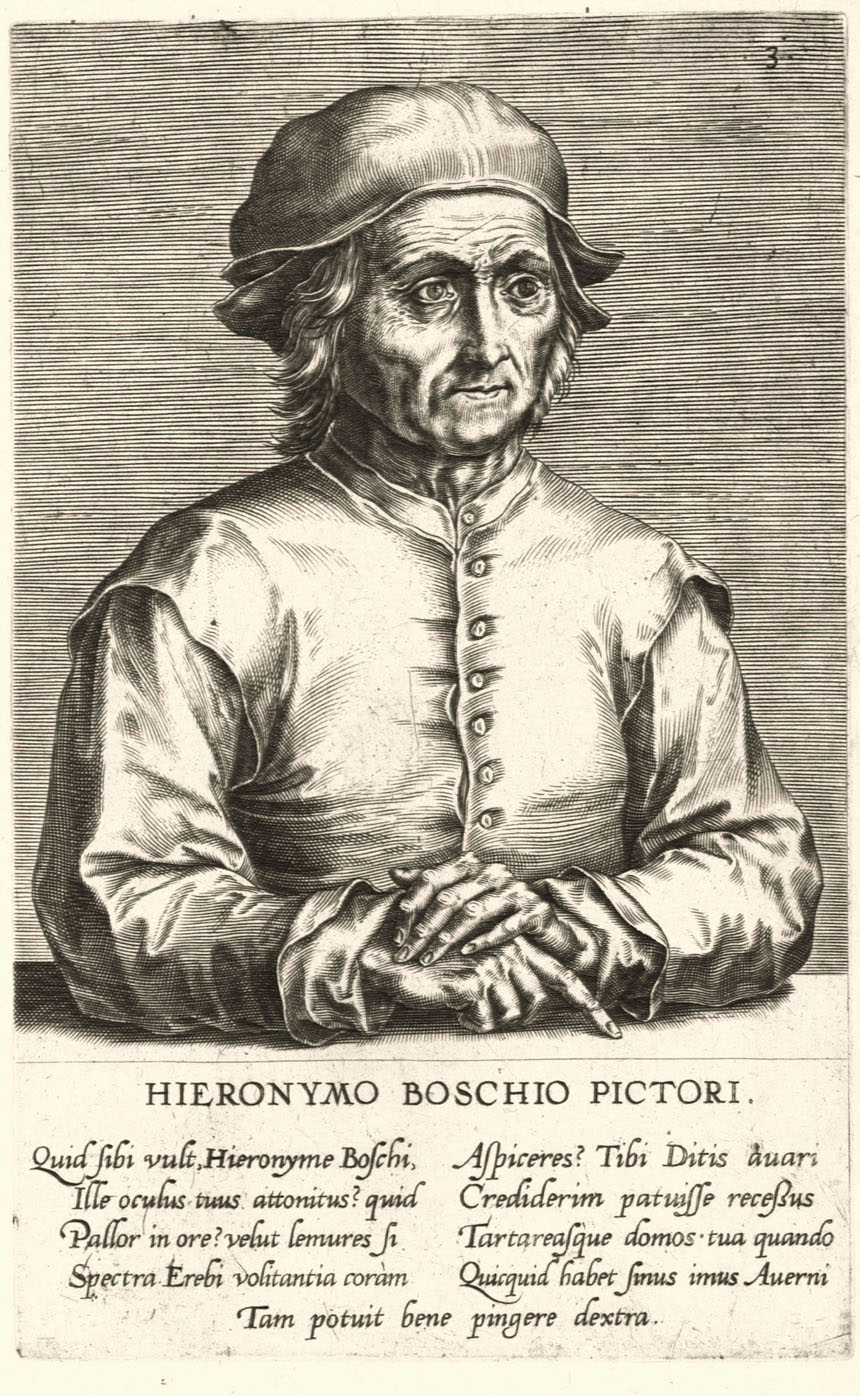

Born: approximately 1450
Died: 1516
Birthplace: ’s-Hertogenbosch, present-day Netherlands (uncertain)
Nationality / cultural identity: Netherlandish
Art movements / traditions: Early Netherlandish painting; Northern Renaissance
The exact birthplace is uncertain; the biography below explains the limits of the surviving evidence.
Hieronymus Bosch: Life, Paintings, and the Garden of Earthly Delights
Why Hieronymus Bosch Still Looks So Strange
Few painters from around 1500 feel as immediately recognizable as Hieronymus Bosch. His worlds teem with hybrid animals, fragile bodies, burning cities, enormous fruits, strange machines, musical instruments turned into instruments of punishment, and buildings that look simultaneously organic and engineered. Yet the fascination of Bosch’s art does not come from strangeness alone. Beneath the fantasy is a persistent concern with human behavior: desire, greed, foolishness, violence, temptation, fear, devotion, judgment, and the possibility of salvation.
That combination helps explain why Bosch has been rediscovered again and again. Modern viewers can respond to the sheer imaginative force of The Garden of Earthly Delights without knowing its theological background, while scholars can spend decades debating the meaning of a single detail. The paintings invite close looking but resist easy decoding.
Bosch belonged to the religious and cultural world of the late fifteenth- and early sixteenth-century Low Countries. He was not a Surrealist centuries before Surrealism, and his monsters should not automatically be read as records of dreams or hallucinations. His imagery grew from Christian belief, devotional culture, biblical texts, proverbs, moral literature, public spectacle, workshop practice, and a remarkably inventive visual imagination. Understanding that historical setting makes the paintings stranger in a more interesting way: Bosch was using recognizable ideas from his own world and pushing them into forms no one else quite imagined.
What We Actually Know About Bosch
Bosch’s documented biography is much thinner than his modern fame might suggest. He was born around 1450, but the exact year is uncertain. Even his precise birthplace cannot be securely established from surviving records. His birth name was Jheronimus, or Jeroen, van Aken. The name Bosch came from ’s-Hertogenbosch, the city with which his life and career became closely identified.
The van Aken family had been associated with painting for generations. Bosch’s father, Anthonius van Aken, was a painter, as were other relatives. No surviving document records Bosch’s training, so it is safest to say that he probably learned in the family environment rather than claim details that are not known.
The first archival reference to him dates from April 5, 1474. By then he was appearing in legal documents alongside members of his family. He later married Aleid van de Meervenne, a woman from a prosperous local family. A document of June 1481 already identifies Bosch as her husband, and surviving property records show that their marriage had taken place sometime between 1477 and 1481. They had no known children.
These records complicate the popular image of Bosch as an isolated eccentric. He was a property-owning citizen with family connections, patrons, religious affiliations, and a respected place in urban society.
’s-Hertogenbosch and the Brotherhood of Our Lady
Bosch spent his documented adult life in ’s-Hertogenbosch, a prosperous city in the Duchy of Brabant. Its market square brought together merchants, craftspeople, clergy, travelers, officials, performers, and people from different social levels. Religious processions and ceremonies existed alongside trade, festivals, public entertainment, and ordinary daily life.
That environment matters because Bosch’s art is full of observation. His landscapes may contain impossible creatures, but the people inside them behave in sharply recognizable ways. They quarrel, bargain, flirt, drink, sing, gamble, pray, stare, deceive, carry burdens, follow crowds, and chase after things they desire.
Bosch’s membership in the Brotherhood of Our Lady provides some of the strongest documentary evidence for his status. He entered the confraternity as an ordinary member in 1486/87 and became a sworn member the following year. That was a significant advancement into a smaller and more prestigious circle.
The Brotherhood was centered on devotion to the Virgin Mary at the church of Saint John. It also functioned as a social network connecting religious practice with influential members of the city. Bosch’s participation places him firmly inside the religious culture that shaped many of his themes. Sin, temptation, mortality, salvation, judgment, and spiritual attention were not exotic subjects imposed on his pictures by later interpreters; they were central concerns of his society.
A Moral Imagination, Not a Symbol Dictionary
Bosch’s imagery has encouraged generations of viewers to search for hidden meanings. Sometimes that is productive. A motif may relate to a biblical passage, proverb, devotional text, saint’s legend, or moral convention. But the desire to decode Bosch can easily become more confident than the evidence allows.
The safest way to approach his symbolism is to begin with large patterns before assigning exact meanings to small objects. Bosch repeatedly shows people becoming absorbed in temporary pleasures, material possessions, sexual desire, entertainment, violence, or foolish behavior. Saints and sacred figures, by contrast, often struggle to maintain spiritual concentration within a world full of distraction.
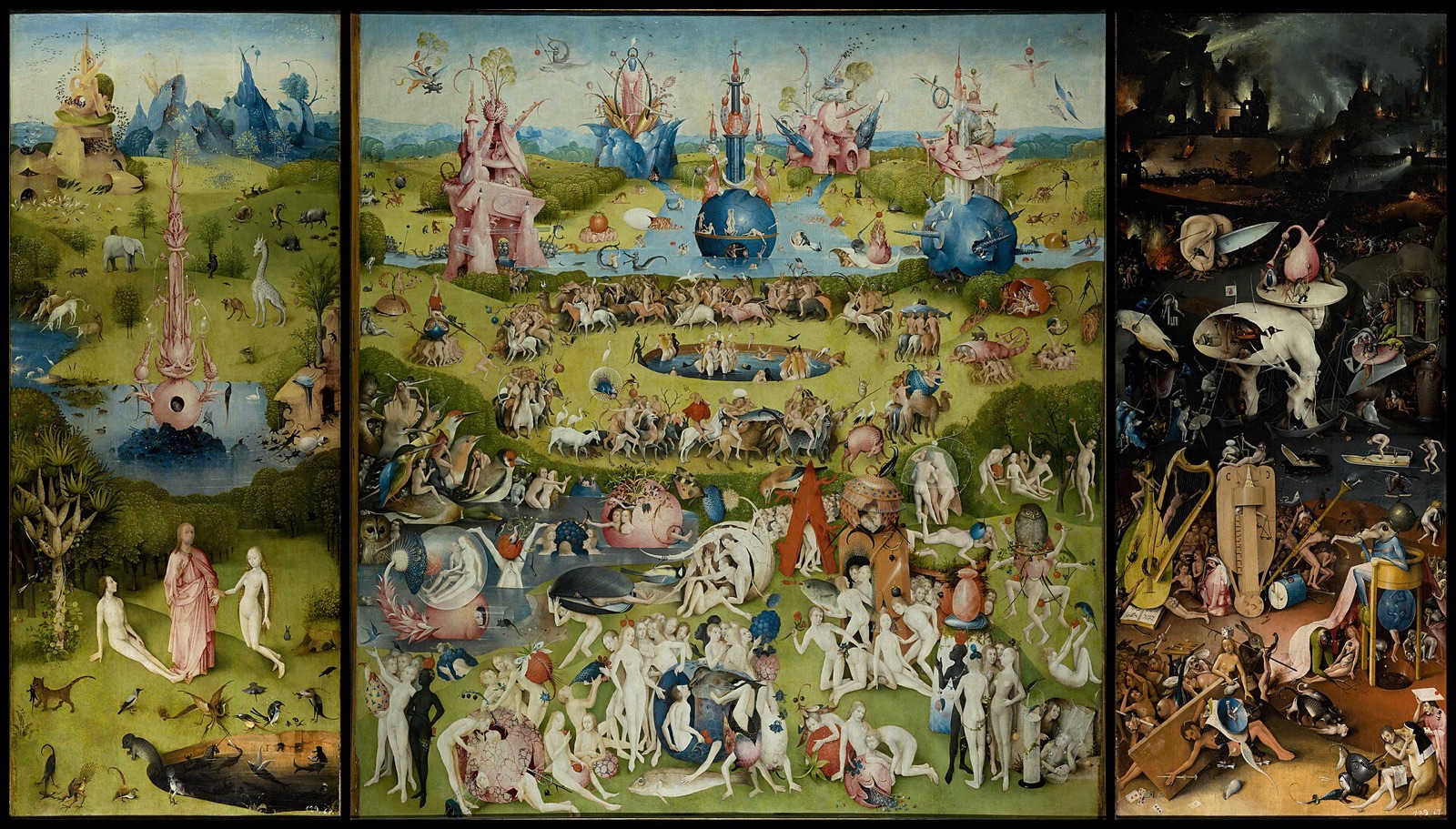
The Garden of Earthly Delights demonstrates the problem perfectly. Its three open panels move from a paradisiacal beginning through a densely populated central world to a terrifying vision of punishment. That broad progression is visible. The precise meaning of every fruit, bird, shell, glass tube, gesture, and hybrid creature is not.
That uncertainty is not a weakness. It is part of what makes Bosch powerful. The paintings rarely operate like diagrams with one correct answer. They establish moral tension through accumulation, contrast, surprise, repetition, and visual instability.
How Bosch Painted
Bosch generally painted in oil on oak panels, a standard support in Northern European painting of his period. What distinguishes him is not an exotic material but what he did with it.
Modern technical examination has revealed extensive underdrawing beneath the paint. Infrared reflectography allows scholars to see preliminary lines that Bosch later covered, altered, or abandoned. These changes, known as pentimenti, show that he often developed ideas during the making of a painting rather than mechanically following a fully fixed design.
The National Gallery’s Christ Mocked is particularly revealing. In the underdrawing, Christ’s tormentors originally behaved with greater physical aggression. During painting Bosch reduced some of that violence. The final scene is therefore not simply a painted version of the first design. Its psychological tension was refined through revision.

The paint itself can be surprisingly economical. Bosch used thin layers in places, worked wet paint into wet paint, dragged or feathered strokes with brushes, and allowed aspects of the underdrawing to remain perceptible beneath lighter passages. His technical control matters because the apparent chaos of his inventions is often supported by very deliberate design.
In crowded scenes, Bosch can make dozens of tiny episodes remain legible. In more concentrated works, he can build tension through a handful of faces and hands. The imagination is extravagant; the construction is disciplined.
Five Works That Reveal Bosch’s Range
Triptych of the Adoration of the Magi — circa 1494
The Prado’s Triptych of the Adoration of the Magi is essential because it shows Bosch working with a familiar Christian subject while already introducing the unsettling details that make his art distinctive. The triptych was commissioned by Peeter Scheyfve and Agneese de Gramme of Antwerp and can be dated to around 1494.
At the center, the Magi approach the Christ Child, but the scene is surrounded by details that complicate its apparent serenity. The architecture is unstable, distant landscapes contain secondary episodes, and an enigmatic nearly naked figure appears at the doorway behind the kings.
The work also reminds us that Bosch’s imagination was not opposed to traditional devotion. He could operate inside an established religious subject while making the viewer alert to danger, prophecy, and the larger drama of salvation.
The Garden of Earthly Delights — 1490–1500
The Garden of Earthly Delights is Bosch’s most famous painting and his most difficult to summarize. The Prado dates the triptych to 1490–1500.
When closed, the work presents a muted vision of the world. Once opened, its scale and color change dramatically. The left panel presents a paradisiacal setting with God, Adam, and Eve. The central panel becomes an extraordinary field of nude figures, animals, oversized fruit, pools, transparent forms, and fantastical architecture. The right panel transforms that visual abundance into darkness, punishment, fire, and grotesque torment.
The central panel has inspired competing interpretations for centuries. It is better to acknowledge that uncertainty than to pretend there is a universally accepted solution. What can be seen clearly is Bosch’s concern with attraction and consequence. Things are beautiful and unstable at the same time. Pleasure is everywhere, but permanence is nowhere.
Look also at the scale shifts. Birds become enormous. Fruit becomes architecture. Bodies enter shells, spheres, plants, and structures. Bosch continually takes something familiar and changes its size, context, or function until it becomes both recognizable and impossible.
Saint Christopher Carrying the Christ Child — circa 1490–1505
Bosch’s Saint Christopher, now associated with Museum Boijmans Van Beuningen, shows how he could build a large landscape around a single devotional narrative. Christopher carries the Christ Child across the water, discovering that the child bears a supernatural weight.
The principal story is clear, but Bosch surrounds it with incidents that reward slow looking. Odd structures, distant figures, and unusual creatures occupy the landscape. The painting creates a productive tension between the saint’s task and the distractions around him.
That tension is characteristic of Bosch. A sacred figure may provide the spiritual center of a composition, but the eye is constantly tempted to wander elsewhere.
Christ Mocked (The Crowning with Thorns) — about 1510
Christ Mocked in the National Gallery proves that Bosch did not need a landscape full of monsters to create an unsettling image. The composition is extremely compressed. Christ occupies the center while four tormentors close in around him.
Bosch organizes the image through shapes, diagonals, color relationships, gazes, and a striking sequence of hands. Christ’s pale clothing separates him visually from the surrounding figures, while his stillness contrasts with their invasive closeness.
Technical examination makes the painting even more revealing. The tormentors were more overtly violent in the underdrawing. By reducing their physical aggression, Bosch made their expressions and intentions harder to read. The final image is disturbing because it is controlled rather than because it is chaotic.
The Haywain Triptych — 1512–1515
The Haywain Triptych turns a familiar object into the center of a moral spectacle. The Prado dates the work to 1512–1515.
A massive cart of hay moves through the central panel while people from different levels of society scramble to obtain pieces of it. Clergy, rulers, nobles, and ordinary people are all implicated. Demonic forces guide the procession toward the hell shown on the right wing.
The Prado connects the image with the Flemish idea that the world is like a haywain from which everyone takes what they can. The metaphor works because hay is abundant, desirable in the moment, and ultimately of little lasting value. Bosch turns the pursuit of possessions and sensory gratification into an enormous procession that almost no one seems willing to leave.
What to Look for in a Bosch Painting
Begin with the overall structure. If the work is a triptych, do not immediately zoom in on the strangest monster. Compare the panels first. Notice shifts in light, color, landscape, crowding, and mood. Bosch often builds meaning through the movement from one state to another.
Then look at scale. Ordinary things repeatedly become too large or too small. Fruit, musical instruments, containers, birds, fish, buildings, and pieces of furniture may become landscapes, shelters, machines, or instruments of punishment.
Look for hybrids. Bosch joins human bodies to animals, objects, plants, and architecture. These creatures are effective because they are never completely unfamiliar. Your eye recognizes the parts even when it cannot make sense of the whole.
Watch behavior. Bosch often tells you as much through gestures as through symbols. Who is looking at whom? Who is distracted? Who follows the crowd? Who is still? Who is touching, stealing, eating, climbing, fighting, hiding, praying, or performing?
Notice the contrast between calm and disorder. In Christ Mocked, Christ remains composed as the figures press around him. In images of saints, spiritual concentration is often tested by a surrounding world of temptation and absurdity.
Look into the distance. Bosch frequently places small narratives far from the central action. These details are not simply decorative filler; they expand the moral and narrative field of the picture.
Finally, separate what you can see from what you think it means. Careful description is often the best first step. A strange object can be identified visually before it is assigned a symbolic interpretation. In Bosch, that discipline is especially important.
Bosch, His Workshop, and His Followers
Another reason Bosch requires careful scholarship is that his visual language became enormously influential. Paintings and drawings were copied, adapted, and produced in his style, both within workshop contexts and by later followers.
The Bosch Research and Conservation Project has been crucial in separating these categories. Its research combines art-historical study with dendrochronology, infrared reflectography, macrophotography, conservation evidence, and close comparison of drawing and painting methods.
The resulting picture is more complicated than a traditional list of “Bosch paintings.” Some works can be associated with Bosch and his workshop; others were made in the workshop without his direct involvement; still others belong to later followers.
That distinction matters for anyone writing about Bosch today. A grotesque creature or hell scene can look convincingly Boschian without having been painted by Bosch himself. Attribution should therefore be treated as evidence, not as a stylistic guess.
Death and the Survival of His Reputation
Bosch died in 1516. The exact day is not known, but the Brotherhood of Our Lady recorded a funerary service for “Jheronimus van Aken painter” on August 9 of that year, indicating that his death had occurred shortly beforehand.
His reputation survived. Important collectors sought his paintings, and works associated with him entered major collections, especially in Spain. Philip II’s collecting played an important role in the later history of several Bosch works now associated with the Prado and El Escorial.
The sixteenth century also saw a flourishing of Bosch-inspired imagery. Pieter Bruegel the Elder and other Netherlandish artists explored related worlds of moral satire, crowded human behavior, demons, and folly, although they developed those interests in their own ways.
Centuries later, the Surrealists admired Bosch’s transformations and impossible creatures. That later enthusiasm is historically important, but it should not be mistaken for an explanation of Bosch’s intentions. His art came from a very different intellectual and religious world.
Bosch’s Enduring Power
Bosch’s paintings continue to matter because they reward two kinds of looking at once. From a distance, a work such as The Garden of Earthly Delights can read as a sweeping vision of humanity moving from creation toward consequence. Up close, it fractures into hundreds of individual stories and visual puzzles.
His art is imaginative without being arbitrary. The monsters are unforgettable, but the deeper subject is often recognizably human. People desire what will not last. They become distracted. They imitate one another. They fail to notice danger. They suffer. They seek protection. Sometimes they remain steadfast while chaos gathers around them.
Bosch also offers a useful lesson about uncertainty in art history. Technical research has revealed how he drew and revised, archival research has clarified parts of his social world, and conservation science has helped distinguish original work from workshop production and imitation. Yet major questions remain unresolved.
That combination of evidence and mystery is one of Bosch’s great strengths. His paintings do not survive because they can be reduced to a list of bizarre symbols. They survive because every strange detail belongs to a larger visual argument about how human beings move through a world filled with temptation, beauty, danger, and consequence.
Sources & further reading
- Museo Nacional del Prado — Hieronymus Bosch
- Bosch Research and Conservation Project — Closer to Bosch
Image credits and public-domain source records appear beneath each image.