Gustav Klimt
Gustav Klimt combined figures, ornament and rich surface pattern in a distinctive approach to painting. His work became closely associated with Vienna’s artistic renewal around 1900.
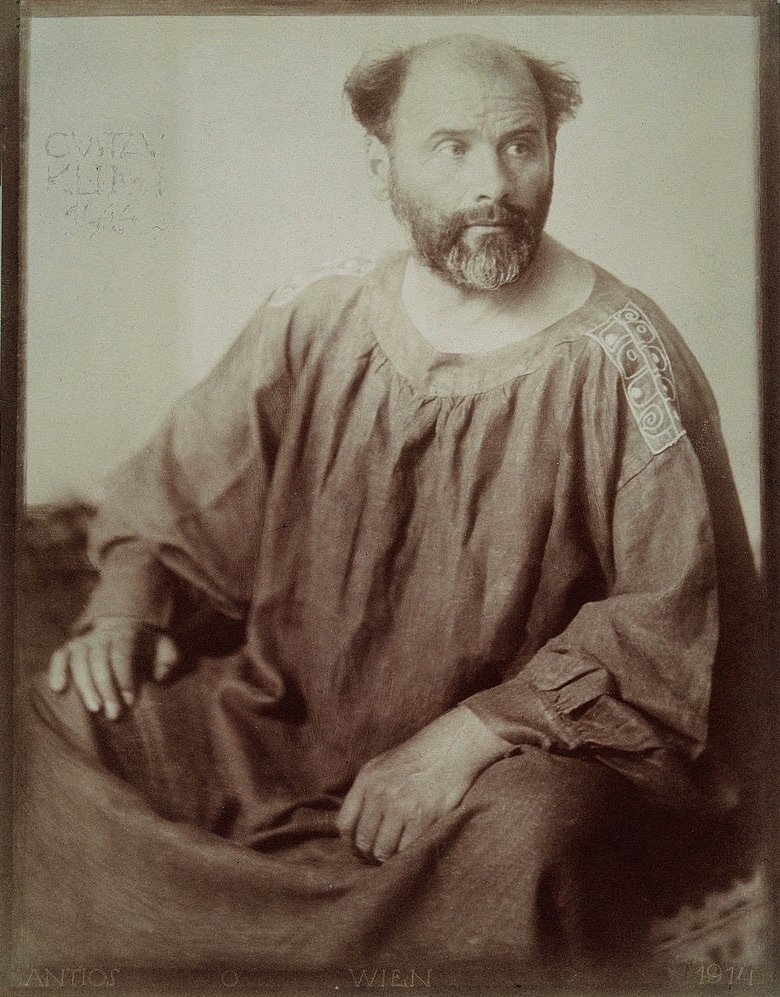

Born: 1862-07-14
Died: 1918
Birthplace: Baumgarten near Vienna, Austria
Nationality / cultural identity: Austrian
Art movements / traditions: Vienna Secession; Symbolism; Viennese Modernism (Jugendstil)
Gustav Klimt: Art, Gold, and the Reinvention of Viennese Painting
Who Gustav Klimt Was
Gustav Klimt was one of the central artists of Vienna around 1900 and a leading figure in the transformation of Austrian art from nineteenth-century academic tradition to modernism. Born on July 14, 1862, in Baumgarten, then on the outskirts of Vienna, Klimt first built his reputation as a highly trained decorative painter. He later became a co-founder and the first president of the Vienna Secession, the group that challenged conservative exhibition culture and opened Vienna more fully to international modern art.
Today Klimt is most closely associated with shimmering gold, elaborate pattern, sensual figures, and The Kiss. Yet the famous Golden Period was only one part of a much broader career. Klimt painted public decorations, allegories, portraits, landscapes, and monumental friezes, while producing a large body of drawings. Across these different forms, he repeatedly tested the boundary between the illusion of three-dimensional space and the physical flatness of the painted surface.
That tension is one of the keys to his art. A face or hand may be modeled with striking naturalism while the body dissolves into ornament. A landscape may be based on close observation but compressed into a dense, almost tapestry-like field of color. Gold can suggest preciousness and timelessness while simultaneously reminding the viewer that a painting is an object made of material spread across a surface. Klimt’s achievement lies not simply in creating a recognizable decorative style, but in turning decoration, symbolism, portraiture, craft, and painting into a distinctly modern visual language.
Early Life, Training, and the Künstler-Compagnie
Klimt grew up in a family connected to the applied arts. His father, Ernst Klimt, was an engraver. In 1876, at the age of fourteen, Gustav entered Vienna’s School of Applied Arts, where he received rigorous training in drawing, historical styles, decorative design, and the conventions of academic painting. His younger brother Ernst Klimt and fellow student Franz Matsch followed a similar path.
The three young artists began working together and eventually became known as the Künstler-Compagnie, or Artists’ Company. During the 1880s and early 1890s they received important commissions for theaters and public buildings. Their work included decorative projects for Vienna’s Burgtheater and Kunsthistorisches Museum as well as commissions elsewhere in the Habsburg Empire.
These early works were very different from the Klimt most viewers recognize today. They were grounded in historicism, illusionistic figure painting, and the expectations of official culture. But the experience was foundational. Klimt learned how to organize large surfaces, integrate figures with architectural settings, control complex decorative programs, and move between fine art and applied design. Even after his mature style became radically flatter and more symbolic, those skills remained visible.
The 1890s: Personal Loss and Artistic Change
The year 1892 was a difficult turning point. Klimt’s father and his brother Ernst died within months of one another. During the following years, the Künstler-Compagnie ceased to function as before, while Klimt’s own work moved away from the academic historicism that had made the group successful.
The most public sign of that change came through the Faculty Paintings commissioned for the Great Hall of the University of Vienna. Klimt was assigned allegorical paintings representing Philosophy, Medicine, and Jurisprudence. Instead of producing straightforward celebrations of knowledge and progress, he created unsettling compositions involving naked bodies, mortality, sexuality, suffering, and forces that appear beyond rational control.
The works provoked intense criticism. Their imagery was considered too obscure, too modern, and too provocative for the official setting. Klimt eventually withdrew from the commission and distanced himself from large government projects. The episode helped define his break with official artistic expectations.
The original Faculty Paintings no longer survive. They were destroyed by fire in 1945, and their appearance is known through historical photographs, studies, and later research. Their loss leaves a major gap in Klimt’s oeuvre, because the controversy surrounding them was crucial to his transformation from successful public decorator to independent modern artist.
The Vienna Secession and a New Idea of Art
In 1897, Klimt joined other progressive artists in leaving Vienna’s conservative Künstlerhaus and founding the Vienna Secession. He became the new association’s first president. The Secession aimed to create a freer exhibition system, bring international art to Vienna, and challenge the hierarchy that separated painting and sculpture from architecture and the applied arts.
This wider concept of art suited Klimt perfectly. He increasingly treated the entire picture surface as something to be designed. Conventional depth became less important. Naturalistically painted flesh could sit beside flat areas of ornament; figures might be enclosed by decorative fields rather than placed convincingly inside rooms or landscapes.
The Beethoven Frieze, created for the Secession’s fourteenth exhibition in 1902, is one of the clearest expressions of this approach. The exhibition was conceived as a Gesamtkunstwerk, or total work of art, bringing architecture, sculpture, painting, and design together around a tribute to Ludwig van Beethoven. Klimt’s long frieze formed part of that environment rather than functioning as an isolated easel painting.
Its imagery moves through longing, danger, suffering, and fulfillment. Elongated bodies, ornamental pattern, unusual materials, and deliberately flattened forms create a symbolic sequence rather than a conventional narrative scene. The frieze shows Klimt using decoration as a serious expressive language, not as an accessory added after the subject was painted.
Gold, Surface, and the Golden Period
Klimt’s use of gold is among the most recognizable features of his mature art, but it is easy to oversimplify. His father’s work as an engraver formed part of his early environment, and Klimt later encountered Byzantine mosaics, medieval gold grounds, Japanese and East Asian art, and many forms of historical ornament. His visits to Ravenna in 1903, where he saw the mosaics of San Vitale, were important, but gold did not suddenly enter his art because of one trip.

Belvedere research shows that Klimt’s intensive use of real gold developed around 1900. In Judith I of 1901, he used gold leaf on a large scale as a central part of the image. He subsequently worked not only with gold leaf but also with silver, platinum, gold dust, and other metallic effects.
These materials changed the logic of his paintings. Traditional illusionistic painting encourages viewers to imagine that they are looking through the surface into a believable space. Metallic leaf does the opposite: it catches real light and calls attention to the physical plane of the picture. Klimt used that contradiction creatively. A face may project a sense of living presence while the surrounding gold pulls the image toward flatness, ornament, and icon-like stillness.
Judith I is an early and powerful example. The biblical heroine is presented close to the viewer, with a sensuous, almost confrontational immediacy. Her flesh is modeled, but the gold-rich setting resists ordinary depth. The painting does not simply illustrate a biblical story. It turns Judith into a psychologically charged modern image in which beauty, danger, sexuality, and ornament are deliberately difficult to separate.
Portraiture and Vienna’s Patronage Culture
Private portrait commissions became increasingly important after Klimt’s conflicts over public art. Many of his most ambitious portraits depict women from wealthy Viennese families who participated in the city’s cultural life and patronage networks.
Klimt did not treat clothing, furniture, or background as neutral supports for likeness. Instead, they became active components of the composition. In some portraits, the sitter’s face and hands remain highly individualized while garments and surroundings spread across the canvas as fields of pattern.
Portrait of Adele Bloch-Bauer I, completed in 1907, is one of the most elaborate examples. Klimt began work on the commission years earlier. Adele’s face and hands emerge from a dense field of gold and silver filled with geometric, eye-like, spiral, and jewel-like motifs. Her dress, chair, and background are difficult to distinguish from one another. She appears both physically present and transformed into a precious decorative image.
The painting also has a consequential later history. Works belonging to the Bloch-Bauer family were seized during the Nazi era, and the twentieth- and twenty-first-century restitution history of Klimt’s paintings became internationally significant. That history is essential to the object’s biography, although it is distinct from the artistic circumstances in which Klimt originally created the portrait.
The Kiss: Intimacy and Abstraction
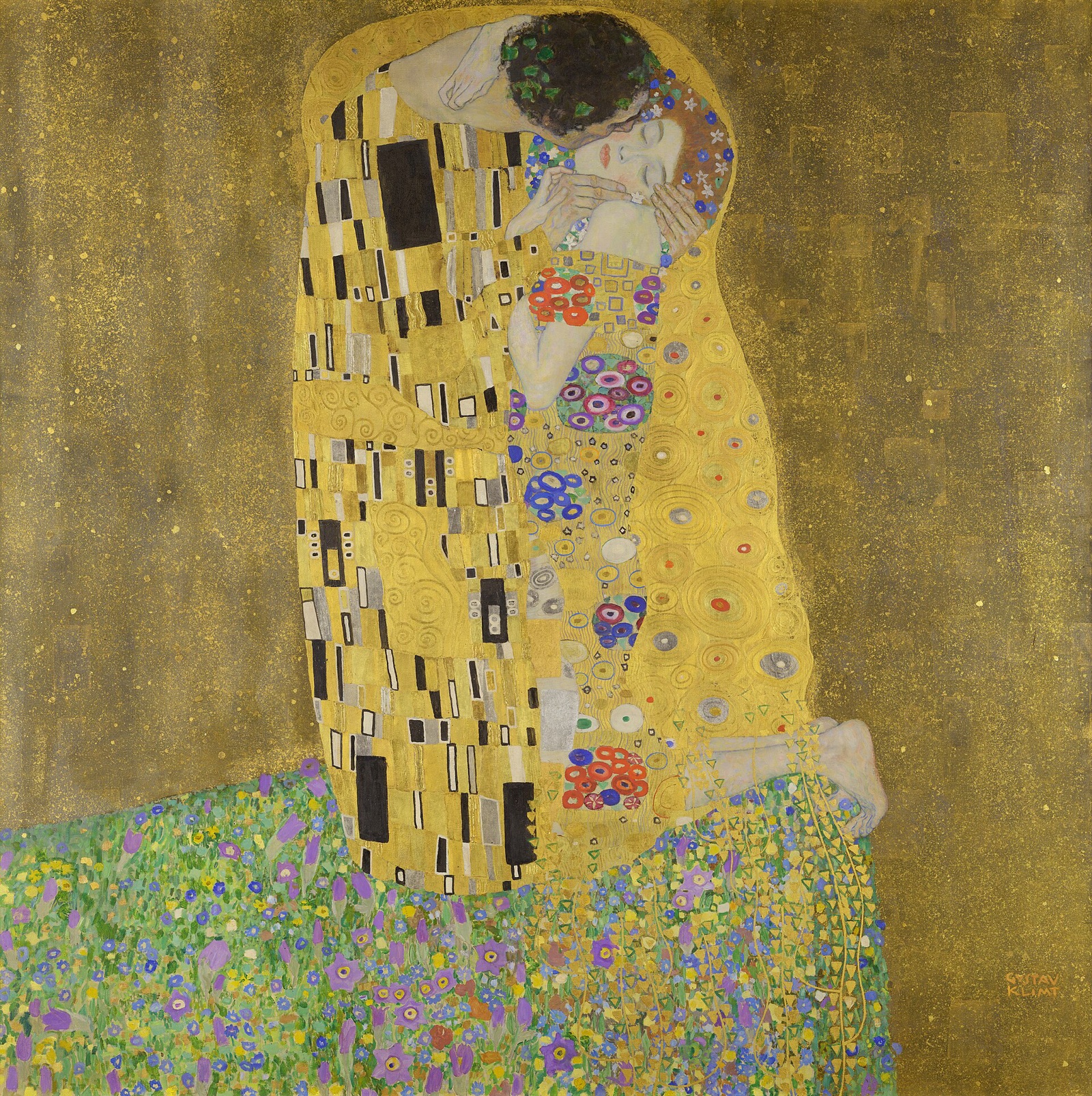
The Kiss, dated 1908/09 by the Belvedere, stands at the height of Klimt’s Golden Period. A couple embraces at the edge of a flower-filled ground while broad golden garments envelop their bodies. The man’s robe contains stronger rectangular forms, while the woman’s garment includes more rounded and floral shapes. Those differences are visually clear, but they should not be treated as a fixed universal symbolic code.
What gives the painting its force is the tension between human intimacy and decorative abstraction. Faces, hands, feet, and flowers remain connected to the visible world. Much of the rest of the composition is transformed into pattern and metallic surface. The figures are close enough to feel personal, yet the gold removes them from an ordinary location and gives the embrace a more timeless, emblematic quality.
The Belvedere notes that Klimt combined gold leaf with oils and other metallic effects in works from this period. The Kiss was acquired by the Austrian state when it was first shown in 1908, demonstrating that by this stage Klimt could be both controversial and institutionally celebrated.
Landscapes: Klimt Beyond the Figure
Klimt’s landscapes are sometimes overshadowed by his portraits and golden figure paintings, but they formed a substantial part of his career. The Leopold Museum has noted that landscapes account for roughly a quarter of his painted oeuvre.
Beginning around 1900, Klimt regularly spent part of the summer in the Salzkammergut, especially near the Attersee. These stays provided many of his landscape subjects. He painted gardens, orchards, trees, lakes, farmhouses, and views around Schloss Kammer.
The landscapes reveal the same interest in surface that appears in his figure paintings, but without gold or elaborate portrait costume as the primary device. Klimt often used square canvases and compressed space so that vegetation, water, and architecture become dense arrangements of color. In works such as Cottage Garden with Sunflowers or Avenue to Schloss Kammer, individual natural forms remain recognizable even as the whole scene approaches pattern.
This is an important counterpoint to the idea that Klimt was merely a decorative painter of glamorous women. His landscapes show sustained attention to observation, framing, color, and the transformation of nature into pictorial structure.
Five Works That Show Klimt’s Development
Judith I — 1901
Judith I stands at the threshold of Klimt’s Golden Period. The figure is close, sensual, and psychologically intense, while real gold contributes to a surface that is simultaneously luxurious and unsettling. It demonstrates how Klimt could transform a traditional subject through modern pose, cropping, material, and ornament.
Beethoven Frieze — 1902
Created for the Vienna Secession’s fourteenth exhibition, the Beethoven Frieze is inseparable from the Secessionist ideal of the total work of art. Its symbolic sequence, elongated figures, and decorative materials show Klimt moving far beyond the conventions of his early public commissions.
Portrait of Adele Bloch-Bauer I — 1907
This portrait brings Klimt’s Golden Period to extraordinary density. Adele’s face and hands remain individualized while gold, silver, dress, furniture, and background merge into an almost continuous ornamental field. It is both a portrait of a specific person and a radical experiment in how much of a figure can be absorbed into surface.
The Kiss — 1908/09
Klimt’s best-known painting condenses many of his mature concerns: gold, touch, pattern, flowers, naturalistic flesh, and flattened space. Its popularity can obscure how strange its pictorial construction is. The couple’s bodies are difficult to locate beneath the ornament, and intimacy is expressed through a composition that continually shifts between physical presence and abstraction.
Death and Life — 1910/11, later reworked
Death and Life shows Klimt after the peak of the Golden Period. A solitary figure of death faces a tightly gathered group representing different stages and relationships of human life. The Leopold Museum documents Klimt’s repeated reworking of the painting, evidence that the final image was not the result of a single fixed conception. Its brighter colors and different handling of ornament point toward the changes in his later style.
What to Look for in a Klimt Painting
Start with the boundary between flesh and pattern. Klimt often paints a face or hand with greater spatial realism than the surrounding clothing or background. Notice exactly where the body seems solid and where it begins to merge with ornament.
Look at what gold does rather than simply noticing that it is present. Metallic surfaces reflect actual light, which makes the picture change as the viewer moves. They can flatten space, isolate a figure, or make a scene feel removed from ordinary time.
Pay attention to the edges of things. In many Klimt paintings, it is surprisingly difficult to tell where clothing ends and background begins, or where a body continues beneath a decorative shape. That ambiguity is deliberate and central to his mature style.
Notice repetition. Rectangles, spirals, circles, flowers, eyes, leaves, and mosaic-like marks create visual rhythms. Instead of assuming each motif has one fixed symbolic meaning, first ask how it organizes the surface and directs your eye.
Compare the portraits with the landscapes. The subjects are different, but the underlying concerns often overlap: square formats, compressed depth, repeated marks, and dense fields that hover between description and pattern.
Finally, look for change across his career. The early academic decorator, the Secessionist experimenter, the painter of gold-rich portraits, the landscape artist, and the later allegorical painter are all Klimt. His work becomes more meaningful when those phases are seen as connected developments rather than reduced to one signature style.
After the Golden Period: Later Work and Legacy
Klimt remained a major figure in Viennese art through the 1910s. His later paintings often moved away from the extensive metallic surfaces of the Golden Period toward stronger color, looser pattern, and new decorative combinations. He continued painting portraits, landscapes, allegories, and figure subjects while maintaining an enormous drawing practice.
He died in Vienna on February 6, 1918, at the age of fifty-five. His career had lasted only about four decades, yet it encompassed a remarkable transformation in the role of painting and decoration within modern art.
Klimt’s importance rests on more than the immediate beauty of works such as The Kiss. He helped challenge Vienna’s conservative exhibition system, participated in a movement that brought fine and applied arts into closer conversation, and developed ways of combining realism, symbolism, ornament, and material surface that remain instantly recognizable.
His paintings can be seductive at first glance, especially when gold and richly patterned surfaces dominate. Their deeper interest appears when the viewer notices the contradictions underneath that beauty: flatness and depth, intimacy and distance, observation and pattern, tradition and experimentation. Klimt made those tensions the subject of painting itself, which is why his work remains central to the story of Viennese Modernism.
Sources & further reading
Image credits and public-domain source records appear beneath each image.