Georges Seurat
Georges Seurat brought a deliberate structure to scenes of modern life. His pointillist technique explored how small touches of color combine in the viewer’s eye.
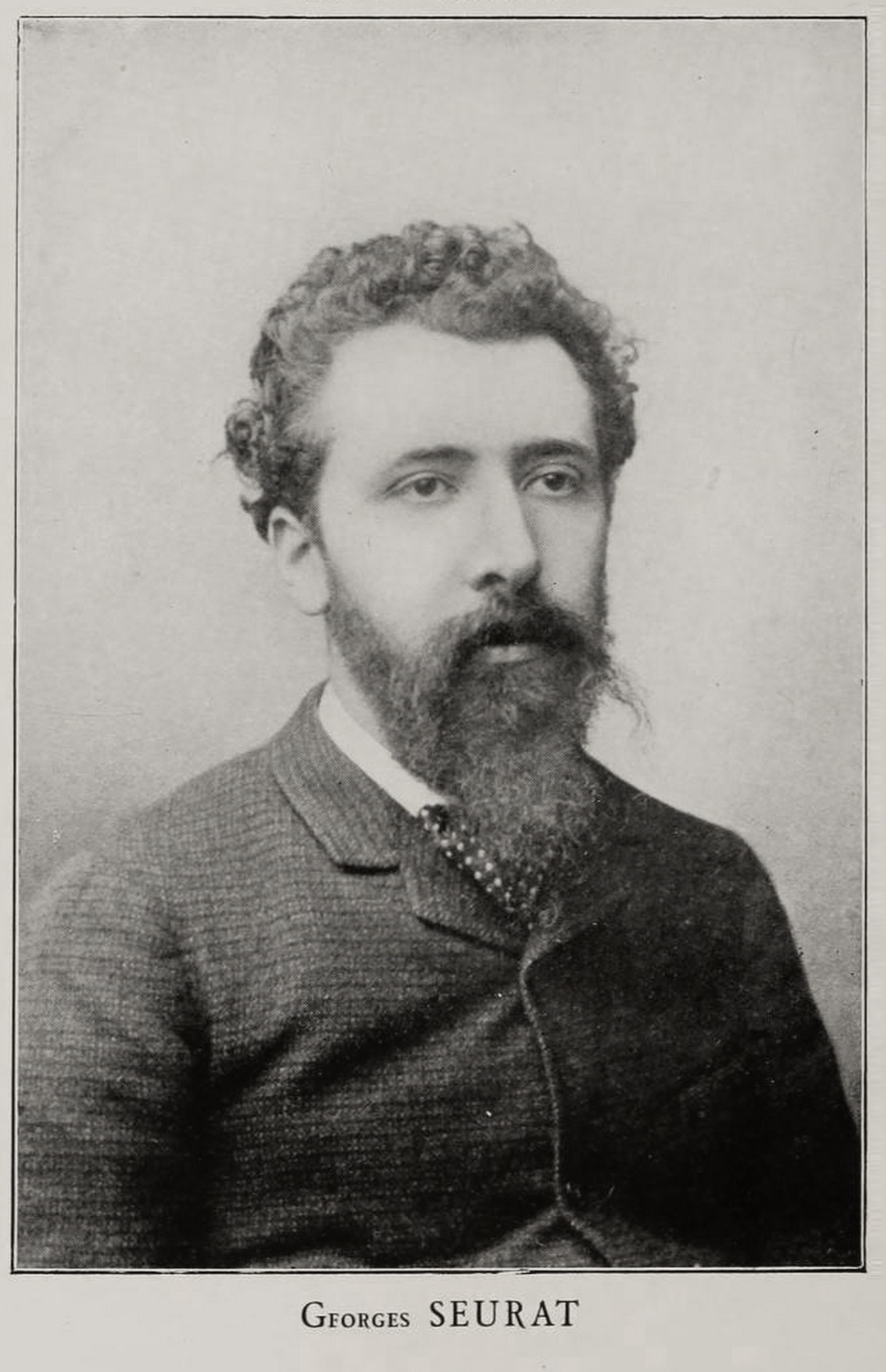

Born: 1859
Died: 1891
Birthplace: Paris, France
Nationality / cultural identity: French
Art movements / traditions: Post-Impressionism; Neo-Impressionism
Georges Seurat: Life, Art, and the Reinvention of Color
An Artist Who Made Modern Life Monumental
Georges Seurat (1859–1891) changed the direction of modern painting in a remarkably short career. He is best known for Pointillism and for A Sunday on La Grande Jatte—1884, but the familiar image of an artist patiently covering canvases with dots tells only part of the story. Seurat was also a formidable draftsman, a careful student of older art, an observer of modern Paris, an experimental colorist, and an artist who believed that composition could be constructed with unusual precision.
His paintings often seem paradoxical. They depict the new world of suburban railways, industrial riverbanks, public parks, cafés, circuses, and popular entertainment, yet their figures can possess the stillness of sculpture or the measured rhythm of an ancient frieze. He drew on contemporary theories of color and perception, but he also relied on repeated studies, revision, memory, intuition, and close observation. The result was a new kind of modern painting: less spontaneous in appearance than Impressionism, more deliberate in structure, and increasingly concerned with how separate marks of color could become a unified image in the viewer’s eye.
That combination made Seurat a central figure in Neo-Impressionism and a crucial bridge between nineteenth-century Impressionism and later experiments in color, structure, and abstraction.
Academic Training and the Importance of Drawing
Seurat was born in Paris in 1859 and received a traditional artistic education. At the École des Beaux-Arts he studied under Henri Lehmann, a pupil of Jean-Auguste-Dominique Ingres. He also studied earlier Italian and French painting in the Louvre. This academic foundation remained important even after his art became radically modern.
The discipline is visible in his sense of scale, balance, and figure placement. Seurat did not abandon the past so much as redirect its compositional seriousness toward contemporary subjects.
Drawing was equally fundamental. His Conté-crayon sheets are among the most distinctive drawings of the late nineteenth century. Instead of relying on crisp outlines, Seurat rubbed and layered dark crayon across textured paper so that bodies, buildings, trees, and streets seem to emerge from shadow. Black can appear dense and velvety, while untouched paper becomes light.
These drawings reveal something essential about Seurat’s art. Beneath the colored dots of the mature paintings was an artist deeply concerned with mass, silhouette, light, shadow, and spatial structure. MoMA has emphasized the importance of these works in their own right, not merely as preparation for paintings. They show Seurat reducing the modern city to tonal relationships that can feel both specific and mysterious.
Bathers at Asnières: The First Monumental Statement
Seurat’s first major painting, Bathers at Asnières (1884), already announced his ambition. The canvas is enormous, closer in scale to traditional history painting than to a casual study of leisure. Yet the subject is unmistakably modern: men and boys rest along the Seine opposite the island of La Grande Jatte, with bridges, factory chimneys, and the industrial suburb of Courbevoie in the distance.
The National Gallery notes that Seurat prepared the work through numerous drawings and oil studies. That prolonged process matters. Instead of trying to preserve the sensation of a passing instant, he built the scene deliberately.
The figures rarely interact. One sits with his back turned. Another reclines on the grass. A boy at the river’s edge cups his hands to his mouth. Their profiles and bodies are simplified and stable, giving the scene a quiet monumentality. Seurat was painting contemporary people, but he arranged them with a formality that recalls older art.
Bathers at Asnières also shows Seurat before the fully developed Pointillist technique of his later work. Its brushwork varies, and broad passages coexist with smaller touches of color. The painting was rejected by the official Salon in 1884, then shown in the independent exhibition organized outside the Salon system. It became a crucial step between Seurat’s academic training, his encounter with Impressionist color, and the new method he was about to develop.
A Sunday on La Grande Jatte and the Emergence of Neo-Impressionism
Seurat began A Sunday on La Grande Jatte—1884 in 1884 and worked on it through 1886. The finished painting presents a Sunday crowd on the island of La Grande Jatte, a leisure destination on the Seine near Paris. People stroll, sit beneath trees, fish, sail, and watch the river. A woman with a parasol dominates the right side; nearby, another woman walks with a small monkey. Soldiers, children, couples, dogs, boats, and upright tree trunks are distributed across the broad field.
At first glance the scene appears calm and orderly. Look longer and it becomes stranger.
Many figures are shown in profile or rigidly frontal poses. They occupy the same public space without much visible social interaction. Repeated verticals and curves link bodies, parasols, trees, clothing, and shadows. The park becomes almost a stage on which each person has been carefully placed.
That effect was the result of an extraordinary preparatory process. Art Institute of Chicago research documents dozens of drawings, small painted panels, and larger studies connected with the composition. Seurat tested individual figures, trees, color relationships, and arrangements, then altered them repeatedly. The finished painting therefore combines calculation with experimentation rather than following a single mechanical formula.
When La Grande Jatte appeared at the eighth and final Impressionist exhibition in 1886, it represented a striking challenge to the older generation. Critic Félix Fénéon soon used the term Neo-Impressionism to describe the new direction associated with Seurat and artists such as Paul Signac.
The painting became the defining image of that movement.
Divisionism and Pointillism: More Than “Painting with Dots”
The terms Pointillism and Divisionism are often used as though they mean exactly the same thing, but the distinction is useful.
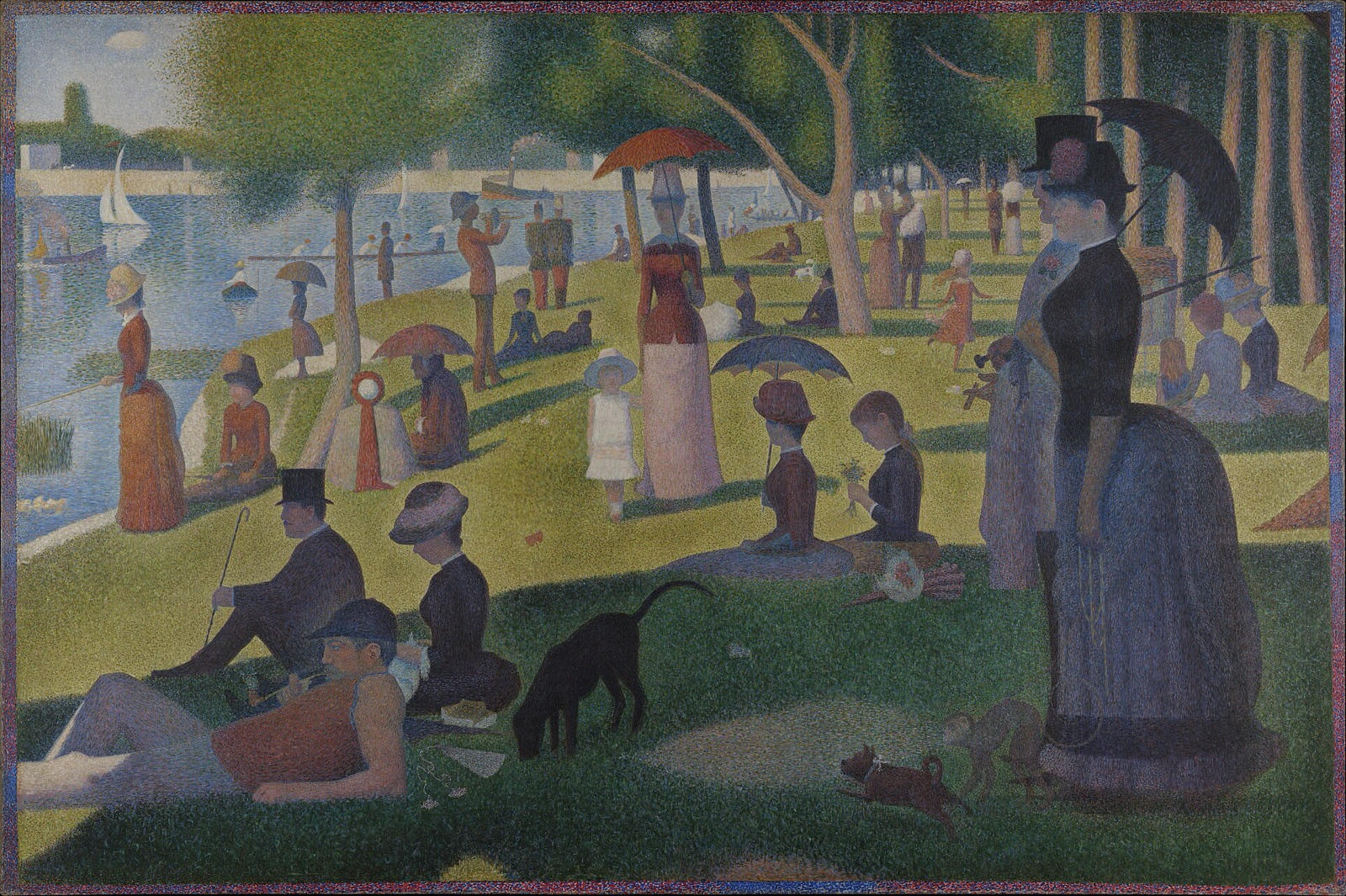

Pointillism refers to the visible application of small, discrete dots or touches of paint. Divisionism refers more broadly to separating colors on the canvas instead of blending them completely on the palette. Neo-Impressionist artists hoped that neighboring touches of contrasting or related hues would interact in the viewer’s perception and create a more luminous effect.
Seurat was deeply interested in nineteenth-century theories of color, contrast, and visual perception. Writings associated with thinkers such as Michel-Eugène Chevreul and Ogden Rood helped shape the intellectual environment in which he worked. But it is misleading to imagine that he simply translated a proven scientific law into paint. His art was an artistic experiment informed by contemporary theory, not a laboratory demonstration.
That distinction makes the paintings more compelling. Seurat used ideas about optical mixture as part of a larger pictorial system involving composition, value, line, rhythm, and subject matter.
From a distance, the marks in a mature Seurat can organize themselves into flesh, grass, water, fabric, sky, or shadow. Up close, those same forms break apart into separate strokes and points. The viewer moves back and forth between image and material—between what the painting depicts and the colored marks from which it is built.
Modern Paris Made Still
One of Seurat’s most distinctive achievements was his treatment of modern life.
Impressionist painters had already made boulevards, cafés, rivers, theaters, and leisure important subjects. Seurat shared that interest but changed the emotional temperature. His crowds seldom feel spontaneous. Instead, people become part of a larger visual order.
This can create an unusual psychological effect. In La Grande Jatte, dozens of people gather in one place, yet many seem self-contained. The repetition of profiles, upright bodies, and carefully spaced forms can make a leisure scene feel formal, theatrical, even slightly uncanny.
Seurat carried that approach into the world of popular entertainment.
Circus Sideshow (Parade de cirque), painted in 1887–88, depicts performers outside the Cirque Corvi attempting to attract customers. The Metropolitan Museum of Art identifies it as Seurat’s first nocturnal painting and his first major composition devoted to popular entertainment. Gaslights glow above a shallow platform while musicians, performers, and prospective spectators are arranged in measured horizontal and vertical bands.
The subject should be noisy, temporary, and commercial. Seurat makes it strangely solemn.
Instead of reproducing the excitement of the fairground directly, he reorganizes it. Hats become repeated shapes. Lights form a rhythm. Bodies turn into silhouettes. Architecture and figures share the same geometric discipline.
The Drawings: Darkness, Light, and the Modern City
Seurat’s drawings deserve to be considered alongside the famous paintings rather than beneath them.
Working primarily in Conté crayon, he used the grain of the paper to create soft transitions between black and white. Figures can be barely legible, then suddenly emerge from darkness. Streets and buildings can seem less constructed from lines than from atmosphere.
These drawings often depict the edges of modern Paris: workers, suburban spaces, entertainment districts, solitary figures, and city types. Their subdued tonal range makes them very different from the brilliant color of La Grande Jatte, yet the underlying concerns are similar. Seurat was always asking how separate visual elements—dark and light, figure and ground, color and contrast—could be organized into a coherent whole.
The drawings also show that his simplification of form was not a side effect of Pointillism. It was a fundamental part of his vision.
Coasts, Harbors, and the Logic of the Border
Seurat repeatedly left Paris during the summer to work along the French coast. These landscapes allowed him to explore atmosphere, water, sky, and architecture without the dense social narratives of his figure paintings.
The Channel of Gravelines, Grand Fort-Philippe (1890) is among the finest examples. Horizontal bands of shore, channel, distant structures, and sky create an unusually calm image. Boats and maritime details are present, but everything is subordinated to proportion, color, and spacing.
Seurat also became increasingly interested in the physical boundary of the painting. In some mature works he painted colored borders directly around the image. The Art Institute records that he later added a painted border to La Grande Jatte in 1888–89.
These borders are more than decoration. Their colors respond to the adjacent areas of the composition, extending Seurat’s concern with contrast all the way to the edge. They also remind the viewer that a painting is both an illusion of a world and a flat, deliberately bounded object.
The Circus and a Career Cut Short
In his final years Seurat pushed his structured language toward scenes of movement and entertainment.
The Circus (1891), now at the Musée d’Orsay, shows a female equestrian performer, acrobatic bodies, a horse in motion, a clown in the foreground, and spectators arranged in the stands. Curves, diagonals, and repeated arcs create a far more energetic rhythm than the stillness of La Grande Jatte.
Yet the movement is highly controlled. The Musée d’Orsay describes the painting as a major application of Divisionist research and relates its design to contemporary theories concerning the expressive effects of line and color. The animated arena and the rigid seating area are deliberately contrasted, making motion itself part of the composition’s structure.
The painting was shown at the Salon des Indépendants in 1891. Seurat died only days later at the age of thirty-one, leaving the work unfinished.
His death brought an abrupt end to a career that was still changing.
Five Essential Works
Bathers at Asnières (1884) is the first major statement of Seurat’s ambition. Modern suburban leisure is elevated to monumental scale, while academic preparation, Impressionist color, and an emerging concern with structure coexist within one painting.
A Sunday on La Grande Jatte—1884 (1884–1886; painted border added 1888–89) is the defining work of Neo-Impressionism. Its divided color is famous, but equally important are its scale, extensive preparatory process, repeated geometry, and strangely suspended social world.
Circus Sideshow (Parade de cirque) (1887–1888) extends Seurat’s method into artificial nighttime light and popular entertainment. Its quiet, friezelike arrangement transforms a fairground attraction into an almost ceremonial scene.
The Channel of Gravelines, Grand Fort-Philippe (1890) shows how effectively Seurat’s mature method could serve landscape. Water, architecture, boats, and sky are simplified into balanced horizontal zones and carefully differentiated color.
The Circus (1891) pushes in another direction. Curving bodies, diagonals, bright hues, and the circular movement of the ring create excitement without abandoning Seurat’s commitment to order.
What to Look for in a Seurat Painting
Start by changing your distance from the work. From several feet away, look for the large structure: the balance of figures, shadows, trees, shorelines, or architecture. Then move closer. Forms that seemed solid begin to fragment into separate touches of color. Moving back again lets the image reassemble.
Next, look for geometry before looking for dots. Seurat often builds compositions from repeated verticals, horizontals, arcs, diagonals, and parallel profiles. A tree trunk may echo a standing figure. The curve of a parasol may answer the curve of a skirt. A railing or shoreline may divide the picture as firmly as an architectural plan.
Watch the color relationships. Complementary or contrasting colors frequently sit beside one another rather than being completely blended. The effect can make surfaces appear to vibrate without sacrificing overall control.
Notice the social distance between people. In Seurat’s public scenes, figures often share space without visibly sharing experience. That tension between crowd and isolation contributes to the distinctive atmosphere of his art.
Finally, look at the drawings whenever possible. They reveal the tonal foundation beneath the color. Once you have seen Seurat build a face or a body from near-black crayon and exposed paper, the paintings begin to look less like collections of colored dots and more like complex constructions of light, mass, rhythm, and perception.
What Seurat Changed
Seurat’s death in 1891 could have ended Neo-Impressionism almost as soon as it emerged. Instead, Paul Signac continued to develop and advocate Divisionism, and the approach spread to artists in France, Belgium, and beyond.
Its longer legacy cannot be measured simply by counting later painters who used dots. Seurat helped establish the idea that color could be systematically separated and organized, that modern life could be given monumental structure, and that a painting could openly acknowledge the mechanics of perception.
Those ideas mattered to later artists experimenting with intensified color and increasingly abstract organization. The Metropolitan Museum of Art traces Neo-Impressionism’s influence toward artists including Henri Matisse, Piet Mondrian, and Wassily Kandinsky.
Seurat remains important because his work cannot be reduced to a technique. Pointillism is immediately recognizable, but it was only one element of a larger project. He joined old-master discipline to modern subjects, tonal drawing to brilliant color, direct observation to studio construction, and intellectual theory to visual intuition.
In barely more than a decade, he created a body of work that asks a surprisingly modern question: how much can a painting control what we see, and how much of the image is completed by the act of looking?
Sources & further reading
- National Gallery, London — Georges Seurat
- The Metropolitan Museum of Art — Georges Seurat (1859–1891) and Neo-Impressionism
Image credits and public-domain source records appear beneath each image.