Franz Marc
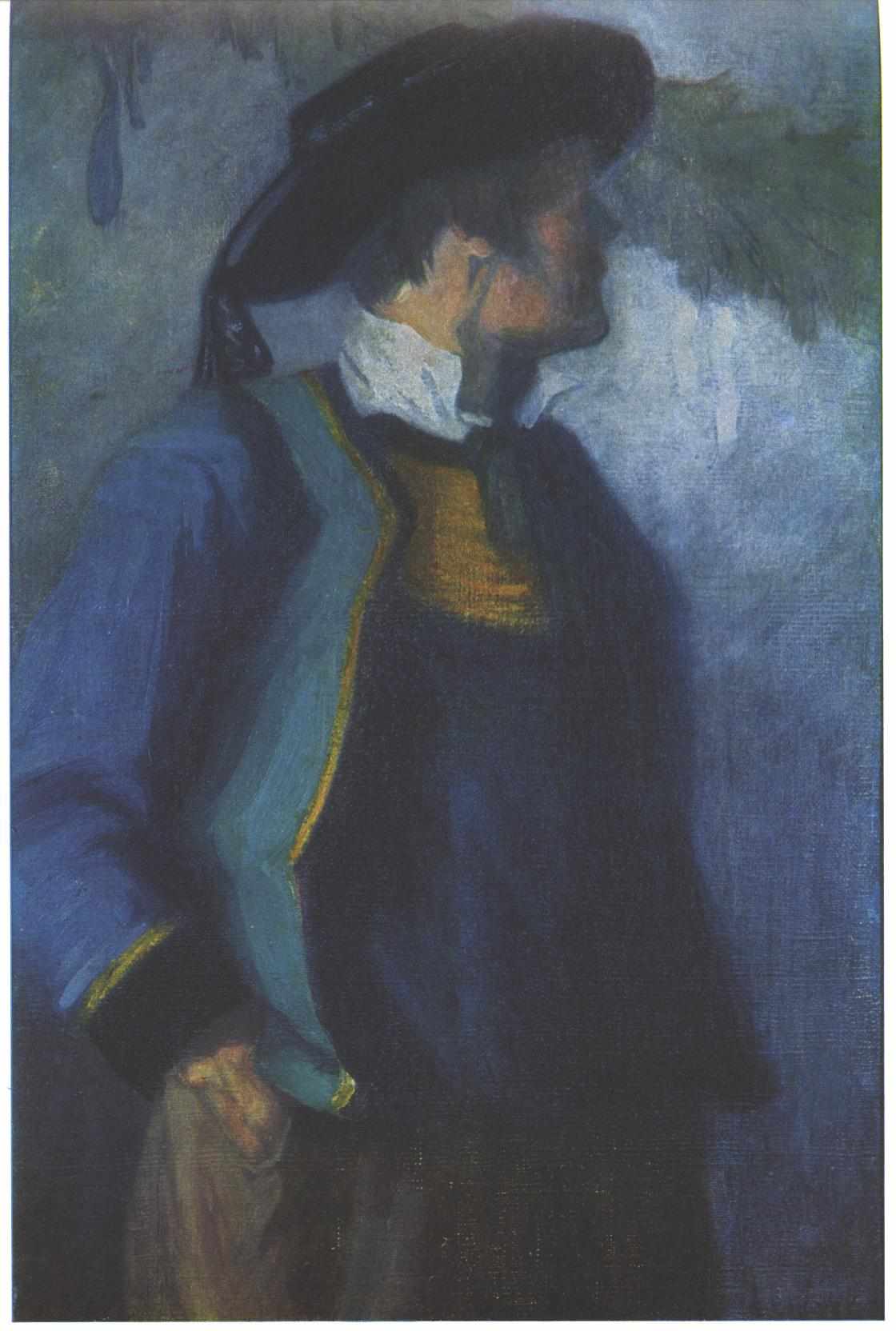
Franz Marc made animals central to a vivid, expressive vision of nature. He helped establish Der Blaue Reiter, a major group in German modern art.

Born: 1880
Died: 1916
Birthplace: Munich, Germany
Nationality / cultural identity: German
Art movements / traditions: Expressionism; Der Blaue Reiter
Franz Marc: Animals, Color, and the Search for a New Visual Language
Why Franz Marc Matters
Franz Marc was one of the defining artists of German Expressionism and a central figure in Der Blaue Reiter, the Munich-based circle that helped reshape European modern art in the years before the First World War. His paintings are famous for blue horses, yellow cattle, red animals, and landscapes broken into vivid fields of color. Their appeal is immediate, but Marc's importance goes far beyond their unusual palette.
For Marc, animals became a way to rethink the relationship between living beings and the natural world. Rather than painting a horse, deer, cow, or tiger as an isolated subject, he increasingly tried to make the animal and its surroundings feel as though they belonged to the same visual system. Curves in a horse's back echo hills. A crouching tiger is constructed from the same sharp planes as the space around it. Color carries emotional and symbolic force while also organizing the composition.
That combination—recognizable animals, expressive color, and a steady movement toward abstraction—made Marc's brief career unusually influential. His mature work was concentrated into only a few years, yet it helped establish a modern language in which color and form could communicate meanings that did not depend on realistic appearance.
Early Life and Artistic Training
Franz Marc was born in Munich on February 8, 1880, the son of the landscape painter Wilhelm Marc. He entered the Munich Academy of Fine Arts in 1900, where he studied under Gabriel von Hackl and Wilhelm von Diez. The academy provided conventional artistic training, but Marc soon looked beyond academic naturalism.
Trips to Paris in 1903 and 1907 exposed him to newer French painting. Museum biographies identify artists such as Vincent van Gogh and Paul Gauguin as important points of contact in Marc's expanding understanding of color and simplified form. Instead of treating color primarily as a way to imitate what the eye sees, modern French painting suggested that it could become a more independent element of expression.
Marc also spent long periods in the Bavarian countryside, including around Kochel, Lenggries, and Sindelsdorf. There he studied animals closely and gradually made them the central subjects of his art. During a stay in Lenggries in 1908 with the artist Maria Franck, whom he later married, he developed the recurring motif of horses gathered in pasture. By 1910 he had given up his Munich studio and settled in Sindelsdorf.
Animals and Marc's Vision of Nature
Marc did not choose animals merely because they were picturesque. They became central to a larger artistic and spiritual search. The Franz Marc Museum describes the animal world as a primary field through which he pursued a purer relationship to nature. His paintings repeatedly ask how an artist might move beyond simply observing an animal from the outside and instead imagine a deeper unity between creature and environment.
That ambition helps explain why Marc's animals often seem woven into their surroundings. In earlier works, the figures are more clearly separated from landscape. As his style develops, contours begin to rhyme across the picture. The arc of a neck may continue into a hillside; the angle of a leg may be repeated by a branch or a colored plane. Background and subject gradually stop behaving like separate layers.
The change is visible in works from around 1909 to 1911. Siberian Dogs in the Snow, dated 1909/1910 by the National Gallery of Art, still shows Marc working from close observation: two pale dogs stand in a snowy landscape rendered with cool naturalistic tones. In later paintings, such observation gives way to more synthetic arrangements in which anatomy, color, and landscape are reorganized to express an inner logic rather than ordinary appearance.
Color as More Than Decoration
Marc's color is one of the most recognizable features of his art, but it is easy to oversimplify. In 1911 correspondence he associated blue, yellow, and red with particular qualities. Blue carried spiritual associations; yellow was connected with warmth, cheerfulness, and sensuality; red could signify material force or resistance. These ideas were personal and historically specific. They should not be treated as a universal key that mechanically explains every painting.
Research from the Franz Marc Museum shows that Marc was also deeply interested in how colors behave in relation to one another. Around 1910 and 1911 he studied contemporary color theory, complementary contrasts, and optical effects. He even used a prism in his experiments with neighboring colors. His mature palette therefore operates on several levels at once: color can suggest an emotional or symbolic quality, but it can also create balance, tension, rhythm, or visual vibration.
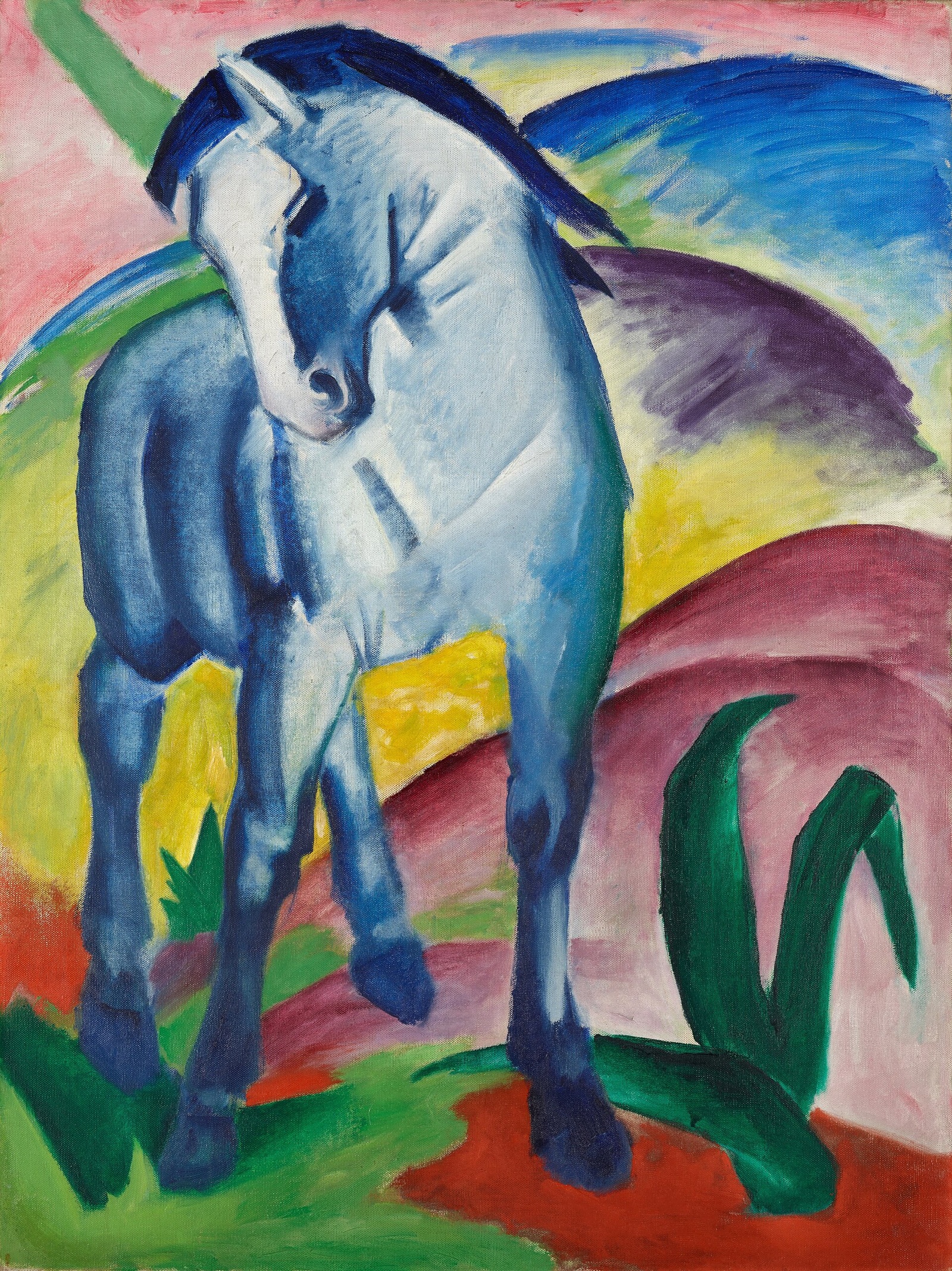
Blue Horse I, painted in 1911, shows how these concerns come together. The horse is intensely blue, but Marc is not trying to describe an unusual lighting effect. The color belongs to the expressive identity of the figure. At the same time, the animal's bowed head and rounded body echo the curving forms around it. The result is calm and monumental. The horse remains unmistakably a horse, yet the painting is already moving away from naturalistic representation toward a more constructed world of color and shape.

Der Blaue Reiter
Marc's development accelerated through his friendships with August Macke and Wassily Kandinsky. He met Macke in 1910 and Kandinsky in 1911. Marc became closely involved with the Neue Künstlervereinigung München, but disagreements within that association led to a split. Marc and Kandinsky became leading forces in the new constellation known as Der Blaue Reiter.
The first Blue Rider exhibition opened in Munich in late 1911, and Marc and Kandinsky edited the Der Blaue Reiter almanac, published in 1912. The group was not defined by one uniform style. Its artists shared a broad belief that modern art could communicate inner or spiritual realities through color, form, rhythm, and imagination rather than simply reproduce visible appearances.
Marc's paintings were a natural fit for that project. The Large Blue Horses, from 1911, places three powerful blue horses before rolling areas of red, yellow, and green. Their bodies are linked by repeated curves: necks, backs, flanks, and landscape forms flow into one another. Instead of three independent animal portraits, Marc creates a single rhythmic structure. The painting is an especially clear example of his effort to merge living bodies and landscape into one organic composition.
Yellow Cow, also painted in 1911, creates a different mood. The bright yellow animal appears to leap or dance through a highly colored landscape. Where Blue Horse I feels meditative and The Large Blue Horses feels monumental, Yellow Cow feels buoyant and almost ecstatic. The comparison is useful because it shows that Marc did not assign animals one fixed emotional meaning. He changed pose, color, rhythm, and surrounding forms to create very different states of being.
From Curving Forms to Faceted Space
Marc's art shifted again after he encountered newer developments in French painting. In 1912 he traveled to Paris with August Macke and came into direct contact with the work of Robert Delaunay. Delaunay's use of luminous color, together with Cubist and Futurist approaches to fragmentation and movement, helped Marc push his compositions toward greater abstraction.
Tiger, painted in 1912, marks an important point in that transition. The animal crouches with concentrated tension, but its body is built from angular, faceted shapes. Those same sharp forms continue through the surrounding space, so the tiger seems simultaneously distinct from and fused with its environment. Marc uses fragmentation not to make the subject disappear but to intensify its alertness and compressed energy.
By 1913 and 1914, animals and landscapes could become even more difficult to separate. Marc increasingly organized his pictures through intersecting diagonals, arcs, shards, and color zones. This was not a simple abandonment of nature. Even as representation became less literal, organic forms remained the underlying source of his visual language.
Animal Destinies and a More Unstable World
Animal Destinies, painted in 1913, is among Marc's most powerful late works. The painting is filled with fractured forms, violent diagonals, intense color, and animals caught within a scene that feels unstable and vulnerable. Its imagery is far removed from the serene balance of Blue Horse I.
Because Marc was killed during the First World War only a few years later, Animal Destinies has often been interpreted retrospectively as a premonition of catastrophe. The chronology matters: the painting was made in 1913, before the war began. It is better understood first as evidence of how dramatically Marc's visual language had changed by that point—toward fragmentation, collision, and heightened tension—rather than as a literal prophecy.
The painting also has a remarkable later history. A fire damaged a substantial part of the canvas, and Paul Klee restored the lost area in 1919 using darker tones that deliberately distinguish the reconstruction. The work was later confiscated by the Nazi regime as so-called 'degenerate art' and entered the Kunstmuseum Basel collection in 1939. Its physical history became part of the larger story of modern art under political attack in twentieth-century Germany.
Five Key Works
The Large Blue Horses — 1911
Three blue horses are bound together through sweeping curves and repeated forms. Look at how the animals' backs and necks echo the rolling landscape. The picture shows Marc transforming a group of animals into one continuous visual rhythm.
Blue Horse I — 1911
A single blue horse lowers its head before bands of vivid color. Its monumental stillness makes the work one of Marc's clearest statements about expressive color and the merging of animal form with surrounding landscape.
Yellow Cow — 1911
The yellow cow appears to spring through a brilliantly colored setting. The work demonstrates how differently Marc could use animal imagery: here movement, color, and pose create a sense of exuberance rather than calm.
Tiger — 1912
The crouching tiger is constructed from angular planes that continue into its surroundings. The painting reveals Marc absorbing Cubist ideas while preserving the physical tension and recognizability of the animal.
Animal Destinies — 1913
Animals, trees, and landscape are broken into intersecting shards and diagonals. The painting shows how far Marc had moved toward abstraction and how dramatically the harmony of his earlier animal paintings could give way to instability.
What to Look For in Franz Marc's Paintings
A useful way to approach Marc's paintings is to look beyond the question of why an animal is blue, yellow, or red. His color is important, but the relationships among forms are equally revealing.
Start with the contours. Follow the curve of an animal's back or neck and see whether it reappears in a hill, tree, or neighboring shape. Marc often uses those repetitions to make animals feel structurally connected to the landscape.
Next, watch the temperature of the color. Cool blues may be placed against warmer reds or oranges; yellow can press against violet; red can intensify against green. These contrasts generate energy even when the animal itself is motionless.
Then compare early and later works. Earlier paintings retain more conventional space and observed anatomy. In the mature work, bodies become simplified arcs, blocks, or facets. By 1912 and 1913, the boundary between figure and environment may begin to dissolve altogether.
Finally, notice how varied the emotional atmosphere can be. Blue Horse I is quiet and inward. Yellow Cow is joyful and animated. Tiger is compressed and alert. Animal Destinies is fractured and unstable. Marc's animals were not a single symbolic formula; they were flexible vehicles through which he explored harmony, vitality, tension, and transformation.
War, Death, and Legacy
When the First World War began in 1914, Marc entered military service on the French front. His opportunities to paint were sharply reduced, although he continued to draw; Lenbachhaus records thirty-six drawings in his Sketchbook from the Field. Marc was killed on March 4, 1916, during a reconnaissance ride near Verdun. He was thirty-six years old.
His career was brief, but the work he produced between roughly 1910 and 1914 placed him among the most important figures of German Expressionism. Together with Kandinsky and the other artists associated with Der Blaue Reiter, Marc helped establish a modern conception of painting in which color and form could carry meaning independently of realistic description.
His animals remain his most familiar achievement, but their significance lies in what he asked them to do. A horse, cow, tiger, deer, or cat could become more than a subject. Through color, rhythm, simplification, and increasingly abstract structure, Marc used animals to investigate how living beings might relate to the world around them. That is why his strongest paintings remain both accessible and radical: they begin with something immediately recognizable, then transform it into a larger visual language of energy, emotion, and connection.
Sources & further reading
- Städtische Galerie im Lenbachhaus — Franz Marc (1880–1916)
- Franz Marc Museum — Franz Marc and His Color Theory
Image credits and public-domain source records appear beneath each image.