Cassius Marcellus Coolidge
Cassius Marcellus Coolidge is best known for comic paintings of dogs acting like people, particularly the works commonly grouped as Dogs Playing Poker.
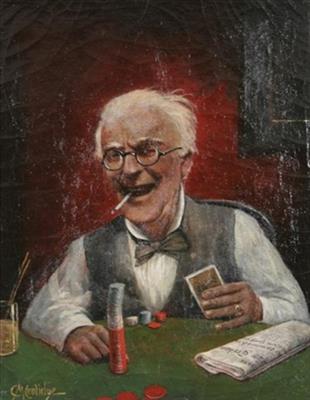

Born: 1844
Birthplace: Near Antwerp and Philadelphia, New York, United States (uncertain)
Died: 1934
Nationality / cultural identity: American
Art movements / traditions: American commercial illustration; humorous genre painting; anthropomorphic animal painting
Cassius Marcellus Coolidge: The Artist Behind Dogs Playing Poker
Cassius Marcellus Coolidge (1844–1934) created some of the most familiar images in American popular art, even though his own name is less widely known than the scenes he painted. His anthropomorphic dogs—especially the solemn card players commonly grouped under the popular label Dogs Playing Poker—turn ordinary social rituals into carefully staged visual comedy. Dogs smoke cigars, study their hands, watch their opponents, argue cases, travel, celebrate, and compete with an earnestness that makes the joke work.
Coolidge did not follow the conventional path of an academically trained nineteenth-century painter. His career moved through business, illustration, sign painting, humorous imagery, advertising, and photographic novelty. That unconventional background is important to understanding his art. He learned to make an image communicate quickly, to build a joke from recognizable behavior, and to create scenes that remained legible when reproduced for a mass audience. His best-known paintings sit between humorous genre painting, commercial illustration, and American popular culture.
An Unconventional Path to Art
Coolidge was born in 1844 in northern New York. Surviving secondary sources disagree about the exact town of his birth, so a more precise birthplace is best treated cautiously. What is well documented is his association with Antwerp, New York, where American Heritage reports that he worked between 1868 and 1872 as a druggist, a painter of street signs and house numbers, and a founder of both a newspaper and an early local bank.
This varied working life makes Coolidge very different from artists whose careers began in academies, ateliers, or art schools. His artistic development was tied to practical communication and entrepreneurship. The same qualities that matter in sign painting and advertising—clarity, instant recognition, direct visual impact—would later become central to the success of his dog pictures.
Coolidge also had an inventive side. In 1874 he received U.S. Patent No. 149,724 for an “improvement in the processes of taking photographic pictures.” His idea combined a sitter’s real head with a miniature painted or drawn body, producing a comic photographic portrait. The method anticipated the familiar amusement-park and boardwalk gag in which a person appears inside an exaggerated or improbable body. Long before the poker-playing dogs, Coolidge was already exploring a basic comic device that would define his mature imagery: place an ordinary subject into an unexpected role, then present the absurdity with complete visual seriousness.
From Commercial Illustration to Humanlike Dogs
By the late nineteenth century, Coolidge was developing paintings of dogs behaving like people. American Heritage reported that cigar companies were among his early commercial customers, using reproductions of his paintings as promotional giveaways. He later became closely associated with Brown & Bigelow, the St. Paul printing and advertising company whose calendars, posters, and prints carried his dog scenes to a very large audience.
An important work from before that famous commission is Poker Game, an oil painting signed and dated 1894 and documented by Sotheby’s. Its date matters because it shows that Coolidge had established the poker-playing dog subject before the early-twentieth-century Brown & Bigelow pictures. The idea was not invented for one advertising campaign; it had already become part of his visual repertoire.
Dogs Playing Poker Is Not One Painting
One of the most persistent misunderstandings about Coolidge is that Dogs Playing Poker is the title of a single painting. It is better understood as a popular umbrella term for a group of related dog pictures. American Heritage later described sixteen oil paintings made for Brown & Bigelow in the early 1900s. Many involve card games, but others place anthropomorphic dogs in settings such as a courtroom, a ballpark, a pool room, a holiday celebration, or a travel mishap.
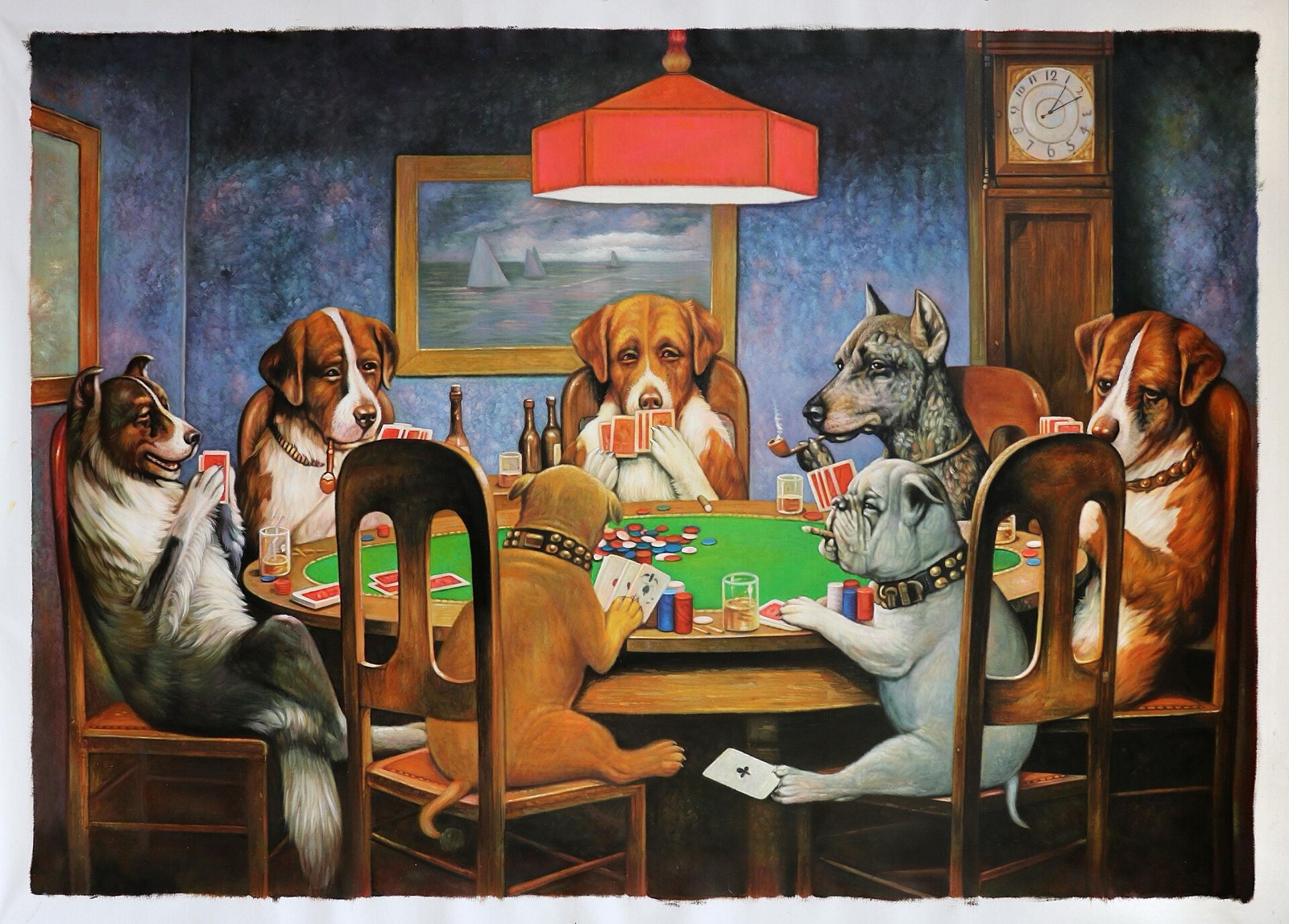

The Smithsonian American Art Museum’s Inventories of American Painting and Sculpture reinforces this distinction by cataloguing separate Coolidge works under individual titles. Its records include A Friend in Need, His Station and Four Aces, Breach of Promise Suit, New Years Eve in Dogville, Ten Miles to a Garage, One to Tie, Two to Win, and Looks Like Four of a Kind. Treating these paintings individually is important because each one has its own setting, narrative, and visual joke.
How Coolidge’s Paintings Work
The humor in Coolidge’s art depends on contrast. His subjects are impossible—dogs do not smoke cigars, play poker, argue lawsuits, or commute like businessmen—but the scenes themselves are constructed as if nothing unusual is happening. The rooms, furniture, cards, lamps, clothing, gestures, and social relationships are handled with enough seriousness to make the canine behavior seem temporarily believable.
That deadpan approach is one reason the pictures remain memorable. Coolidge does not merely place dogs around a table. He gives each figure a role in a small drama. One dog studies its cards. Another watches an opponent. A third appears confident, suspicious, distracted, or caught off guard. The viewer is encouraged to read the dogs as human personalities while still enjoying the absurdity of their animal faces and bodies.
American Heritage singled out Coolidge’s attention to expression, clothing, and furniture, and those details are central to the paintings’ storytelling. The surroundings establish social type and mood. A hanging lamp can focus attention on the card table; cigars and bottles help define the club-like atmosphere; a carefully arranged hand of cards can suggest a bluff, a winning combination, or a secret advantage. The jokes are visual, but they often depend on narrative timing—the sense that the viewer has arrived at exactly the moment before something is revealed.
Three Key Works
Poker Game (1894) is a crucial early example. Sotheby’s records the painting as signed C. M. Coolidge and dated 1894. Its importance lies not only in the subject but in its chronology: the painting demonstrates that Coolidge was exploring the poker-dog motif years before the Brown & Bigelow commission made the imagery famous. The setting already contains the formula that would become closely associated with him—human social ritual, individualized dogs, and an atmosphere of intense seriousness around an inherently comic premise.
A Friend in Need (1903) became the most recognizable Coolidge image. A Cincinnati Art Museum interpretive label identifies the work as a 1903 oil on canvas. At first glance it appears to be another poker table full of dogs, but the picture rewards closer reading. The title points the viewer toward the action: one dog is discreetly helping another. The humor is not only that dogs are playing cards; it is that the animals are engaged in a familiar human drama of loyalty, rule-bending, and competition. That small act gives the painting a story rather than merely a gimmick.
Looks Like Four of a Kind (1910) is documented in the Smithsonian’s Inventories of American Painting and Sculpture as an oil painting dated 1910. Its title again turns the card game into a narrative prompt. Coolidge asks the viewer to inspect the situation, read the players, and anticipate what the hand might mean. Works like this show that he returned to the poker subject over many years while varying the social tension and comic setup.
What to Look for in Coolidge’s Art
The most rewarding way to view a Coolidge painting is to slow down after the initial joke. Start with the dogs’ eyes and head positions. Who is watching the cards, and who is watching another player? Then follow the paws, chips, cards, and objects on the table. These details often reveal the narrative that the title only hints at.
Next, look at the way Coolidge uses breed, posture, and expression to distinguish personalities. A large dog can appear imposing or self-assured; a smaller dog can seem anxious, alert, or mischievous. The effect is not a scientific study of canine behavior but a form of character acting. Coolidge uses animal differences the way a genre painter might use costume, facial expression, and body language to separate human characters.
The settings matter too. Coolidge’s interiors are not neutral backgrounds. Furniture, lamps, wall decoration, smoking accessories, bottles, clothing, and sporting equipment help create the social world of the scene. The more convincingly the surroundings resemble an ordinary human environment, the funnier the dogs’ participation becomes.
Finally, notice the tension between realism and caricature. Coolidge needed his dogs and rooms to be recognizable enough for the narrative to read clearly, but the paintings are not exercises in naturalistic animal behavior. Their purpose is comic transformation. The dogs are believable as characters precisely because the artist balances recognizable anatomy with human gesture and social convention.
Style, Technique, and Place in American Art
Coolidge is difficult to place within a formal art movement, and it is more accurate to describe the kind of work he made than to force him into one. His best-known paintings belong to a tradition of humorous genre imagery and commercial illustration, with anthropomorphic animals used to parody human behavior. He worked in oil for many of the surviving dog paintings, but the larger significance of the pictures lies in how effectively they functioned as reproduced images.
That reproducibility was not secondary to his career. Brown & Bigelow distributed his work through advertising posters, calendars, and prints, giving the paintings a cultural life far beyond the original canvases. Coolidge’s images therefore belong to the history of American visual culture as much as to the history of easel painting. They show how a picture designed for broad circulation can become more famous than the artist who made it.
From Novelty Art to American Visual Culture
Coolidge’s reputation has often been framed through the language of kitsch, and his dog paintings have certainly lived a different cultural life from the canonical works of academic, modernist, or avant-garde art. But calling them kitsch does not fully explain their durability. The pictures survived because the central idea is immediately understandable and because Coolidge executed it with unusually clear storytelling.
His dogs are not memorable simply because they are dogs. They are memorable because they behave like recognizable social types. They bluff, compete, help one another, show off, make mistakes, and take their games seriously. The viewer recognizes human behavior before fully registering how strange the scene is. That reversal—seeing ourselves in the animals—is the source of much of the comedy.
Their later life in parody and popular culture also demonstrates how thoroughly the visual idea entered American memory. The image of dogs gathered around a poker table can be recognized even when Coolidge’s original paintings are not directly reproduced. In that sense, the concept escaped its original advertising context and became a visual shorthand of its own.
Coolidge’s achievement was not to transform American painting through a new formal theory. It was to perfect a durable form of visual storytelling. By combining anthropomorphic animals, everyday social situations, carefully observed props, and deadpan humor, he created pictures that communicate almost instantly and still invite a second look. For an artist whose career developed outside the conventional fine-art establishment, that extraordinary recognizability is a significant legacy.
Sources & further reading
- American Heritage — A Man’s Life (Carla Davidson, 1973)
- Smithsonian American Art Museum — Inventories of American Painting and Sculpture: Cassius Marcellus Coolidge records
Image credits and public-domain source records appear beneath each image.